Kettlebell Pullover On Stability Ball
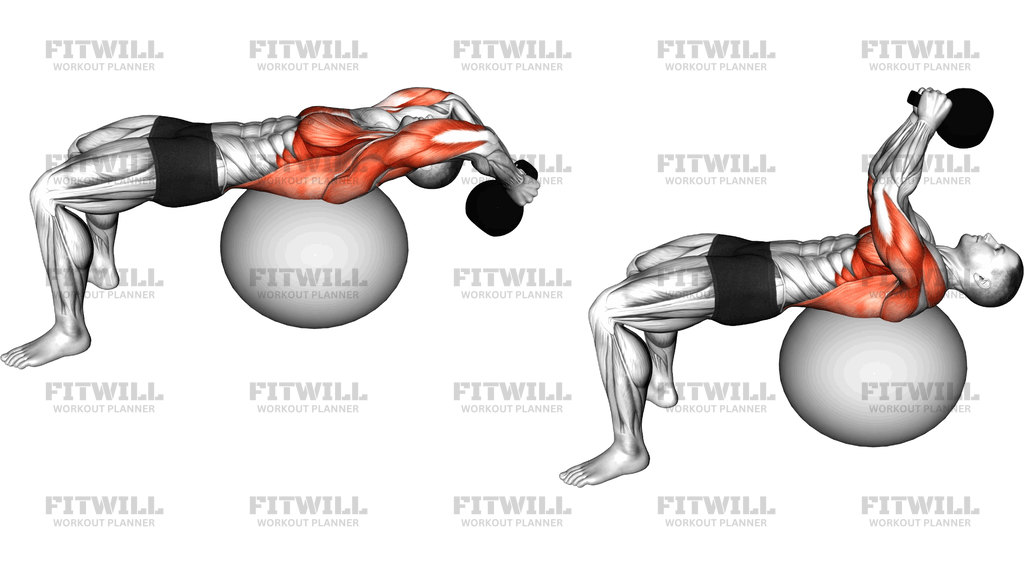
The Kettlebell Pullover On Stability Ball is a floor-free variation of the classic dumbbell pullover, performed with your upper back and shoulders draped across a stability ball while your hips stay lifted in a bridge. You hold a kettlebell with both hands by the horns, extend it back over your head toward the floor, then pull it in an arc back over your chest. The shape of the movement is a shallow arc, not a straight press, which is what separates a pullover from a triceps extension or a fly.
This exercise hits the chest and lats through a long range of motion, with the triceps and shoulders assisting along the arc. The stability ball changes the character of the exercise significantly: because your torso is balanced on an unstable surface, your core, glutes, and hip stabilizers have to work continuously to keep your body level and your bridge position intact. That makes it a two-for-one movement — an upper-body pullover and an anti-rotation core challenge in the same rep.
It suits intermediate lifters who are comfortable on a stability ball and want more lat and chest stretch than a bench pullover provides, as well as anyone training at home with minimal equipment. Because the ball drops lower than a flat bench and lets your shoulders travel further back, the stretch at the bottom is deeper, so most people should start with a lighter kettlebell than they would use on a bench. A common loading range is between 8 and 20 kg depending on experience.
Setup quality determines everything here. Your upper back, roughly from the shoulder blades to the base of the neck, should rest on the crown of the ball, feet planted flat and wide enough to feel stable, knees bent around 90 degrees, and hips held high so your torso forms a roughly straight line from knees to head. If your hips sag or you sit too far forward on the ball, you lose both the stretch position and the bracing benefit.
Execution should be slow and deliberate. Lower the kettlebell back behind your head on an exhale-free inhale, stop when you feel a comfortable stretch across the chest and lats, then exhale as you pull the weight back over your chest, keeping a slight bend in the elbows the whole time. Never let the kettlebell drift behind your head so far that your shoulders roll forward or your lower back arches hard.
Use it as an accessory lift after pressing work, as a finisher for chest and back on a pull-push day, or as part of a core-focused stability ball circuit. If you have never combined a ball with a loaded overhead movement, rehearse the arc with body weight or a very light weight first until the path feels automatic.
[ Workout Log & Planner ]
Put your next workout in Fitwill
Keep your plan and training log ready when you are.


Instructions
- Place a stability ball on a non-slip surface and sit on it with a kettlebell of your chosen weight positioned within arm's reach on the floor in front of you.
- Walk your feet forward and roll your torso down the ball until your upper back and the back of your shoulders rest on the crown of the ball, with your head supported and neck relaxed.
- Plant both feet flat on the floor about hip-width to shoulder-width apart, bend your knees to roughly 90 degrees, and lift your hips until your body forms a straight line from knees to shoulders.
- Pick up the kettlebell with both hands, gripping the horns on either side of the handle, and press it to arms' length directly over your chest with a soft bend in both elbows.
- Brace your abs and squeeze your glutes to hold the bridge before the weight starts moving — this is what keeps you from rolling off the ball.
- Inhale and slowly lower the kettlebell in an arc back over and slightly behind your head, keeping the elbows bent and pointing down toward the floor, until you feel a stretch across your chest and lats.
- Exhale and pull the kettlebell back along the same arc until it finishes above your chest, feeling the pecs and lats drive the movement rather than just bending the elbows.
- Pause briefly at the top, recheck that your hips are still level and lifted, then begin the next rep.
- Complete all reps, then before standing up, set the kettlebell down on the floor beside you or bring it to your chest and sit up on the ball — never drop it while your body is still draped over the ball.
Tips & Tricks
- The most common mistake is dropping the hips mid-set. As the weight travels behind your head, your center of gravity shifts backward, so consciously re-squeeze the glutes every rep to keep the bridge line intact.
- Do not turn the pullover into a triceps extension. If your forearms are the only thing moving and your upper arms are swinging, the arc is too narrow — widen the path and let the shoulders travel with the weight.
- Head position matters: keep the back of your head resting on the ball rather than chin-jutting forward to watch the kettlebell. Pushing the head up rounds the upper back and shortens the lat stretch.
- Start with a kettlebell you could press for 15+ reps. The deep stretch position on a ball is less forgiving than on a bench, and heavy loads make it hard to bail safely.
- If you feel the ball slipping under your shoulders, wipe sweat off the ball and your upper back, and position yourself so the peak of the ball sits just below your shoulder blades.
- Control the bottom two to three inches of the arc — that is where most people lose tension and where the shoulder is most vulnerable. If you cannot stop the kettlebell there, the weight is too heavy.
- Keep your feet wide and press them actively into the floor. A narrow stance makes the whole setup wobble side to side, which steals focus from the pull.
- Breathe in on the way back, out on the pull forward. Holding your breath through the stretch tends to make you brace rigidly and lose the smooth arc.
- If your lower back aches instead of your chest and lats, your ribs are flaring. Tuck the pelvis slightly under and reduce the depth of the descent until the stretch is felt in the front of the shoulder and chest.
Frequently Asked Questions
What muscles does the Kettlebell Pullover On Stability Ball work?
The chest and lats are the primary movers through the arc, with the triceps and front shoulders assisting. Because you are balanced on a stability ball, your abs, glutes, and lower back also work hard to hold the bridge.
Is the Kettlebell Pullover On Stability Ball suitable for beginners?
It can be, but most people should learn the pullover pattern on a flat bench first. If you are new to stability ball training, practice the bridge position with no weight, then add a light kettlebell of around 6-10 kg.
How should I hold the kettlebell during the Kettlebell Pullover On Stability Ball?
Grip the horns on either side of the handle with both hands, fingers wrapped around the sides, and keep the bell resting against your forearms. Avoid gripping the top of the handle with both hands stacked, which reduces control when the weight passes over your face.
Why is the stretch deeper on a stability ball than on a bench?
The ball sits lower and rounds away beneath your shoulders, so your arms can travel further back before they touch anything. Enjoy the extra range, but respect it — stop the descent at a comfortable stretch rather than chasing maximum depth.
My hips drop when the kettlebell goes behind my head. How do I fix it?
Squeeze your glutes hard before starting the set and think about driving your knees slightly forward as the weight travels back. Widening your foot stance and slowing the descent also helps you keep the bridge.
Can I use a dumbbell instead of a kettlebell for this exercise?
Yes, a single dumbbell held vertically by the top of the head with both hands is a direct substitute. The kettlebell's horns actually give a slightly more secure two-handed grip over the face, which many people prefer.
How many reps and sets should I do of the Kettlebell Pullover On Stability Ball?
Two to four sets of 8-12 controlled reps works well as a chest and back accessory. Because the ball adds a balance demand, prioritize smooth tempo over heavy loads.
Is it safe for the shoulders?
It is generally fine when the elbows stay softly bent, the descent stops at a comfortable stretch, and the weight is modest. If you have a history of shoulder instability, keep the arc shallow and check with a qualified professional first.
What should I do if I lose balance during the set?
Bring the kettlebell in tight to your chest with both hands and sit up onto the ball to reset. Never try to fight a lost position with a loaded weight extended over your face.