Weighted Bottle Side Lying Shoulder External Rotat
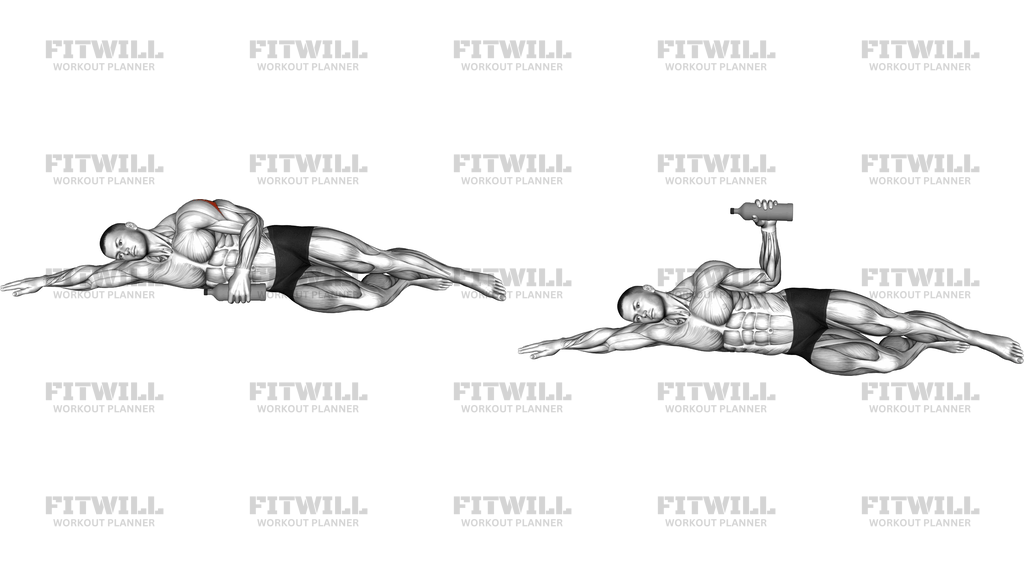
The Weighted Bottle Side Lying Shoulder External Rotation is a small, focused rotator cuff exercise performed lying on your side while holding a light weighted bottle in your upper hand. With your elbow pinned against your ribs and bent to roughly 90 degrees, you rotate your forearm from resting against your stomach up toward the ceiling, keeping the elbow fixed in place the entire time. It looks like a tiny movement, and that is exactly the point: the muscles it targets are small, and they respond to precise, controlled work rather than heavy loading.
The main muscle at work is the infraspinatus, one of the key external rotators of the rotator cuff, supported by the teres minor and the rear portion of the shoulder. Because your body weight pins your shoulder blade to the floor, the shoulder joint has to do the rotating on its own, which makes this one of the cleanest ways to isolate external rotation. That isolation matters for anyone rebuilding shoulder health after irritation, building durability for pressing, throwing, or overhead sports, or simply trying to correct the common imbalance between strong internal rotators and weak external rotators.
The setup is what makes or breaks this exercise. Lying on your side with your head supported and your bottom arm extended under your head stabilizes your torso so nothing else compensates. Your top elbow stays glued to your side at your ribs; if it drifts away from your body or creeps up toward your shoulder, the load shifts away from the rotator cuff and the movement loses its purpose. A light bottle, whether a water bottle or a small weighted bottle, is usually all the resistance you need, especially when starting out.
To execute it well, rotate slowly from the start position with your forearm across your stomach until your forearm points toward the ceiling, pause briefly, then lower under control over two to three seconds. The temptation is always to rush or to swing the weight using momentum, and that is where the exercise falls apart. Keep the range within what your shoulder can do without your torso rolling backward; most people end somewhere between 70 and 90 degrees of rotation.
This exercise shows up most often in shoulder warm-ups, rehabilitation-style programming, and accessory work after pressing sessions. Because the equipment is simple, it is easy to do at home or while traveling, and the side-lying position makes cheating nearly impossible when performed honestly. Treat it as a precision exercise: modest weight, strict elbow position, and deliberate tempo will get you far more than chasing extra load.
[ Workout Log & Planner ]
Put your next workout in Fitwill
Keep your plan and training log ready when you are.


Instructions
- Lie on your side on an exercise mat with your bottom arm extended along the floor and your head resting on that arm or on a small cushion.
- Hold a light weighted bottle in your top hand with a neutral grip, and bend your top elbow to 90 degrees so your forearm rests across your stomach, elbow tucked against your ribs.
- Stack your hips and legs, and gently brace your core so your torso stays quiet and does not roll during the movement.
- Exhale and rotate your forearm upward from your stomach, pivoting only at the shoulder while your elbow stays pinned to your side.
- Continue until your forearm points toward the ceiling or you reach your comfortable end range, then pause for a one-count.
- Inhale and lower the bottle back down slowly over two to three seconds until your forearm rests back across your stomach.
- Keep your wrist straight and firm throughout so the bottle stays level and does not tilt forward or back.
- Complete all repetitions on one side, then switch to lying on your opposite side and repeat with the other arm.
- Rest briefly between sides and reset your body position before each set so your elbow placement and torso alignment stay consistent.
Tips & Tricks
- If your elbow lifts off your ribs mid-set, the weight is too heavy or you are fatigued; drop to a lighter bottle or reduce repetitions rather than letting the elbow drift.
- Place a small folded towel between your ribs and elbow if you feel pressure or discomfort there, but keep the elbow in the same position.
- Rolling your torso backward is the most common cheat on this movement; it turns the exercise into a partial shoulder press and unloads the rotator cuff, so watch yourself in a mirror from the front if you are unsure.
- Lower the bottle slower than you raise it. The two- to three-second lowering phase is where much of the rotator cuff work happens.
- If your shoulder pinches at the top of the rotation, stop a few degrees short of vertical instead of forcing the end range.
- Keep the bottle balanced in your hand; letting it tip toward your fingers changes the resistance lever and pulls your wrist out of line.
- Start with a bottle that feels almost too light. The side-lying position gives you no assist from momentum, and the last few reps should feel smooth, not straining.
- Do this after pressing or pulling workouts, or as part of a shoulder warm-up, rather than before heavy pressing when the cuff is already fatigued.
- Both sides should feel symmetrical in strength and range; if one side lags clearly behind, give it an extra set or two rather than matching it to the stronger side immediately.
Frequently Asked Questions
Which muscles does the Weighted Bottle Side Lying Shoulder External Rotation work?
It primarily targets the infraspinatus and teres minor of the rotator cuff, which externally rotate the shoulder. The rear shoulder and the muscles stabilizing the shoulder blade assist to a lesser degree.
Is a weighted bottle heavy enough, or should I use a dumbbell?
A light bottle is deliberately appropriate here, especially for beginners or anyone doing shoulder rehab-style work. Because the side-lying position removes momentum and body leverage, even light resistance provides a real training effect; progress by adding reps or slightly more water before jumping to heavier equipment.
Why do I have to lie on my side instead of standing for this exercise?
Lying on your side pins your shoulder blade and torso to the floor, which prevents your body from swinging or leaning to help. That forces the shoulder joint itself to perform the rotation, making it one of the most honest ways to isolate the external rotators.
How far should I rotate my forearm in the Weighted Bottle Side Lying Shoulder External Rotation?
Rotate until your forearm points roughly toward the ceiling, which is usually 70 to 90 degrees of rotation. Stop earlier if your torso starts rolling backward or you feel pinching at the front or back of the shoulder.
My elbow keeps lifting off my ribs during the set. What am I doing wrong?
This usually means the weight is too heavy or you are rushing. Reduce the load, slow the tempo, and consciously keep the elbow tucked; if it still drifts, finish the set early and build up gradually.
How many sets and repetitions should I do?
Most people do well with two to three sets of 12 to 20 controlled repetitions per side. Since the goal is endurance and control in a small muscle group, higher repetitions with light load work better than low-rep heavy sets.
Can beginners do the Weighted Bottle Side Lying Shoulder External Rotation?
Yes, it is very beginner friendly. The position is stable, the equipment is light and safe, and the movement pattern is easy to learn. Beginners should start with an empty or barely filled bottle and focus entirely on keeping the elbow fixed.
What can I use instead of a weighted bottle?
A very light dumbbell, a small soup can, or a light resistance band anchored at waist height all work. The key is light resistance that lets you keep the strict elbow position and slow tempo.
Is it normal to feel this more in the back of the shoulder than the front?
Yes. The working muscles sit on the back of the shoulder blade, so a working ache behind and above the shoulder blade is expected. Sharp pain in the front of the shoulder is a signal to reduce the range or the weight.
Should I do both arms in the same session?
Yes, train both sides even if one feels stronger, starting with your weaker side. Matching the weaker side's repetitions keeps the imbalance from widening over time.