Seated Cross Body Hamstring Reach
The Seated Cross Body Hamstring Reach is a static stretch performed on the floor with one leg extended straight ahead and the other leg bent and tucked in close to the inner thigh. From that position, you hinge forward over the extended leg and reach the hand on the same side as your bent leg across your body toward the toes of the outstretched foot. The crossing reach creates a diagonal line of stretch that lengthens the hamstring of the straight leg while the folded leg position opens the hip and gently rotates the pelvis.
This stretch is especially useful for anyone with tight hamstrings from long hours of sitting, running, cycling, or heavy lower body training. Because one leg is folded rather than both being extended, it is easier on the lower back than a classic seated forward fold, and the crossed-arm reach lets you bias the stretch slightly differently than reaching with both hands straight ahead. The bent-leg side also gets a mild hip and inner thigh release, making this an efficient two-in-one lower body stretch.
The setup is what makes or breaks this stretch. Sitting tall with the extended leg truly straight and the kneecap facing the ceiling keeps the hamstring in a clean line of pull. If the extended knee bends or the hip rolls backward to chase the toes, you lose tension on the hamstring and shift stress into the lumbar spine. The folded leg should rest comfortably with the foot tucked toward the inner thigh of the straight leg, not jammed underneath the body.
To perform it well, think of leaning your chest toward your thigh rather than reaching only with your hand. Exhale as you fold, let the hand travel toward the toes or ankle, and hold a position where you feel a firm but tolerable pull along the back of the thigh. The hold should be somewhere between twenty and forty seconds, breathing steadily, before you slowly rise back up and switch sides.
You will see this stretch used in post-run cooldowns, leg day recovery routines, flexibility and mobility sessions, and general evening wind-downs. It requires no equipment and very little space, so it works equally well in a gym, on a yoga mat at home, or on a patch of clean floor after training. People working toward toe-touch flexibility or better hamstring range for squats and deadlifts often keep it in rotation because it targets the back of the thigh at a slightly rotated angle that plain forward folds miss.
Keep the movement honest: a stretch should feel like a long, steady pull, never sharp pain behind the knee or in the sitting bone. Bending the extended knee slightly is a fair modification for very tight hamstrings, and using a towel or strap looped around the foot can bridge the gap until your reach improves. Never bounce in the end position, and let flexibility progress over weeks rather than forcing range in a single session.
[ Workout Log & Planner ]
Put your next workout in Fitwill
Keep your plan and training log ready when you are.


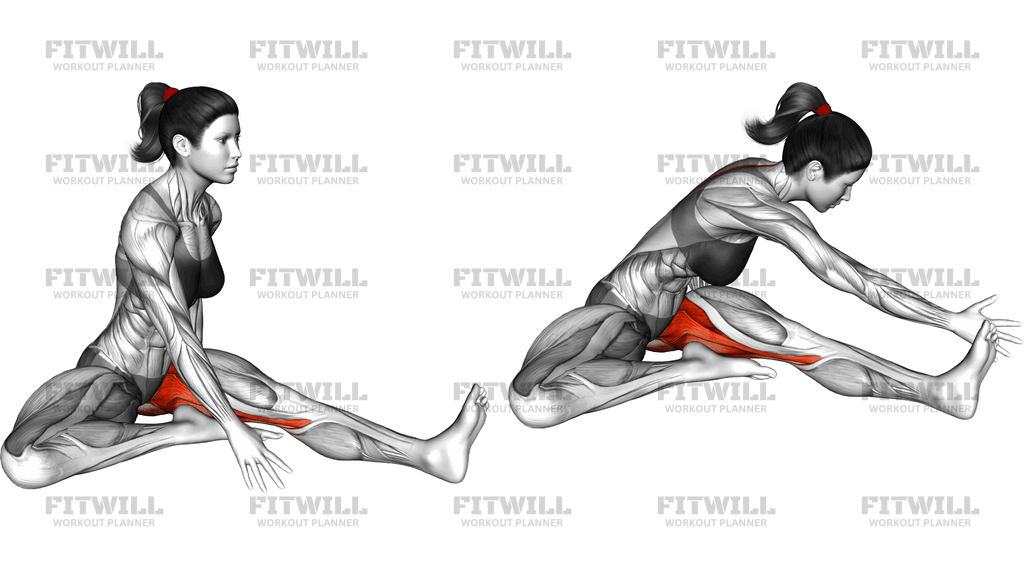
Instructions
- Sit on the floor or on an exercise mat with your right leg extended straight in front of you and your left knee bent, placing the sole of your left foot against the inner thigh of the right leg so the left knee points out to the side.
- Sit up tall on your sitting bones, square your chest over the extended right leg, and let your left hand rest lightly on the floor or on your bent knee for balance.
- Draw your belly button gently in and lengthen your spine before you start to lean, so you hinge from the hips instead of rounding from the waist.
- Inhale, then exhale as you hinge your chest forward over the straight leg and reach your left hand across your body toward the toes of the extended right foot.
- Continue the reach until you feel a steady stretch along the back of the right thigh; your hand can land on the shin, ankle, or toes depending on your flexibility.
- Hold the end position for 20 to 40 seconds, keeping the right knee straight and the toes pulled gently back toward the shin to deepen the calf and hamstring stretch.
- Inhale and slowly walk the hand back and lift your chest upright, undoing the fold in a controlled manner rather than springing up.
- Exhale fully during the forward reach and inhale as you return, keeping your breathing slow and even throughout the hold.
- Release the folded left leg, shake it out briefly, then switch sides with the left leg extended and the right hand reaching across.
- Repeat one to three rounds per side, aiming to relax a little deeper into the stretch on each exhale.
Tips & Tricks
- Round the lower back early and you will feel the stretch in your spine instead of your hamstring; fix this by leading with the chest and imagining your sternum moving toward your toes.
- Do not let the extended knee drift outward or bend, as this is the most common way to leak tension away from the hamstring; press the back of that knee toward the floor instead.
- Keep the folded foot against the inner thigh, not tucked under the hip, so the bent-knee side stays comfortable and the pelvis stays level.
- If your hand cannot reach your foot, rest it on your shin or loop a towel around the toes and pull lightly rather than collapsing your back to close the distance.
- Pointing the toes of the extended foot up intensifies the stretch into the calf and the hamstring tendon near the knee, while letting the foot relax softens it.
- Try rotating your chest slightly toward the ceiling as you reach across to feel the stretch shift along the outer hamstring line.
- Avoid bouncing at the end range; repeated pulsing on a cold hamstring is the fastest way to leave this stretch with a strain.
- Do this after training or a light warm-up walk rather than on completely cold muscles, when the tissue lengthens more comfortably.
- If one side is noticeably tighter, give it an extra hold but never push past the point where your breath becomes strained.
Frequently Asked Questions
Which muscles does the Seated Cross Body Hamstring Reach stretch?
The primary target is the hamstrings of the extended leg, including the biceps femoris, semitendinosus, and semimembranosus. The folded-leg position also gives a mild release to the glutes and inner thigh, and the calves contribute when you flex the toes back.
Why does the reach cross the body instead of going straight to the toes?
Reaching the opposite hand across biases the stretch along the hamstring at a slight rotation, which hits the back-of-thigh line differently than a symmetrical forward fold. It also adds a gentle pelvic rotation that many people find gives a stronger, more specific hamstring pull.
Is the Seated Cross Body Hamstring Reach suitable for beginners?
Yes, it is beginner-friendly as long as you keep the extended knee nearly straight and only fold as far as a comfortable pull allows. A towel around the foot or a slightly bent extended knee makes the starting range accessible for tight hamstrings.
How long should I hold the stretch?
Aim for 20 to 40 seconds per side, and repeat one to three rounds if you are working on flexibility. Shorter holds of about 15 seconds work fine as a quick cooldown after a run or leg session.
Should my back be straight or rounded during the reach?
Keep your spine long and hinge from the hips, accepting that your hand may only reach your shin or ankle. Rounding the lower back just to touch the toes moves the stretch into the spine and away from the hamstring.
My bent knee hurts when I fold it toward my thigh. What can I do?
Sit on a folded towel or low cushion to raise your hips and reduce the angle of the folded leg, or slide the foot a little farther from the inner thigh. If knee discomfort persists, switch to a straight-legged forward fold variation instead.
Can I do the Seated Cross Body Hamstring Reach every day?
Yes, this bodyweight stretch is gentle enough for daily practice, especially when held at a moderate intensity. Keep the effort at a comfortable pull rather than pushing to maximum range every session.
Should I stretch before or after my workout?
Long holds like this are best used after training or on their own, when the muscles are warm. Before a workout, favor brief dynamic leg swings so you are not holding a long static hamstring stretch right before lifting or sprinting.
What should I feel if the stretch is positioned correctly?
You should feel a long, even pull along the back of the straight thigh, possibly reaching into the calf when the toes are pulled back. Sharp pain behind the knee, pins and needles, or lower back ache are signs to back off and adjust your setup.
How is this different from a regular seated toe touch?
In a toe touch both legs are extended and you fold straight ahead, which loads the lower back more heavily. Here one leg is folded with the foot against the inner thigh and the reach crosses the body, so the stretch isolates one hamstring at a time with a rotational angle and less spinal stress.