Walkout To Plank Into Up Dog
The Walkout To Plank Into Up Dog is a flowing body weight sequence that takes you from standing all the way down to the floor and back up again. You hinge forward, walk your hands out along the floor until your body forms a straight plank, drop your hips into an upward-facing dog stretch, then reverse the whole path to return to standing. Because every rep travels through a hinge, a long plank hold, and a spinal extension, it trains several patterns in one continuous movement instead of isolating a single joint action.
This movement earns its place in warm-ups, core circuits, and general strength work because it hits so many bases at once. The walkout portion builds anti-extension strength in the abs and deep core as you resist sagging at the hips, while the up dog position opens the chest, hip flexors, and front of the shoulders. The forward fold at the start and finish lengthens the hamstrings and calves, and the long lever of your extended body challenges the shoulders, triceps, and upper back as they support and steer your weight.
Setup matters more here than it looks. Standing with feet close together gives you enough hamstring length demand to make the fold meaningful, but if your hamstrings are tight, a slightly wider or softer-knee stance keeps the movement accessible. The real discipline comes once your hands touch the floor: your fingers should walk forward while your hips stay stacked over your heels for as long as possible, so your lower back rounds under control rather than collapsing early.
To execute it well, think of the plank as the checkpoint that proves your core is doing its job. If your hips poke up or your lower back dips when you reach full extension, you have walked out too far or lost your brace. From the plank, sweep your chest forward and down between the shoulders before lifting into up dog, keeping the arms long and the shoulders pulling down away from the ears rather than shrugging up. Reverse everything with control, walking the hands back toward the feet before rolling up through the spine one vertebra at a time.
The exercise suits beginners who want a scalable core entry point, as well as trained lifters looking for a shoulder-and-core primer before pressing sessions. People with wrist sensitivity should keep the walkout shorter and shift weight back toward the heels of the hands, and anyone with a history of lower back irritation can substitute a hip-hinge walkout with a bent-knee fold. Move smoothly rather than fast; the value lives in the transition points, not the speed.
[ Workout Log & Planner ]
Put your next workout in Fitwill
Keep your plan and training log ready when you are.


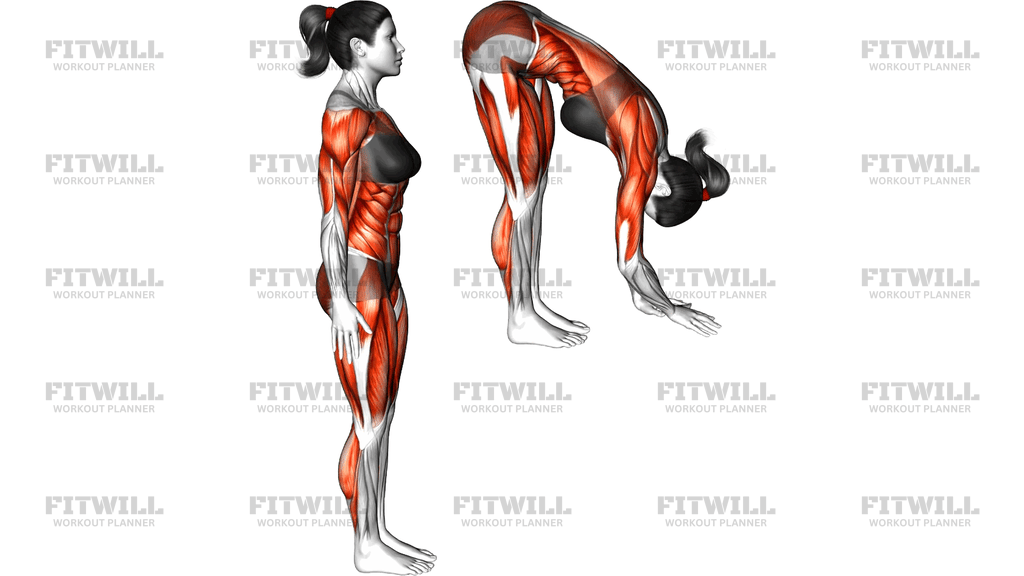
Instructions
- Stand tall with your feet roughly hip-width apart, arms relaxed at your sides, and your weight balanced over the middle of each foot.
- Brace your core lightly, then hinge forward from the hips and let your hands reach toward the floor, allowing a soft bend in the knees if your hamstrings feel tight.
- Place your palms flat on the floor with fingers spread wide, then keep your hips stacked over your heels while you begin walking your hands forward in small steps.
- Continue walking out until your shoulders stack directly over your wrists and your body forms one straight line from head to heels in a high plank.
- Squeeze your glutes and brace your abs so your hips neither sag toward the floor nor lift toward the ceiling.
- Shift your weight forward over the tops of your hands, lower your hips toward the floor, and press your chest up into an upward-facing dog, keeping your shoulders drawn down away from your ears.
- Hold the up dog for one or two easy breaths, feeling the stretch across your chest and the front of your hips while your legs stay active.
- Lower your hips back to the plank position, then walk your hands back toward your feet with the same small steps, keeping your hips high.
- Once your hands reach your feet, roll your spine up slowly from the lower back to the head and finish standing tall.
- Exhale as you walk out and extend into up dog, inhale as you return, and reset your stance before starting the next rep.
Tips & Tricks
- If your hands cannot reach the floor from standing without rounding your back heavily, bend your knees more during the fold rather than dumping all the load into your lower back.
- The most common fault is walking out past a true plank: if your hips drop and your lower back starts to arch, stop walking and take one step back in.
- Keep your fingers spread and press the base of your thumb and index finger into the floor in the plank and up dog to protect your wrists.
- In up dog, avoid pushing your head back and jamming the neck; lift the chest and let the gaze come forward instead.
- Do not rush the walkout. Small, even hand steps keep the core loaded the whole way, while big lunging steps turn it into a sloppy pike movement.
- If you feel it mostly in your shoulders, shorten the walkout distance so the hips hold a straighter line and the abs share the work.
- Keep your legs active during up dog by pressing the tops of the feet down; letting the legs go slack shifts the extension into the lower back.
- On the way back in, walk your hands as close to your feet as your hamstrings allow before standing up, so you keep stretching instead of cutting the rep short.
- Work on a mat if your wrists or the floor surface bother you; a slightly cushioned surface also keeps your palms from slipping during the walkout.
Frequently Asked Questions
What muscles does the Walkout To Plank Into Up Dog work?
The abs and deep core work hardest during the walkout and plank, while the shoulders, chest, and triceps support your weight on the floor. The up dog position stretches the hip flexors and chest, and the forward fold loads the hamstrings and lower back.
Is the Walkout To Plank Into Up Dog suitable for beginners?
Yes, because the walkout distance is fully adjustable. Beginners can walk their hands out only halfway toward a plank and skip or shorten the up dog until their core strength and wrist tolerance improve.
Why do my hips sag when I reach the plank in the Walkout To Plank Into Up Dog?
That usually means you walked out farther than your core can hold, or you lost your brace at the bottom. Take one step back in, squeeze your glutes, and keep the walkout to the length where your body stays straight.
How far should I walk my hands out during the Walkout To Plank Into Up Dog?
Walk out until your shoulders sit directly over your wrists and your body forms a straight line from head to heels. If your shoulders drift past your wrists or your lower back arches, you have gone too far.
Can I do the Walkout To Plank Into Up Dog if my hamstrings are tight?
Yes. Bend your knees generously during the forward fold and return to those bent knees before standing up. Over time you can work toward a straighter-leg fold as hamstring flexibility improves.
What can I substitute for the up dog portion of this movement?
If the spinal extension is uncomfortable, hold the plank for a breath or two instead, or move through a low cobra with a smaller backbend. You can also perform the movement as a simple walkout to plank and reverse from there.
Should my knees be locked or bent during the forward fold?
Start with a slight knee bend so you can hinge at the hips and place your hands on the floor without straining. Straighten the legs only as far as feels like a comfortable stretch across the back of the thighs.
How many reps of the Walkout To Plank Into Up Dog should I do?
Five to eight slow, controlled reps work well as a warm-up or core finisher. Focus on quality at the plank and up dog positions rather than adding volume quickly.
Is this movement safe for my wrists?
Generally yes if you spread your fingers, press through the base of the hand, and avoid letting your shoulders collapse behind your wrists. If you have a wrist injury or feel pinching, shorten the hold, ease off the up dog depth, or work on a mat.