Sit To Stand On A Chair
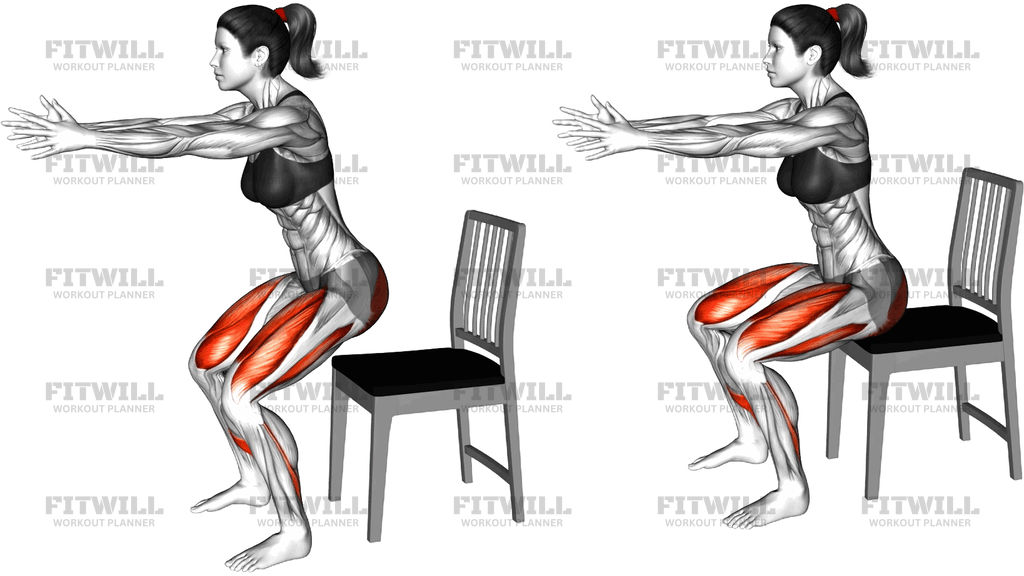
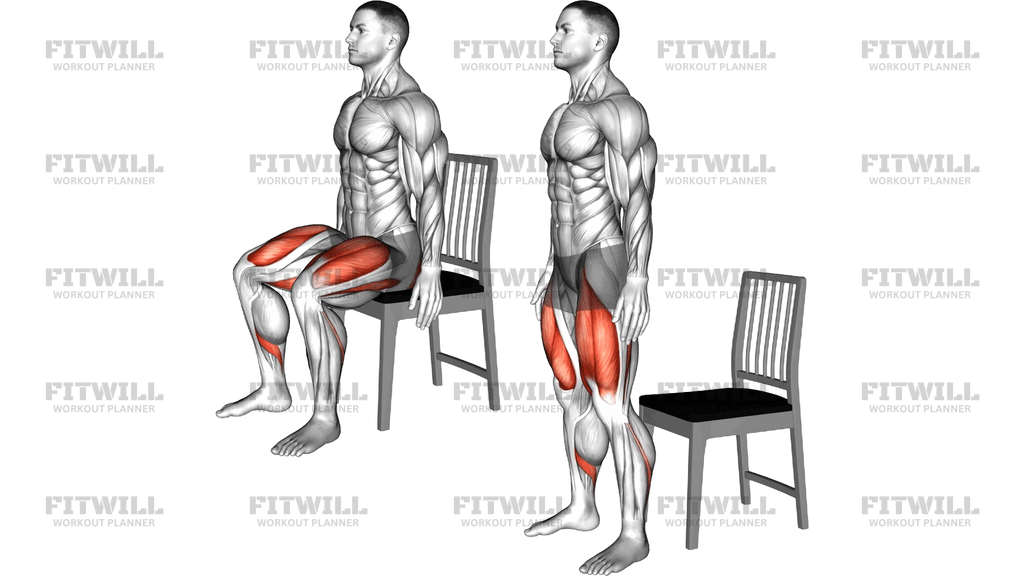
Sit To Stand On A Chair is one of the most practical strength movements you can train, because it rehearses something you already do dozens of times a day: rising from a seated position. Starting seated on a standard chair with feet flat on the floor, you lean slightly forward, drive through your legs, and stand fully upright, then lower yourself back down with control. The image shows the two key positions — the seated start with knees bent roughly ninety degrees, and the tall standing finish with the chair behind you.
The main work is done by the quadriceps, which extend the knees as you rise, with strong assistance from the glutes and hamstrings as the hips open up at the top. Your core and lower back stabilizers keep your torso organized as you lean forward over your feet. The highlighted areas in the movement reflect where the effort concentrates: the front of the thighs and the hip extensors on both the ascent and the controlled descent.
This exercise is especially valuable for beginners, older adults, and anyone returning from a layoff who is not yet ready for loaded squats or lunges. It builds the exact leg strength needed for independent daily living — getting out of cars, off sofas, and up from desks. Because the chair provides a defined depth and a safety net behind you, it also lets people with balance concerns practice the squat pattern with confidence.
Setup matters more than most people expect. Chair height determines the difficulty: a lower seat demands more knee and hip strength, while a higher seat makes the movement easier. Feet should be planted hip-width apart and slightly behind the knees so your weight shifts over the mid-foot as you rise. Pushing off with your hands against the seat or thighs makes the exercise easier, so keep hands free — arms relaxed at your sides or crossed at the chest — if your goal is leg strength.
To execute it well, think of leading with your chest as you hinge forward, then pressing the floor away until your hips and knees are fully open at the top. Avoid the common habit of collapsing back into the seat on the way down; the lowering phase builds nearly as much strength as the lift. Pause briefly in the chair between repetitions if you want clean reps, or touch-and-go for a steadier pace.
A sturdy, non-slip chair on a flat surface is essential. Dining chairs without wheels work well; avoid rolling office chairs or anything that slides. Once body-weight reps feel easy across a comfortable set, you can progress by using a lower seat, slowing the tempo, pausing at the top, or holding a light weight at your chest.
[ Workout Log & Planner ]
Put your next workout in Fitwill
Keep your plan and training log ready when you are.


Instructions
- Place a sturdy chair on a flat, non-slip surface and sit on the front half of the seat with your back upright and not leaning on the backrest.
- Set your feet hip-width apart, flat on the floor, with your shins roughly vertical and your heels a few inches behind your knees.
- Rest your arms at your sides or cross them over your chest — do not push off the seat or your thighs.
- Brace your core lightly and hinge forward from the hips until your chest is over your feet.
- Press evenly through your whole foot — heels and toes — and straighten your hips and knees to rise, keeping your chest lifted.
- Stand fully upright at the top with legs straight, glutes engaged, and shoulders stacked over your hips.
- Reverse the movement by pushing your hips back and bending your knees to lower yourself toward the seat in a slow, controlled descent.
- Touch the seat lightly with control rather than dropping your weight into the chair, then either pause or flow into the next rep.
- Exhale as you stand up and inhale as you lower back down, breathing steadily throughout the set.
- Complete your reps, then stand and reset your foot position if your stance drifted during the set.
Tips & Tricks
- If your heels lift as you stand, your feet are too far back — scoot them an inch or two forward so the weight stays over your mid-foot.
- Do not let your knees cave inward as you rise; think about spreading the floor gently with your feet so the knees track over the toes.
- If you catch yourself pushing off your thighs with your hands, cross your arms at your chest to force the legs to do the work.
- A lower chair makes the exercise much harder — if full reps are difficult, start with a higher seat and lower it over time rather than half-standing.
- Control the lowering phase for two to three seconds; dropping into the seat is the most common mistake and wastes half the benefit.
- Keep your neck neutral by looking at a spot on the wall ahead of you rather than down at your knees, which helps your chest stay up.
- If your knees ache at the bottom of the motion, check that you are hinging forward from the hips first instead of squatting straight down from an upright torso.
- Pause for a full second at the top and squeeze your glutes — many people rush past the standing position and never fully extend their hips.
- For balance issues, position the chair against a wall and practice near a counter or railing until the movement feels steady with no hand support.
Frequently Asked Questions
What muscles does Sit To Stand On A Chair work?
The quadriceps on the front of the thighs do most of the work extending your knees, while the glutes and hamstrings drive the hips open as you rise. Your core and lower back muscles stabilize your torso as you lean forward over your feet.
Is Sit To Stand On A Chair good for beginners?
Yes, it is one of the best starting points for leg strength because the chair sets your depth and sits right behind you for safety. Once you can handle several sets comfortably, you can progress to squats away from the chair or use a lower seat.
How high should the chair be for this exercise?
A standard chair around knee height, where your knees bend to roughly ninety degrees when seated, is a good starting point. A higher seat makes the movement easier and a lower one makes it harder, so choose based on your current strength.
Should I use my hands to push off the chair when standing up?
Avoid it if your goal is leg strength, because pushing off the seat or your thighs takes load away from the quads and glutes. If you need hand support for balance or safety, keep it light and gradually reduce it as you get stronger.
Why do my heels rise off the floor when I stand up?
That usually means your feet are placed too far back relative to the chair, so your weight shifts toward your toes as you lean forward. Move your feet an inch or two forward and make sure you hinge from the hips before driving up.
How many reps of Sit To Stand On A Chair should I do?
Start with two to three sets of eight to twelve controlled repetitions, resting about a minute between sets. As that becomes easy, add reps, slow the lowering phase, or move to a lower seat before adding external weight.
Can Sit To Stand On A Chair replace regular squats?
For beginners, older adults, or anyone rebuilding basic leg strength, it trains the same fundamental hip and knee extension pattern with less demand and less balance requirement. Once body-weight reps feel easy, freestanding squats let you progress further.
Is the lowering phase important, or is standing up the whole exercise?
Lowering under control matters a lot — the muscles work eccentrically as they lengthen, which builds strength and coordination for the same task. Drop into the seat and you skip roughly half the training effect.
What kind of chair should I use?
Use a stable, armless chair without wheels on a non-slip surface, such as a solid dining chair placed against a wall. Rolling chairs, folding chairs, or anything that can slide sideways create a real risk when your weight shifts during the movement.