Single Leg Forward Bend
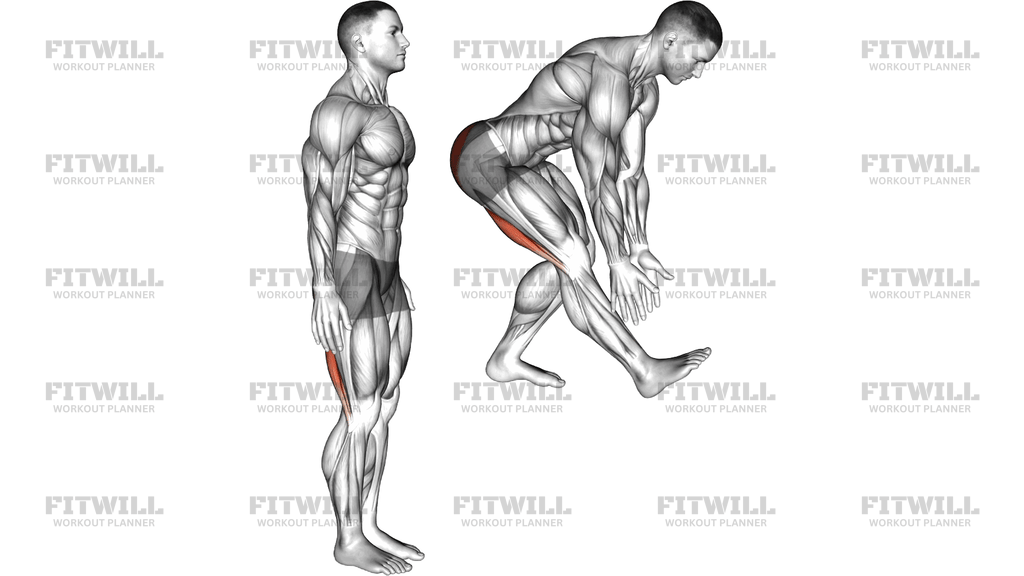
The Single Leg Forward Bend is a standing bodyweight stretch in which you balance on one slightly bent leg and fold forward over it while the other leg extends out in front, heel resting on the floor, as your hands reach down toward the extended foot. It combines a deep posterior-chain stretch with a genuine balance demand, so you are training flexibility and single-leg stability at the same time. The position loads a stretch through the hamstrings and calves of the extended leg while the outer hip of the standing leg works hard to keep your pelvis level.
This movement suits runners, cyclists, and anyone who spends long hours sitting, since those habits commonly leave the hamstrings, hips, and lower back stiff. It is also a practical warm-down choice after squats, deadlifts, or running sessions, and a useful assessment tool: if you wobble or your hips twist when you fold, that tells you something about your single-leg control that a seated stretch would never reveal.
Setup matters more than depth here. Your standing foot should point straight ahead with the knee softly bent rather than locked, and your weight spread across the whole foot. The extended leg reaches forward with the heel down and the toes pulled up, which is what sets the stretch along the back of that leg. If you place the front heel too far away or let the toes collapse inward, you lose the clean line of stretch and the lower back starts rounding to compensate.
To perform it, brace your core lightly, then push your hips back and hinge forward over the standing leg, letting your torso travel toward the extended thigh. Keep your spine long as you descend and let your hands drift down toward the extended foot or the floor for balance, rather than grabbing and pulling. Stop where you feel a firm but tolerable stretch along the back of the front leg or hip, breathe slowly, and let the tension ease over several breaths before pressing through the standing foot to rise back up with a flat back.
Because you are on one leg, expect some shaking at first. That wobble is your stabilizers around the hip and ankle doing their job, and it settles with practice. Keep the standing knee bent enough to stay grounded, and never bounce into the stretch. If your balance is poor, position yourself near a wall or sturdy chair so one hand can touch it for support without taking your weight off the leg.
A typical dose is two to three rounds of 20 to 40 seconds per side, done after training or on recovery days. Move between sides slowly and stand fully upright between reps so you reset your balance rather than swinging from one fold into the next.
[ Workout Log & Planner ]
Put your next workout in Fitwill
Keep your plan and training log ready when you are.


Instructions
- Stand tall with your feet hip-width apart, then shift your weight fully onto one leg and keep that knee softly bent, not locked.
- Extend your other leg forward and place the heel on the floor with the foot flexed, toes pointing up, far enough away that you feel length along the back of that leg.
- Spread your weight across the ball, heel, and big toe of the standing foot, and lightly brace your stomach muscles to steady your pelvis.
- Hinge at the hips by pushing your glutes back and folding your chest forward over the standing leg, keeping your back flat and long.
- Reach your hands down toward the toes of the extended leg or toward the floor for balance, stopping when you feel a solid stretch along the back of the front leg or outer hip.
- Hold the end position and breathe slowly through your nose, letting the stretch soften a little on each exhale without forcing deeper.
- Press through the standing foot and drive your hips forward to stand back up, lifting your chest first so your spine stays neutral on the way up.
- Bring the extended leg back in, stand fully upright, shake out your leg if needed, and reset your balance before repeating on the other side.
Tips & Tricks
- If your standing knee drifts inward as you fold, think about pressing the big toe into the floor and tracking the knee over the middle of that foot.
- Rounding the lower back to reach further is the most common fault in this stretch; keep your chest proud and hinge from the hips instead of curling the spine.
- Wobbling usually means your hips are shifting sideways. Slow the descent down and shorten the fold until you can keep the pelvis square to the front.
- Do not lock the standing knee to feel more stretch. A soft knee protects the joint and actually improves your balance in this position.
- Keep the extended foot actively flexed with the toes pulled back. A floppy foot turns off the calf and hamstring tension you are trying to create.
- If your hands cannot get near the extended foot, rest them on your standing thigh or a low surface. Depth of the fold does not equal quality of the stretch.
- Hold for time rather than reps. Long, calm holds of 20 to 40 seconds give the hamstring tightness time to release, while quick dips in and out achieve very little.
- Avoid this fold with a rounded back if you have an irritated lower back; reduce the range so the stretch lives in the back of the leg, not in your spine.
- Do the tighter side first and match its hold time on the looser side rather than chasing extra depth there.
Frequently Asked Questions
What muscles does the Single Leg Forward Bend stretch?
It primarily targets the hamstrings and calves of the extended leg, with additional stretch through the glutes and lower back as you fold. The outer hip and ankle of the standing leg work to keep you balanced.
Is the Single Leg Forward Bend good for beginners?
Yes, as long as you scale the range. Beginners should bend the standing knee more, shorten the fold, and stand near a wall so one hand can steady them until the balance improves.
Should my standing leg be straight or bent during the Single Leg Forward Bend?
Keep it softly bent. A locked knee makes balancing harder and shifts stress into the joint, while a slight bend lets you hinge properly from the hip.
Why do I lose my balance when I fold forward on one leg?
Folding shifts your center of mass away from your support foot, so the hips and ankle stabilizers have to correct constantly. Shorten the range, move slower, and practice near a wall until the wobble settles.
How far should I reach toward my extended foot?
Only as far as you can go with a flat back and a tolerable stretch behind the leg. Touching the toes is not the goal; pulling yourself down with your hands usually just rounds the spine.
How long should I hold the Single Leg Forward Bend?
Aim for 20 to 40 seconds per side for two or three rounds. Long, steady holds with slow breathing work better than quick repeated dips.
What can I use instead if this is too hard to balance?
Hold a wall, chair, or rack with one hand for support, or substitute a seated forward bend or a heel-propped hamstring stretch on a step, which remove the balance demand while keeping the same stretch.
When is the best time to do the Single Leg Forward Bend?
It works best after training or on recovery days when the muscles are warm. Avoid long static holds right before heavy squatting, deadlifting, or sprinting, since deep pre-workout stretching can temporarily reduce power output.
Can I hurt my lower back doing this stretch?
Not if you hinge from the hips and keep the spine long. Problems arise when people round the lower back to chase depth, so stop at the point where the fold starts curling your back and hold there instead.
Why does my standing hip burn or cramp during the Single Leg Forward Bend?
The outer hip muscles of the support leg are working hard to stabilize your pelvis while you fold, which is normal at first. Stand up, shake the leg out between rounds, and the endurance will build quickly with regular practice.