Standing Ladder Climb
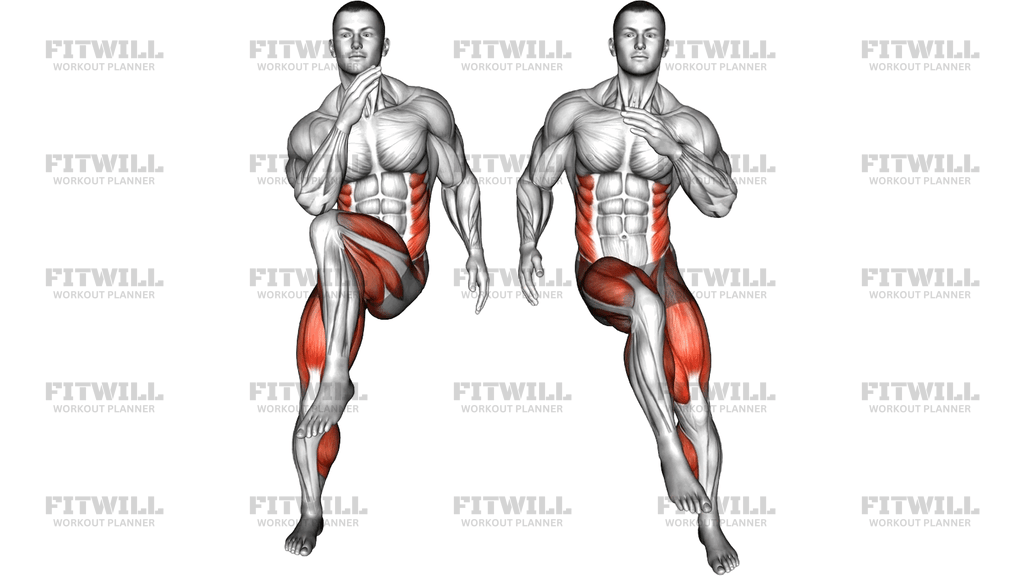
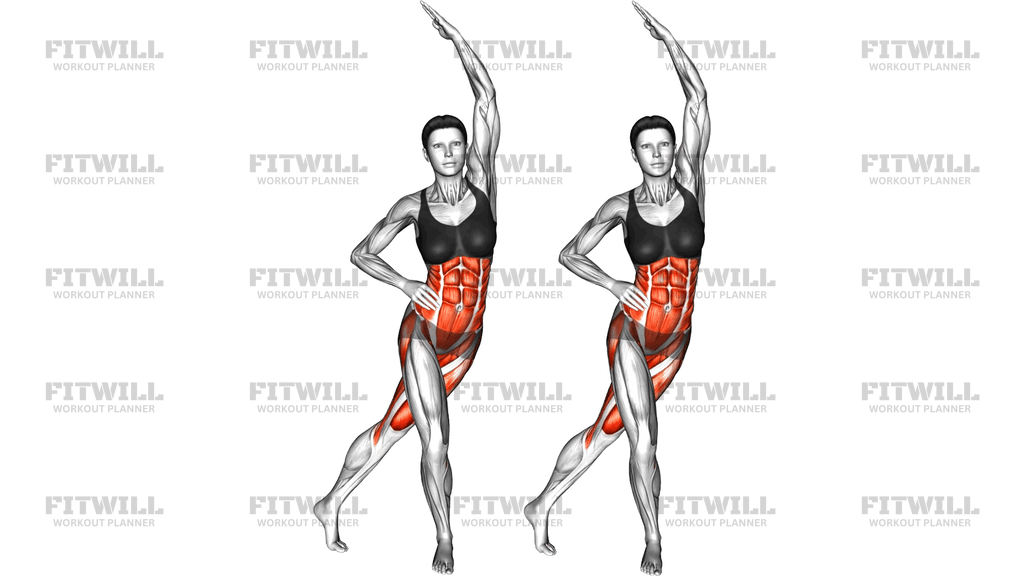
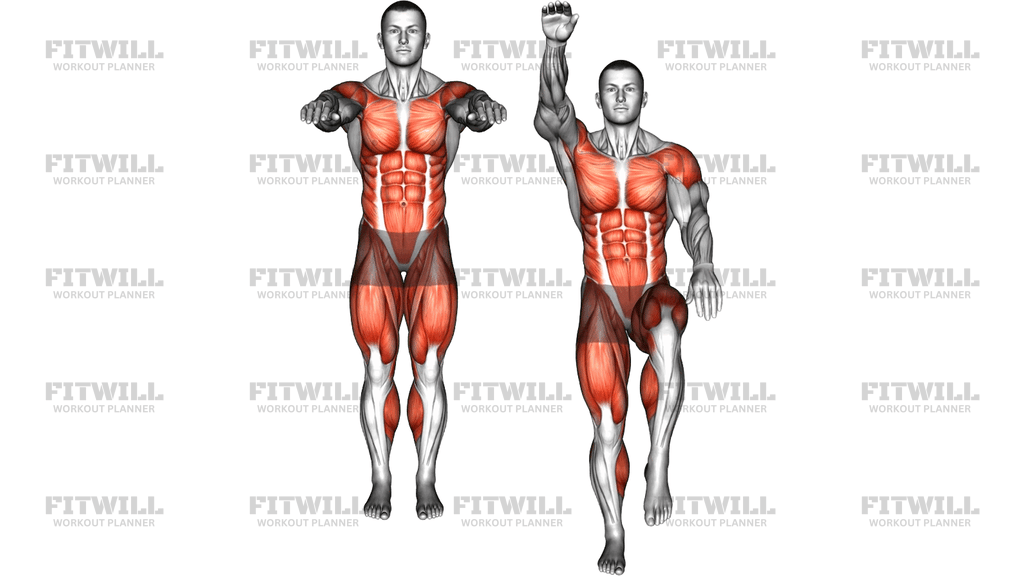
The Standing Ladder Climb is a bodyweight movement that mimics the pattern of climbing a ladder while staying in place. From a tall standing position with both arms extended straight out in front of you at shoulder height, you reach one hand up overhead as if grabbing a high rung while simultaneously driving the opposite knee up toward hip level. You then switch sides in a steady, alternating rhythm, so each rep looks like a slow, deliberate vertical climb performed on the spot.
This exercise works because it combines two demands at once: single-leg balance and coordinated upper-to-lower body movement. Every time you lift a knee, the standing leg has to stabilize the hip, knee, and ankle while your core braces to keep your torso upright. The reaching arm challenges shoulder mobility and control, and the cross-body pattern — right hand up with left knee driving, then the reverse — recruits the obliques and deep core to resist rotation and side-bending.
Because it requires no equipment and very little space, the Standing Ladder Climb fits easily into warm-ups, core circuits, and movement-preparation routines. It is especially useful as a dynamic activation drill before squats, lunges, or running, since it wakes up the hip flexors, glutes, and trunk stabilizers in a pattern that closely resembles real-world stepping and reaching. It is also a low-impact option for people who want core and balance work without jumping or loading the spine.
Setup matters more than it might seem. Standing tall with feet about hip-width apart, arms lifted to shoulder height, gives you a neutral starting position from which the reaching and knee-lifting can happen cleanly. If you start slouched or with your arms hanging, the climb pattern turns into a sloppy lean-and-swing, and the core stops doing the stabilizing work. Keep the torso vertical throughout and let the limbs move around a stable center.
To execute it well, focus on quality of position rather than speed. Reach fully overhead with each arm, lift each knee to at least hip height, and pause briefly at the top of each rep so you own the balance position. Moving too fast turns the drill into exaggerated marching, where momentum replaces control and the standing foot drifts or the low back arches.
Common use cases include general fitness programs, older-adult balance training, athletic warm-ups, and rehab-style return-to-movement work, since the drill can be scaled easily. Beginners can perform it near a wall for light support or with a smaller knee lift; more advanced trainees can slow the tempo, add a two-second hold at the top of each rep, or perform it with eyes forward and no external support to raise the balance demand. As with any standing single-leg drill, stop if you feel sharp pain, and work on a non-slip surface.
Fitwill
Log Workouts, Track Progress & Build Strength.
Achieve more with Fitwill: explore over 9600 exercises with images and videos, access built-in and custom workouts, perfect for both gym and home sessions, and see real results.
Start your journey. Download today!




Instructions
- Stand tall with your feet about hip-width apart, weight spread evenly across both feet, and extend both arms straight out in front of you at shoulder height with palms facing forward, as if resting your hands on the rungs of an invisible ladder.
- Brace your abdominal muscles gently and pull your ribs down slightly so your torso stays vertical and your lower back does not arch.
- Shift your weight onto your left leg and keep that foot flat and firm on the floor as your support base.
- Reach your right hand straight up overhead as if grabbing a high rung while simultaneously driving your left knee up to hip height, keeping the raised foot just behind or beside the standing knee.
- Pause for a beat at the top with your arm fully extended, your knee lifted, and your torso still upright — avoid leaning back or letting your hips shift sideways.
- Lower your left foot back to the floor under control and bring your right hand back down to shoulder height in front of you.
- Immediately repeat on the other side: left hand reaching up, right knee driving up, maintaining the cross-body pattern.
- Exhale as you reach and lift, and inhale as you lower each side, keeping your breathing steady throughout the set.
- Continue alternating sides for your target number of reps or time, rechecking your stance and posture every few reps so your feet stay planted hip-width apart.
Tips & Tricks
- If you keep leaning backward when the knee comes up, your hip flexors are pulling your pelvis into a tilt — squeeze the glute of the standing leg and shorten the knee lift until you can stay vertical.
- Check your standing foot between reps: if it rolls to the outside edge or the toes grip the floor, widen your base slightly and spread your toes before continuing.
- The reach should come from the shoulder, not from shrugging — if your shoulder creeps toward your ear at the top, lower the reach a few inches and press the shoulder blade down as you extend.
- Slow the tempo down before adding reps; this drill loses most of its core and balance value once momentum from fast marching takes over the movement.
- Keep the raised knee pointing forward rather than letting it drift out to the side, which keeps the hip flexors and deep core doing the work instead of the outer hip compensating.
- If balance is shaky, stand within arm's reach of a wall and touch it lightly with one fingertip for reassurance rather than leaning on it — the goal is to need the contact less over time.
- Do not let the descending arm just drop; pull it back down to shoulder height with control, as if lowering yourself one rung at a time, to keep tension on the shoulder and trunk.
- A common mistake is letting the head and eyes follow the reaching hand upward, which tips the chest back — keep your gaze level on a fixed point ahead of you.
- If your lower back feels strained instead of your abs, reduce the knee height and re-brace your midsection before each rep; the movement should feel like trunk control, not back extension.
Frequently Asked Questions
What muscles does the Standing Ladder Climb work?
The primary work comes from the core, especially the abs and obliques, which stabilize your torso while one leg is lifted. The hip flexors drive each knee up, while the shoulders, glutes, and calf of the standing leg handle the reaching and balance demands.
Is the Standing Ladder Climb suitable for beginners?
Yes. It is low-impact and easy to scale — beginners can reduce the knee height, slow the tempo, or stand near a wall for light support. As balance improves, progress to a full-height knee lift with a brief pause at the top of each rep.
Why does the Standing Ladder Climb use a cross-body pattern instead of lifting the knee and arm on the same side?
Reaching the opposite hand and knee together mirrors how humans actually climb and walk, and it forces the obliques and deep core to resist rotation. Matching hand and knee on the same side removes much of that trunk-stabilization demand.
How high should I lift my knee during the Standing Ladder Climb?
Aim for hip height, which gives the hip flexors and lower abs a solid working range without forcing your pelvis to tilt. If you cannot lift to hip height while keeping your torso vertical, use a slightly lower knee position and build up over time.
What is the most common mistake in the Standing Ladder Climb?
Rushing the reps and turning the exercise into fast marching, which lets momentum replace control. The telltale signs are an arched lower back, a leaning torso, and a standing foot that drifts — slow down and pause at the top of each reach to fix it.
Can I use the Standing Ladder Climb as a warm-up?
It works well as a dynamic warm-up before lower-body strength training, running, or hiking because it activates the hip flexors, glutes, and trunk in a stepping pattern. Two to three rounds of ten to twenty alternating reps is usually enough.
What can I substitute if standing balance on one leg is difficult for me?
Try a supported version with your fingertips against a wall or the back of a sturdy chair, or perform the drill while keeping the working foot's toes lightly touching the floor between reps. High knee marches with both hands moving at chest height are another lower-demand option.
How many reps and sets of the Standing Ladder Climb should I do?
For core and balance work, aim for two to three sets of ten to twenty controlled alternating reps, or timed sets of twenty to forty seconds. Quality matters more than volume — stop the set when your knee lift drops or your torso starts leaning.
Is the Standing Ladder Climb safe for people with knee problems?
Because it is low-impact and uses no external load, it is generally gentle on the knees, but the standing leg does absorb single-leg load. Keep the knee lift within a pain-free range, avoid locking the support knee, and consult a professional if you have a recent knee injury.