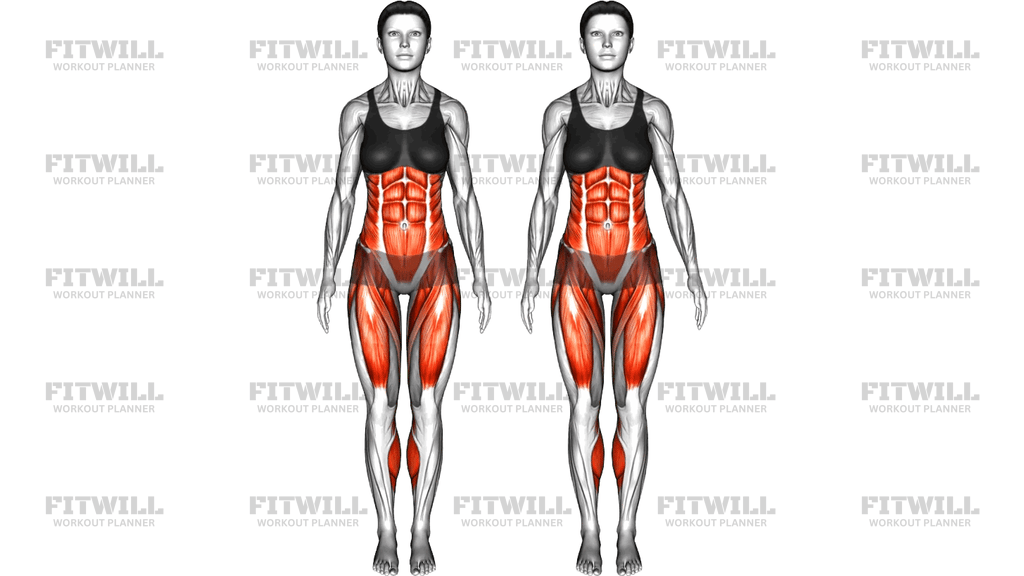
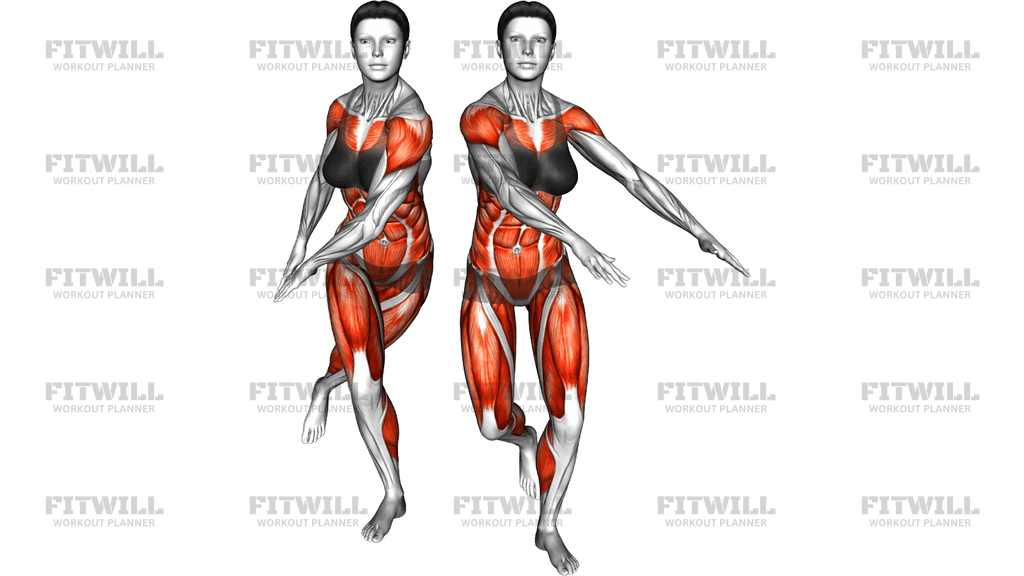
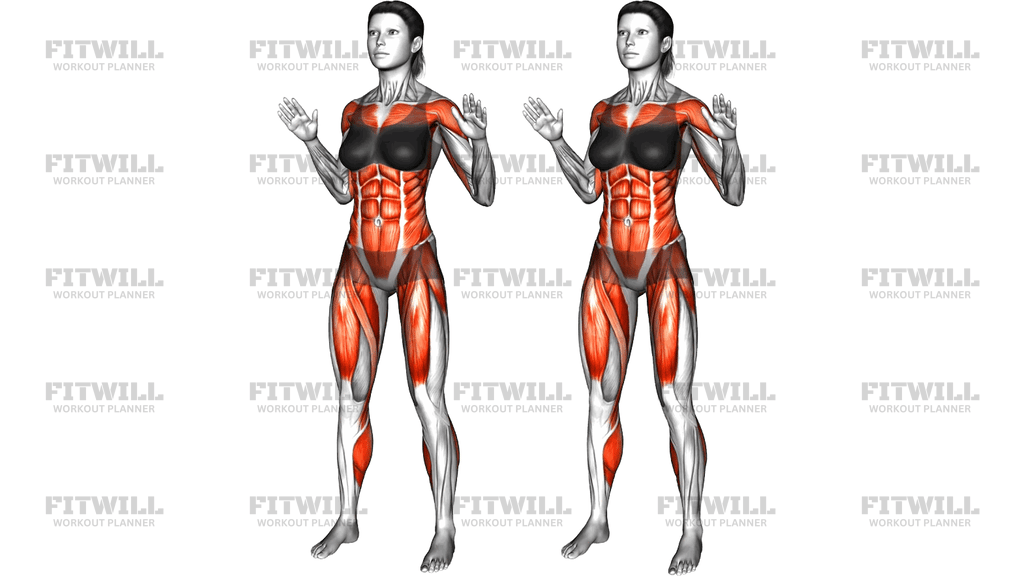
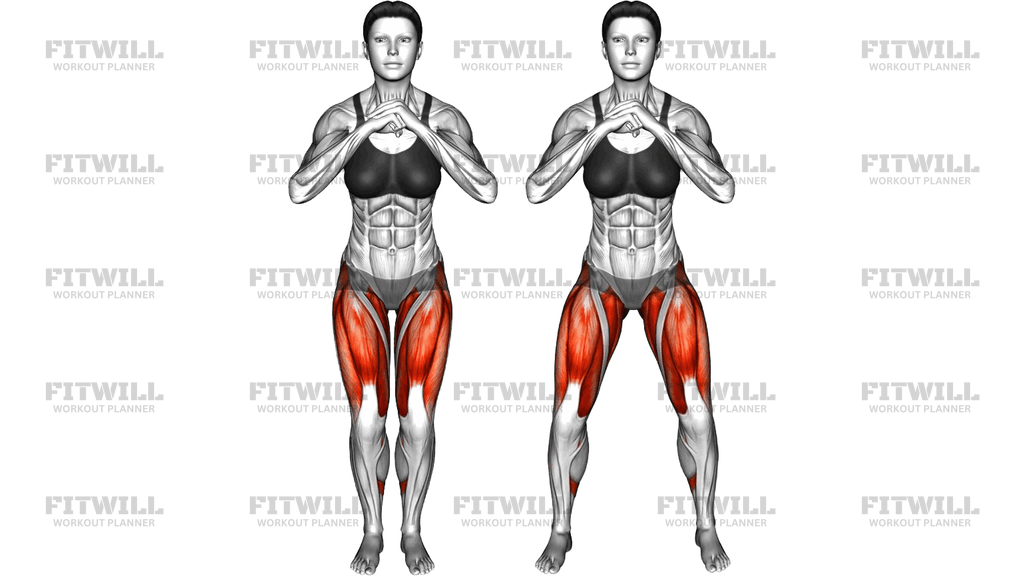
Deep Squat Reach Forward Reach Up
Deep Squat Reach Forward Reach Up is a bodyweight mobility flow that combines a full-depth squat hold with two arm reaches performed in sequence. You start in the bottom of a deep squat with your hands pressed together at your chest and your elbows gently braced inside your knees, then extend both arms forward between your legs, and finally sweep them up and out in front of you toward the horizon. The result is a movement that opens the hips, ankles, and groin while mobilizing the shoulders and upper back in one continuous sequence.
This drill is especially useful for anyone who sits for long hours and has lost the ability to sit comfortably in a deep squat, as well as lifters who want to improve their bottom position for squats, cleans, or snatches. It is also a common warm-up in calisthenics, Olympic weightlifting, and general movement prep because it loads the ankle, knee, and hip joints through their full available range without any external weight.
The deep squat position itself stretches the quads, glutes, adductors, and calves while demanding mobility from the ankles and hips. Pressing the elbows against the inner knees gently encourages the groin to open and helps you keep your chest tall. The forward reach then lengthens the lower back and lats as you round slightly over your legs, and the upward reach reintroduces extension through the spine and shoulders, reversing the rounding and training the opposite end of the range.
Setup matters more than most people expect. Your feet need to be far enough apart and turned out enough that your hips can descend between them rather than behind them, and your heels should stay down the entire time. If your heels lift, your ankles are the limiting factor, and you will get far less out of the hip and groin positions. Take a moment to place your feet deliberately before you descend rather than dropping into whatever position happens to be easiest.
To execute it well, settle into the bottom squat and breathe there for a few cycles before moving your arms at all. Press your elbows into your inner knees just enough to create space in the hips, keep your chest lifted, then reach the arms forward through the gap between your legs and let your upper back round naturally. Sweep the arms up in a wide arc until they are extended overhead and forward, feel the stretch move into your shoulders and upper back, then return to the chest-pressed starting position. Move slowly the whole time and let the breath set the pace.
Use this drill as part of your warm-up before lower-body training, as a standalone daily mobility practice, or as a reset between long stretches of sitting. Two to four rounds of ten to thirty seconds per position is plenty for most people. Stay inside a comfortable stretch, keep weight distributed through the whole foot, and never bounce or force the depth, since the value comes from relaxed time under tension rather than aggressive pushing.
[ Workout Log & Planner ]
Put your next workout in Fitwill
Keep your plan and training log ready when you are.


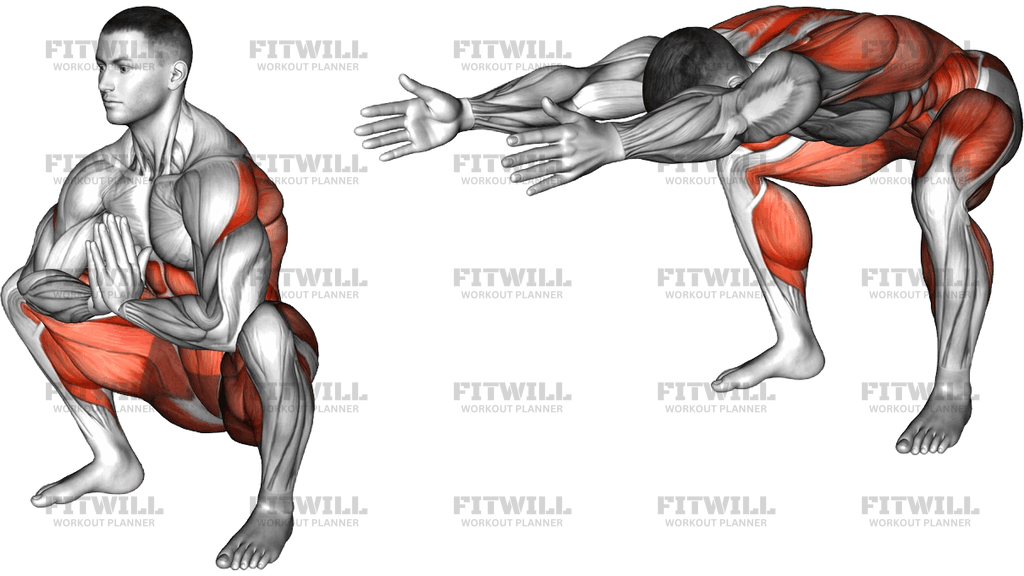
Instructions
- Stand with your feet roughly shoulder-width to slightly wider apart, toes turned out about 15 to 30 degrees, with your weight spread evenly across the whole foot.
- Bend your knees and sink straight down until you reach your deepest comfortable squat, keeping your heels flat on the floor and your torso as upright as you can manage.
- Press your palms together in front of your chest with your fingers pointing up, then use your elbows to gently push outward against the inner sides of your knees.
- Hold this bottom position for two or three slow breaths, letting your hips, groin, and ankles gradually settle and release.
- Keeping your heels down and your hips low, extend both arms straight forward between your knees with your fingers spread, letting your upper back round and your lower back lengthen.
- Hold the forward reach briefly, then sweep your arms out wide and up in an arc until they are fully extended overhead and in front of you, lifting your chest as you go.
- Pause in the upward reach to feel the stretch through your shoulders, upper back, and hip flexors, then bring your hands back to the prayer position at your chest.
- Exhale as you reach forward and up, and inhale as you return to the squat hold; let each reach travel with your breath rather than rushing it.
- Repeat the forward reach and upward reach for the desired number of repetitions, then stand up by driving through your heels and pushing the floor away.
- Reset your stance between rounds if your feet drifted, and shake out your ankles and hips before descending again.
Tips & Tricks
- If your heels lift off the floor at the bottom, widen your stance slightly or place a thin book or rolled mat under each heel; forcing heels down with lifted arches only shifts stress into the knees.
- Do not let your knees collapse inward when you reach forward. Actively keep the elbows pressing out so the knees track over the toes throughout both reaches.
- The most common mistake is dropping the head and slumping entirely during the forward reach. Let the upper back round, but keep the back of your neck long and your eyes soft on the floor a foot or two ahead.
- Breathe slowly and deliberately in the bottom position. Holding your breath makes the hips guard and tighten, which defeats the purpose of the hold.
- Keep your weight balanced between heels and forefoot. Sitting too far back onto the heels makes the forward reach pull you off balance, while leaning too far forward loads the knees.
- Spend extra time in whichever reach feels most restricted. If the forward reach between the legs is where you feel jammed, your hips and lower back need more attention than your shoulders.
- If you cannot squat deep at all yet, hold a sturdy upright support such as a squat rack or doorframe with one hand while you work the arm reaches with the other.
- Warm ankles make this drill far more productive. A few ankle circles or calf raises before you drop into the squat will increase how low you can comfortably sit.
- Move between the two reaches like a slow-motion wave rather than snapping from position to position; the transition is where the lower back and hips get the most out of the sequence.
Frequently Asked Questions
What muscles and joints does the Deep Squat Reach Forward Reach Up target?
The deep squat position stretches the quads, glutes, adductors, and calves while mobilizing the ankles and hips. The forward reach lengthens the lower back and lats, and the upward reach opens the shoulders and hip flexors.
Is the Deep Squat Reach Forward Reach Up suitable for beginners?
Yes, as long as you stay within a depth you can reach with your heels flat and no pain. Beginners can shorten the holds, widen the stance, or hold a support with one hand while building up the required ankle and hip mobility.
Why do my heels rise when I sit into the deep squat?
Lifting heels usually points to limited ankle dorsiflexion, often from tight calves or long hours in shoes with raised heels. Elevate the heels slightly on a rolled mat for now and work on calf and ankle mobility separately.
Should my knees push against my elbows, or my elbows against my knees?
The elbows press gently outward into the inner knees. This creates room for your torso between the legs, keeps the knees tracking over the toes, and encourages the groin to open without forcing it.
How long should I hold each part of the Deep Squat Reach Forward Reach Up?
Spend two to three relaxed breaths in the bottom squat, one to two breaths in the forward reach, and one to two breaths in the upward reach. Total time in the sequence matters more than any single hold.
Can I use this as a warm-up before squatting with a barbell?
It is an excellent warm-up for barbell squats because it takes the ankles, knees, and hips through the exact range you are about to load. Do two to four rounds before your first working set.
My lower back rounds a lot during the forward reach. Is that a problem?
Some rounding is expected and even desirable in this drill, since the reach is meant to lengthen the whole back line. Keep the movement slow and pain-free, and avoid yanking deeper into the rounding with momentum.
What can I substitute if I cannot get deep enough to reach between my legs?
Hold a stable object like a squat rack, doorframe, or table edge while sitting as low as you can, and perform the arm reaches with the free hand. As your depth improves, gradually use the support less.
How often should I do the Deep Squat Reach Forward Reach Up?
Daily is fine for most people, especially if you sit a lot, since it is a low-load mobility drill rather than a strength exercise. Two to four rounds of the sequence per session is a practical dose.
Is it safe if I feel pinching in the front of my hips or knees at the bottom?
A deep stretch sensation is normal, but a sharp pinch is not. Reduce the depth, adjust your foot turn-out, and ease off the elbow pressure. If the pinching keeps happening, get it assessed before continuing to load that range.