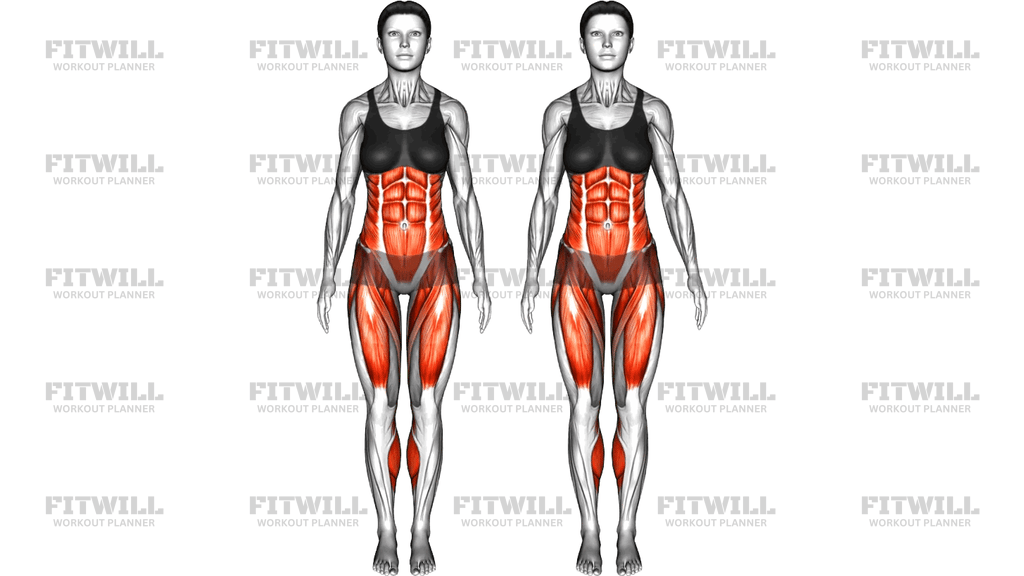
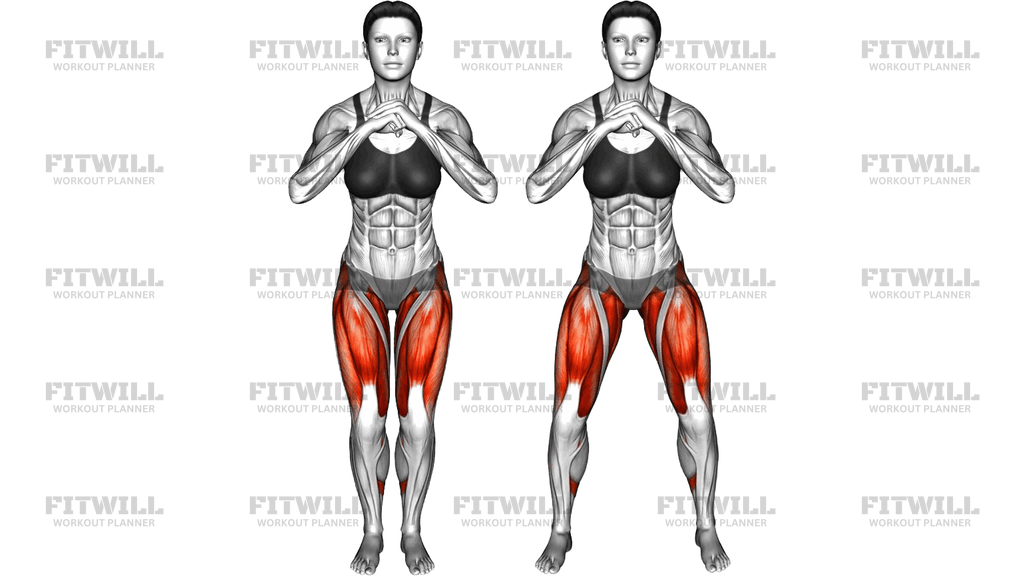
Bodyweight Wide Squat Hands Together
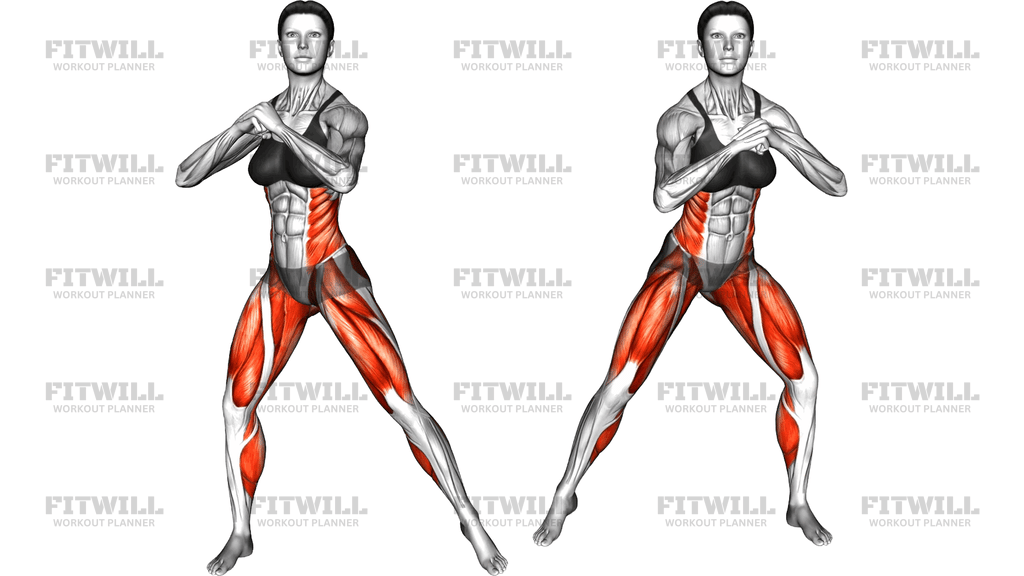
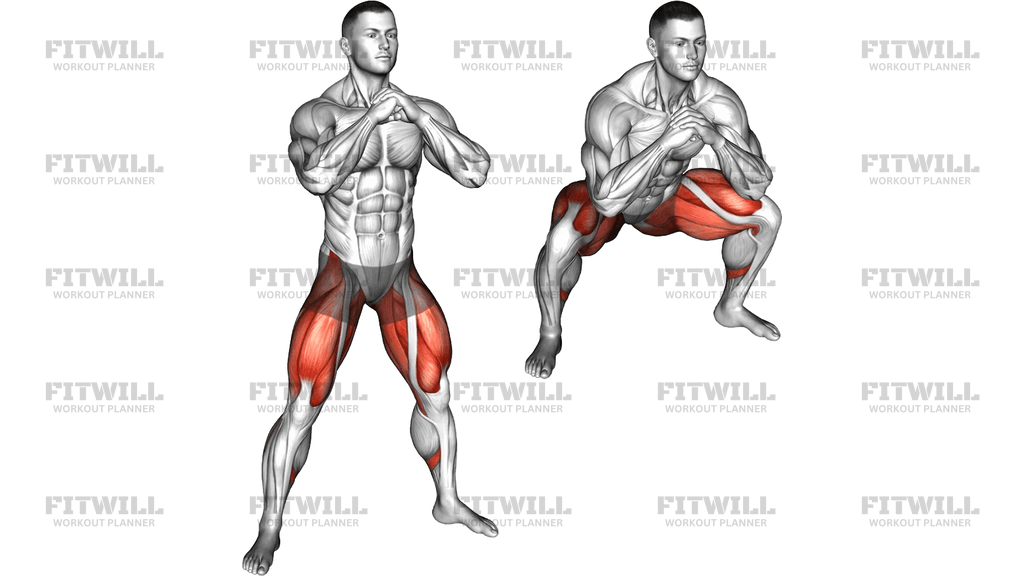
The Bodyweight Wide Squat Hands Together is a wide-stance squat variation performed with the palms pressed together in front of the chest. Clasping the hands does more than give you somewhere to put your arms: it pulls the elbows down and inward, helps you keep the chest tall, and gives you a natural counterweight to sit behind as you lower. The stance itself is much wider than a standard squat, roughly one and a half to two shoulder widths, with the toes turned out at about 30 to 45 degrees.
That wide, externally rotated stance changes the demands of the squat considerably. The inner thighs, particularly the adductor group, work hard to control the thighs as they spread apart at the bottom, while the quads and glutes drive you back up. The glutes also get a stronger stretch in this position than in a narrow-stance squat, which is one reason the variation is so popular for building the hips and thighs without any equipment.
This exercise suits a wide range of people. Beginners can use it to learn squat mechanics with a stable, planted base, since the wide stance lowers the center of gravity and makes balance easier. More experienced lifters use it as a warm-up, a high-rep finisher, or a way to load the adductors and glutes between barbell sessions. It also carries over well to sumo deadlifts, wide-stance box squats, and sports that require lateral strength.
Setup matters here because the wide stance gives your knees a specific path to follow. Your knees should travel out over your little toes, not collapse inward, and your heels must stay glued to the floor. If your stance is too wide for your hip structure or your toes are not turned out enough, you will feel pinching at the front of the hips or be forced to let the knees dive in. Take a moment to find a stance where you can reach a deep position with a flat, neutral spine.
To perform it well, stand tall with your hands pressed together at chest height and elbows pointing down. Brace your midsection, then push your hips back and bend your knees outward as you descend. Go as low as your mobility allows while keeping your torso upright and your whole foot loaded. Pause briefly at the bottom, then drive the floor away through your midfoot and heels to stand back up, squeezing the glutes at the top.
The main safety points are simple: never bounce out of the bottom, keep the knees tracking in the same direction as the toes, and stop the set before your form breaks down. Deep squats are safe for healthy knees when performed with control, but if you have a knee, hip, or ankle issue, work within a depth that feels comfortable and progress gradually.
[ Workout Log & Planner ]
Put your next workout in Fitwill
Keep your plan and training log ready when you are.


Instructions
- Stand with your feet spread roughly one and a half to two shoulder-widths apart and turn your toes out 30 to 45 degrees.
- Press your palms together in front of your chest with your fingers interlaced or stacked, and let your elbows drop down so they point toward the floor.
- Lift your chest, pull your shoulders back slightly, and brace your core as if preparing for a light push to the stomach.
- Shift your weight evenly across both feet and press your whole foot into the floor, feeling three points of contact: heel, big toe, and little toe.
- Push your hips back and let your knees bend outward, tracking over your little toes as you descend between your legs.
- Lower until your thighs are at least parallel to the floor, or as deep as you can go while keeping your heels down and your back neutral.
- Pause for a beat at the bottom, keeping your chest up and your knees pushed wide rather than caving inward.
- Drive through your midfoot and heels to stand up, pushing the floor away and keeping the knees wide on the way up.
- Exhale as you rise, finish tall with your glutes squeezed, then take a breath and repeat for your target reps.
- Between sets, stand fully upright, shake out your hips, and reset your stance so every rep starts from the same position.
Tips & Tricks
- A common mistake with this wide stance is letting the knees collapse inward as you fatigue. Cue yourself to spread the floor apart with your feet on every rep.
- If your heels lift at the bottom, your stance is probably too wide for your hip mobility. Narrow it slightly or turn your toes out a bit more until the heels stay down.
- Keep the pressed hands close to your chest. Letting the arms drift forward shifts weight onto the toes and pulls your torso down with it.
- Do not let the elbows drop between the knees and flare the lower back at the bottom. Your arms are there for balance and chest position, not to pry the legs open.
- A slight forward lean is fine in a wide squat, but if your chest is falling onto your thighs, you are losing brace. Exhale only partially at the top and re-brace before descending.
- Slow the lowering phase to two or three seconds if you tend to dive into the bottom. The adductors get much more out of a controlled descent than a fast drop.
- If you feel a pinch at the front of the hip, avoid forcing maximum depth. Reduce the range slightly and work on gradually increasing depth over weeks, not in a single session.
- Barefoot or flat-soled shoes work well here. Soft, cushioned running shoes make it harder to feel the floor and keep the heels planted.
- Turning the toes out too far, past about 45 degrees, stresses the inner knee and makes it tempting to let the arches fall in. Keep the rotation moderate and let the knees follow the toes.
Frequently Asked Questions
Which muscles does the Bodyweight Wide Squat Hands Together work?
It primarily targets the quads and inner thighs, with strong involvement from the glutes. The hamstrings, calves, and core work to stabilize you through the range of motion.
Why are the hands pressed together instead of held out in front?
Pressing the palms together with the elbows down keeps the chest lifted and acts as a small counterbalance, making it easier to sit back and stay upright at the bottom of the wide squat.
Is the Bodyweight Wide Squat Hands Together good for beginners?
Yes. The wide stance lowers your center of gravity and makes balance easier than a narrow squat, so it is a good way to learn depth and knee control without equipment.
How wide should my stance actually be?
Aim for about one and a half to two shoulder widths, with toes turned out 30 to 45 degrees. Adjust from there: if your heels lift or your hips pinch, narrow the stance slightly.
My knees cave inward on the way up. How do I fix it?
Slow the ascent, reduce the number of reps per set, and actively think about pushing your knees out over your little toes. Strengthening the glutes and inner thighs with side-lying leg raises or band work also helps.
How deep should I go in this exercise?
Go as deep as you can while keeping your heels flat, knees tracking over the toes, and lower back neutral. Depth will improve gradually as your hip and ankle mobility develop.
Can I replace barbell squats with the Bodyweight Wide Squat Hands Together?
It builds solid mechanics and muscular endurance, but it cannot progressively load the legs the way external weight can. Use it as a foundation, warm-up, or high-rep finisher alongside loaded variations.
How many reps and sets should I do?
For strength-endurance and technique work, 3 to 4 sets of 12 to 20 controlled reps is a solid range. Because the resistance is your body weight, higher reps and slower tempo are the main ways to progress.
Is it safe to squat deep with the knees turned out?
For healthy knees and hips, deep squats with the knees tracking over the toes are safe when performed with control. If you have a joint injury or pain during the movement, limit the depth and check with a qualified professional.
What can I use if the wide stance feels too hard on my hips?
Narrow your stance toward a standard squat, reduce the depth, or hold the position only partway down. A sumo-style squat to a bench or box at a comfortable height is also an easy substitution.