Seated Single Leg Raise On Chair
The Seated Single Leg Raise On Chair is a simple body weight movement performed sitting upright on a sturdy chair with your hands resting on the seat beside your hips. From this position, you straighten one leg out in front of you until the knee is fully extended, hold the leg briefly, then lower it back down with control. The illustration shows the exact pattern: an upright torso, both hands supporting on the chair, the working leg lifting from a bent-knee seated position to a straight leg held roughly parallel to the floor.
This exercise primarily trains the quadriceps, with the rectus femoris working double duty because it crosses both the hip and the knee. Straightening the knee against the weight of your own lower leg loads the quads through extension, while lifting the straight leg also calls on the hip flexors at the front of the hip. Your core and trunk stabilizers stay quietly engaged the whole time to keep your torso tall and prevent you from slumping or leaning back as the leg rises.
Because it requires nothing more than a stable chair, this movement is one of the most accessible ways to load the knees and hips. It suits beginners building baseline leg strength, older adults maintaining independence with walking and stair climbing, office workers breaking up long sitting periods, and people recovering knee confidence who are not ready for weighted leg extensions or squats. Physical therapists frequently use this exact seated pattern as a stepping stone toward standing and loaded knee work.
Setup matters more than it looks. A chair without wheels, at a height that lets your feet rest flat and your knees bend to about ninety degrees, gives you a stable base and a clean starting angle. Sitting tall with light hand support keeps the hips in a good position so the rectus femoris can work across both joints without the torso compensating. If you slouch or tip backward, you change the hip angle and make the movement either easier or less specific to what you are trying to train.
To execute it well, extend the knee smoothly until the leg is straight, squeeze the thigh at the top for a moment, and resist the leg back down rather than letting it drop. The lowering phase is where much of the strength benefit lives, so treat it as a two- to three-second descent. Keep the movement in the knee and hip of the working leg; the rest of your body should stay still.
A few practical points keep this safe and effective. Move within a knee range that feels comfortable, especially if you are working around sensitive joints, and never force a locked, painful extension. Stop and reassess if you feel pinching at the front of the hip or knee rather than muscular effort. Done with attention to tempo and posture, this quiet-looking exercise builds genuine strength in the exact muscles that get you up out of a chair.
[ Workout Log & Planner ]
Put your next workout in Fitwill
Keep your plan and training log ready when you are.


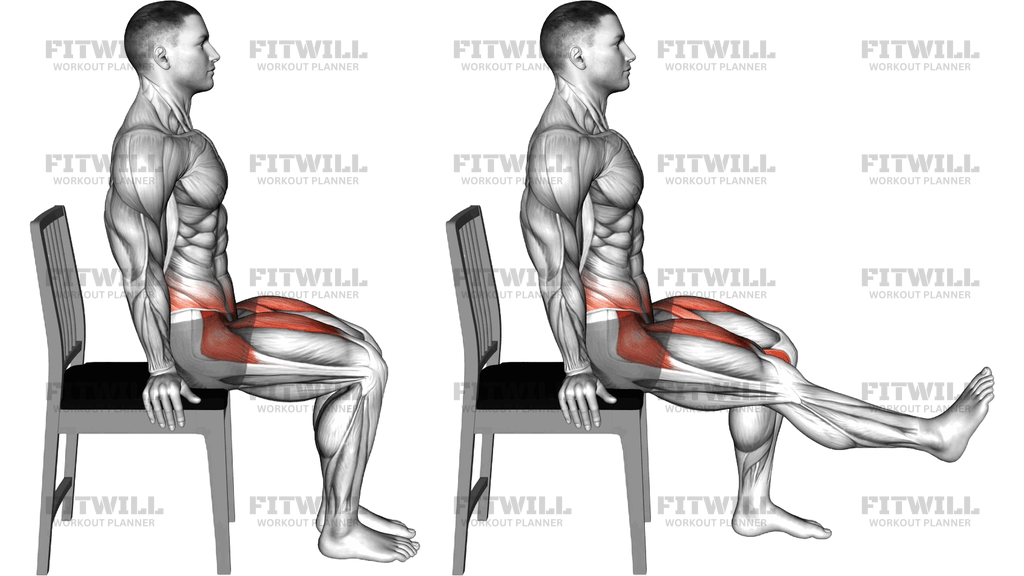
Instructions
- Sit on a stable, armless chair with your feet flat on the floor and your knees bent to roughly ninety degrees.
- Place your palms on the edge of the seat on either side of your hips for light support, and sit tall through your spine.
- Brace your abdominal muscles gently and keep your shoulders relaxed, with your weight balanced evenly over both sit bones.
- Keeping one foot planted, lift the other leg by straightening the knee until the leg is extended in front of you, roughly parallel to the floor.
- Pause at the top for one to two seconds and actively squeeze the thigh muscle with the knee straight but not jammed.
- Lower the leg back down slowly over two to three seconds until your foot returns to the floor with control.
- Breathe out as you raise the leg and breathe in as you lower it, keeping the breath steady throughout.
- Complete all repetitions on one side, then switch legs and repeat, or alternate legs rep by rep if that helps you keep balance.
- Between sets, stand up briefly or shift your weight to reset your posture before sitting back into the same tall position.
Tips & Tricks
- If you catch yourself sliding forward on the seat as the leg lifts, plant your sit bones firmly and grip the chair edge lightly rather than pushing down hard with your hands.
- Avoid rocking your torso backward to help the leg up; if you need to lean back to finish a rep, the leg is moving beyond what your hip flexors can currently control.
- Keep the working knee traveling straight ahead instead of letting the lower leg swing outward or inward as it extends.
- Do not let the foot simply fall back to the floor; the controlled lowering phase is where the quadriceps do a large share of the work.
- Point your toes up toward your shin at the top of the lift to add a small challenge to the thigh and front-of-hip musculature.
- If your knee feels compressed at full extension, back off a few degrees from locked and work in that shorter range instead.
- A chair that is too low makes the lift feel cramped at the hip; choose a seat height that lets your thighs sit roughly parallel to the floor before you start.
- Start with your weaker or stiffer leg first so both sides get equal quality work even when fatigue sets in.
- Slow the tempo down before adding reps; this exercise responds better to a deliberate two-second lift and three-second lower than to fast repetitions.
Frequently Asked Questions
What muscles does the Seated Single Leg Raise On Chair work?
The quadriceps on the front of the thigh are the primary movers, especially the rectus femoris which crosses both the hip and knee. The hip flexors assist in lifting the straight leg, and the core stabilizes your upright torso.
Is the Seated Single Leg Raise On Chair good for beginners?
Yes, it is one of the easiest entry points for leg strength because it uses only the weight of your lower leg and requires no equipment beyond a stable chair. Beginners can start with eight to ten controlled reps per leg and build from there.
Why do my hip flexors fatigue before my quads during this exercise?
Because you lift the leg as a straight limb, the muscles at the front of the hip work hard to raise the whole leg while the quads hold the knee extended. If hip flexor fatigue limits you first, that is normal and usually improves as you practice.
How high should I raise my leg on the Seated Single Leg Raise On Chair?
Aim for a straight knee with the leg roughly parallel to the floor, which is the height shown in the standard setup. If your hip or knee complains at that height, lift slightly less and build up gradually.
Should I hold the leg at the top of the lift?
A one to two second hold at full extension is a good habit because it forces the quadriceps to actively finish the movement. Pause there without jamming or hyperextending the knee.
Can I do the Seated Single Leg Raise On Chair with knee pain?
Many people with cranky knees tolerate this exercise well because it is low load and fully supported, but discomfort should guide you. Work in a shorter range that is pain-free, and check with a qualified professional if pain persists.
What kind of chair should I use?
Use a sturdy, armless chair that will not slide or tip, with a seat height that lets your feet rest flat and your knees bend about ninety degrees. Avoid rolling office chairs or soft couches for this movement.
What can I substitute if I do not have a suitable chair?
A bench, the edge of a firm bed, or a stability ball against a wall can all work as the seat. The key requirements are a stable surface and hips positioned so your knees can bend freely before the lift.
How many reps and sets of the Seated Single Leg Raise On Chair should I do?
Two to three sets of ten to fifteen slow reps per leg is a solid working range for general strength. If the goal is endurance for walking or stairs, stay at the higher end with strict control rather than adding external load.