Wide Forward Fold Twist
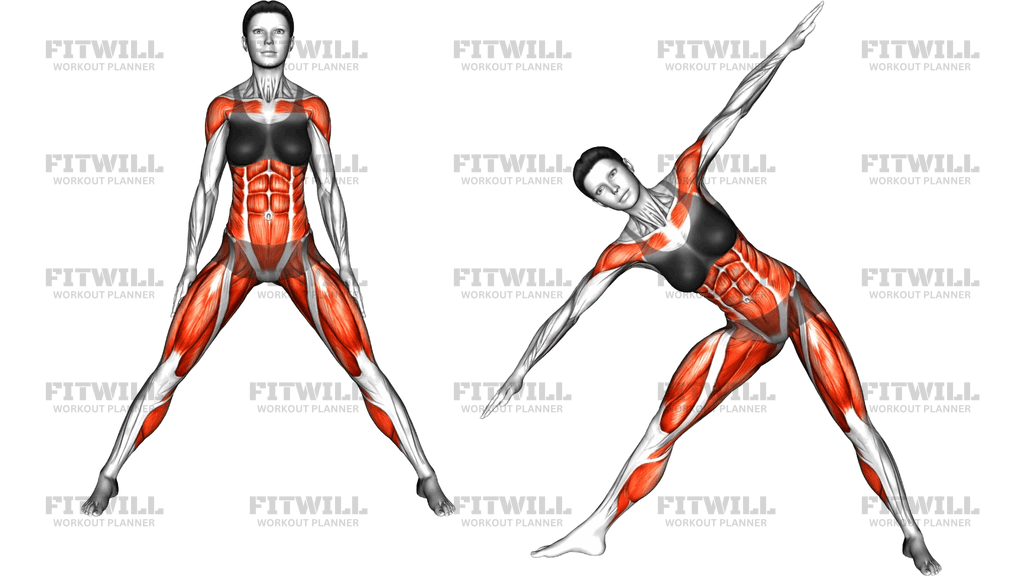
The Wide Forward Fold Twist combines a deep wide-stance hamstring stretch with a rotational reach through the upper body. You start with your feet planted far apart, hinge forward at the hips, and bring your hands toward the floor between your feet. From there, you rotate your torso and reach one arm up toward the ceiling while the opposite hand stays grounded, creating a spiral of length through the hamstrings, lower back, and the muscles along the spine.
This movement is especially useful for anyone who feels chronically tight in the backs of the legs and across the lower back. Because the twist happens while the posterior chain is already under a stretch, it reaches the hamstrings, adductors, and spinal rotators in a way that a standing or seated twist on its own does not. Runners, lifters, and people who sit for long hours often find that this position exposes asymmetries from side to side that a symmetrical forward fold hides.
Setup matters more here than in most stretches. The width of your stance determines how much the inner thighs and hamstrings are loaded, and how far your hands can reasonably reach the floor. If the feet are too close together, the fold becomes a balance struggle; too wide, and the lower back rounds excessively just to get the hands down. A stance roughly one and a half to two shoulder widths, with toes turned slightly in, gives most people a stable base to rotate from.
To execute it well, hinge from the hips rather than curling down from the waist, and let the spine lengthen before you add the twist. Ground one hand firmly, then sweep the other arm open so the shoulder stacks over the supporting hand. The rotation should come from the ribcage and upper back, not from forcing the neck or pulling with the arm. Breathe steadily and let the exhales soften you a little deeper.
You will see this drill used as a warm-up opener before lower body training, as a cool-down stretch after leg days, and as a regular mobility exercise in yoga-style routines. Two to three slow repetitions per side, holding each twist for several breaths, is enough for most people. Move within a comfortable range, avoid bouncing, and come out of the fold with a long spine rather than a rounded one.
Fitwill
Log Workouts, Track Progress & Build Strength.
Achieve more with Fitwill: explore over 9600 exercises with images and videos, access built-in and custom workouts, perfect for both gym and home sessions, and see real results.
Start your journey. Download today!




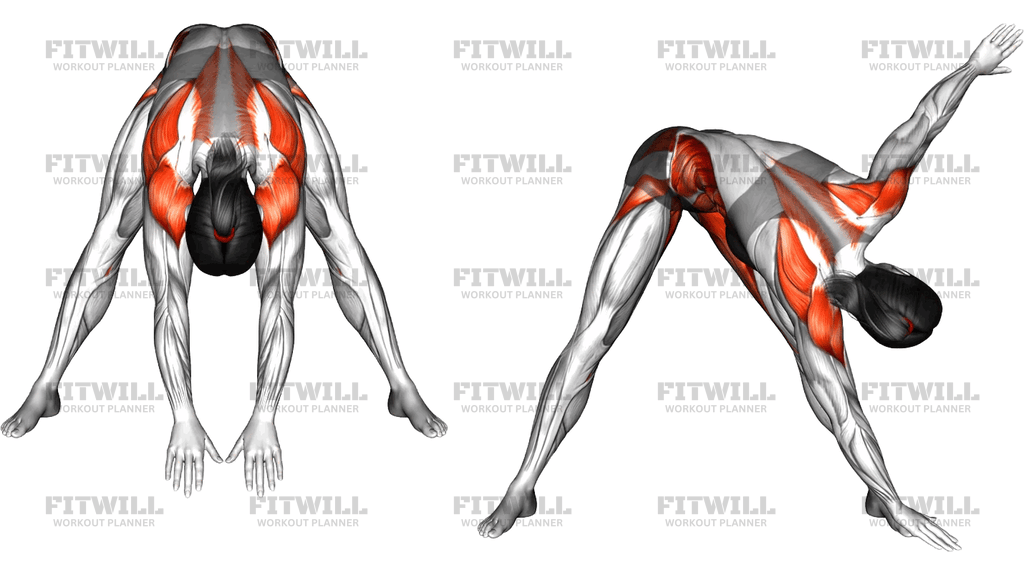
Instructions
- Stand with your feet roughly one and a half to two shoulder widths apart, toes pointing slightly inward, and your weight spread evenly across both feet.
- Rest your hands on your hips, lift your chest, and take a breath to lengthen the spine before you begin to fold.
- Hinge forward at the hips with a long, relatively flat back, lowering your hands toward the floor between your feet.
- Place your right hand on the floor or on a block directly under your face, fingertips spread for support.
- Inhale, then rotate your torso to the right as you sweep your left arm up toward the ceiling, stacking the left shoulder over the right hand.
- Let your head follow the rotation so your gaze drifts toward the raised hand, keeping the neck relaxed rather than craned.
- Hold the twisted position for 20 to 30 seconds, breathing slowly and letting each exhale release you a fraction deeper into the fold and the rotation.
- Exhale as you slowly lower the left arm back down and square your torso forward again over both legs.
- Re-ground through both feet, take one breath in the neutral wide fold, then repeat the twist to the left with the left hand supporting.
- To finish, bring both hands back down, bend your knees slightly, and roll up to standing with a long spine, one vertebra at a time.
Tips & Tricks
- If your hands cannot reach the floor without rounding your back, place them on yoga blocks or on your lower legs instead — the stretch effect on the hamstrings is the same and the lower back stays protected.
- A common mistake is twisting from the lower back while the chest stays facing the floor. Initiate the rotation from the ribcage so the upper spine does the work.
- Avoid locking the knees into a hard brace. A soft bend in the knees lets the hamstrings lengthen without overloading the back of the knee joint.
- Keep the supporting hand under the center of your face rather than out to the side; a hand planted too far forward or outward makes the twist unstable.
- Do not force the raised arm straight up if the shoulder protests. Reaching it slightly forward or back is fine — the direction of the twist matters more than the arm's angle.
- Check that both heels stay planted. Lifting a heel to go deeper shortens the stretch on one side and shifts strain into the lower back.
- Come back to a neutral wide fold between sides instead of swinging straight from one twist to the other; the reset keeps the rotation controlled.
- If your head feels heavy or dizzy, keep your gaze down at the floor for the first several sessions and skip looking up at the raised hand.
Frequently Asked Questions
What muscles does the Wide Forward Fold Twist stretch?
It primarily targets the hamstrings and inner thighs, with the fold also lengthening the calves and lower back. The twist adds stretch to the obliques and the muscles along the spine on the rotating side.
Can beginners do the Wide Forward Fold Twist safely?
Yes, as long as the range is reduced. Beginners should use yoga blocks under the supporting hand, keep a soft bend in the knees, and rotate only as far as feels comfortable through the chest.
Why should I twist in a forward fold instead of doing a normal standing twist?
With the torso already folded and the legs held long, the rotation reaches the upper back and the hamstrings together, which a standing twist with an upright torso cannot do. It also helps reveal side-to-side differences in hamstring and spinal flexibility.
How wide should my feet be for this exercise?
Aim for about one and a half to two shoulder widths, with toes turned slightly inward. You should be able to fold and place a hand on the floor without your balance shifting from foot to foot.
How long should I hold the Wide Forward Fold Twist?
Hold each side for 20 to 30 seconds, or about five to eight slow breaths, and repeat two to three times per side. Longer holds of up to a minute work well as a cool-down stretch.
My supporting hand cannot reach the floor. What should I do?
Place a yoga block, a low step, or a sturdy object under the hand so the twist can happen with a long spine. Forcing the hand down rounds the back and defeats the purpose of the stretch.
Is it normal to feel this more on one side than the other?
Yes, most people have a more flexible twist on one side, often matching their dominant rotation direction. Work each side to its own comfortable limit rather than matching the range of your looser side.
What should I avoid during the Wide Forward Fold Twist?
Avoid bouncing into the fold, pulling on the back of your legs, and forcing the neck to look up at the raised hand. Also avoid widening the fold to the point where a heel lifts off the floor.
When is the best time to use this stretch in a workout?
It works well as a warm-up opener before squats, deadlifts, or running, and equally well as a cool-down after leg training. Keep the holds shorter before a workout and longer afterward.