Inchworm Front Arm Tap
The Inchworm Front Arm Tap is a body weight movement that combines the classic inchworm walkout with an added stability challenge: once you reach the high plank position, you lift one hand at a time to tap the opposite shoulder. This turns an already demanding full-body exercise into a serious anti-rotation drill, because every tap tries to twist your hips and shoulders while your trunk has to refuse.
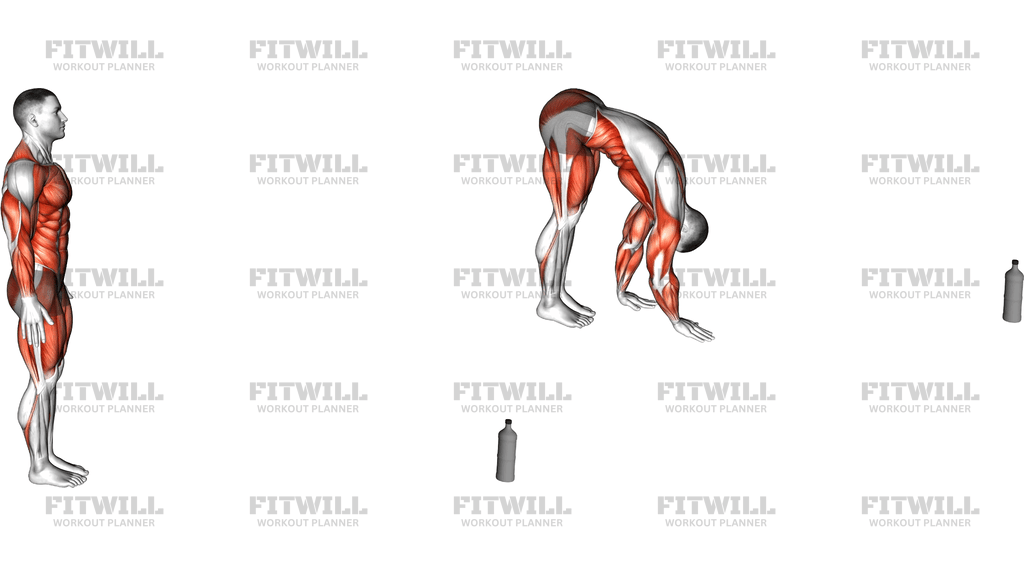
The movement starts from standing, hinges you down to the floor, walks your hands out into a plank, adds the alternating shoulder taps, then reverses the whole thing back to standing. That gives you a hamstring and lower back stretch on the way down, a shoulder and chest load in the plank, and continuous core work throughout. Because you start and finish on your feet, it also doubles as an efficient transition drill between floor-based and standing exercises.
This is a particularly good choice for anyone who wants core strength without crunches or sit-ups. It trains the abdominals, obliques, and deep trunk stabilizers the way they actually work in sport and daily life: resisting unwanted movement while your limbs move. The walkout portion also builds shoulder stability and gives tight hamstrings a gentle, active stretch, which makes it useful as both a warm-up primer and a standalone core exercise.
Setup and body position matter here more than speed. If your hips sag or pike during the plank phase, the shoulder taps lose most of their value and your lower back takes the strain instead. The goal is to keep a straight line from head to heels, feet spread roughly hip-width for a stable base, and hands planted directly under the shoulders before you start tapping.
Expect to feel this in your abs, shoulders, and the backs of your legs all at once. Most people are surprised how quickly a few slow reps with controlled taps fatigue the trunk compared with fast, sloppy reps. If balance is an issue at first, widen your feet slightly or tap more slowly; if your hamstrings won't let your hands reach the floor comfortably, bend your knees a little rather than rounding your back.
The Inchworm Front Arm Tap fits well into warm-ups, circuit training, home workouts with no equipment, and general strength programs. It requires only a small patch of floor, and a pair of markers such as water bottles can be used to set a consistent walkout distance so every rep covers the same range.
Fitwill
Log Workouts, Track Progress & Build Strength.
Achieve more with Fitwill: explore over 9600 exercises with images and videos, access built-in and custom workouts, perfect for both gym and home sessions, and see real results.
Start your journey. Download today!




Instructions
- Stand tall with your feet about hip-width apart at the top of your space, arms relaxed at your sides.
- Hinge forward at the hips and place your palms flat on the floor in front of your feet, bending your knees as much as needed to reach.
- Walk your hands forward one at a time until you are in a high plank position with your wrists directly under your shoulders and your body forming a straight line from head to heels.
- Set your feet slightly wider than hip-width if you want a steadier base before the taps begin.
- Brace your abdominal muscles as if bracing for a light push, squeeze your glutes, and keep your neck in line with your spine.
- Lift your right hand and tap your left shoulder, then place it back down under your shoulder; repeat with your left hand to your right shoulder.
- Keep your hips completely level as you tap; if your torso rotates, slow the taps down and re-brace between each one.
- Complete your target number of alternating taps, breathing steadily throughout.
- Walk your hands back toward your feet, keeping your legs as straight as your hamstrings allow.
- Roll up through your spine to return to standing, and reset your stance before the next rep.
Tips & Tricks
- The most common failure point is hip sway during the shoulder taps. Imagine a glass of water balanced on your lower back; if it would spill, slow down and tighten your glutes.
- If your lower back starts to arch when you lift a hand, widen your feet. A wider base gives your trunk less rotation to fight.
- Do not let your head drop between your arms during the plank phase; look at a spot on the floor about a foot ahead of your hands.
- Use a pair of bottles or other markers to set your walkout depth so every rep lands in the same plank position and you don't creep too far forward or back.
- Walk your hands out with small, even steps rather than two big reaches; small steps keep your shoulders loaded evenly and protect your wrists.
- If your wrists ache, press your whole palm into the floor and spread your fingers instead of sinking into the heel of the hand.
- Tight hamstrings pulling you into a rounded back on the hinge is a frequent mistake. Bend your knees more; you can straighten them gradually over weeks.
- Keep the taps slow and deliberate. Fast taps turn the exercise into a rocking motion where momentum, not your core, does the stabilizing.
- On the return walk, stop when your hands are beside your feet rather than short of them, so each rep finishes with the same hamstring stretch.
Frequently Asked Questions
What muscles does the Inchworm Front Arm Tap work?
The core is the main emphasis, especially the abdominals and obliques working to keep your hips from rotating during each shoulder tap. Your shoulders, chest, and triceps support the plank, and the hamstrings and lower back work during the hinge and walkout.
Why does the Inchworm Front Arm Tap include shoulder taps instead of just a walkout?
Lifting one hand removes half of your support, so your trunk has to resist rotation to keep you level. That anti-rotation demand trains the core in a way a plain plank walkout does not.
Is the Inchworm Front Arm Tap suitable for beginners?
Yes, with adjustments. Beginners can bend the knees generously on the way down, shorten the hand walkout, widen the feet in the plank, or perform the taps from the knees until hip control improves.
My hips twist every time I tap my shoulder. How do I fix that?
Slow each tap down, widen your feet, and squeeze your glutes before lifting the hand. You can also pause for a full breath between taps until your trunk learns to stay level.
Can I do the Inchworm Front Arm Tap if my hamstrings are tight?
Absolutely. Bend your knees as much as needed to place your palms on the floor without rounding your back, and keep them slightly soft during the return walk. Flexibility usually improves with regular practice.
How far should I walk my hands out?
Walk out until your wrists sit directly under your shoulders in a high plank. Going much farther forward shifts load into the shoulders and makes it harder to keep a straight body line during the taps.
What can I substitute for the Inchworm Front Arm Tap?
A plain inchworm walkout works if the taps are too hard, while plank shoulder taps from a fixed position work if floor space is limited. For a similar full-body pattern with more hamstring stretch, a walkout with a push-up added is a good progression.
How many reps should I do?
Start with 5 to 8 walkouts, each with 4 to 6 slow alternating taps. Since this is a control exercise, quality matters far more than speed or volume; stop when your hips start to sway or your back arches.
Is the Inchworm Front Arm Tap hard on the wrists?
It can be if you sink into the heels of your hands. Spread your fingers, press evenly through the whole palm, and shake out your wrists between sets. If discomfort persists, tap from a kneeling plank instead.
Should I breathe in a specific pattern during the movement?
Inhale as you hinge and walk out, then keep breathing steadily during the taps rather than holding your breath. Exhale as you walk back in and roll up to standing.