Wide Stance Split Lunge With Chair Support
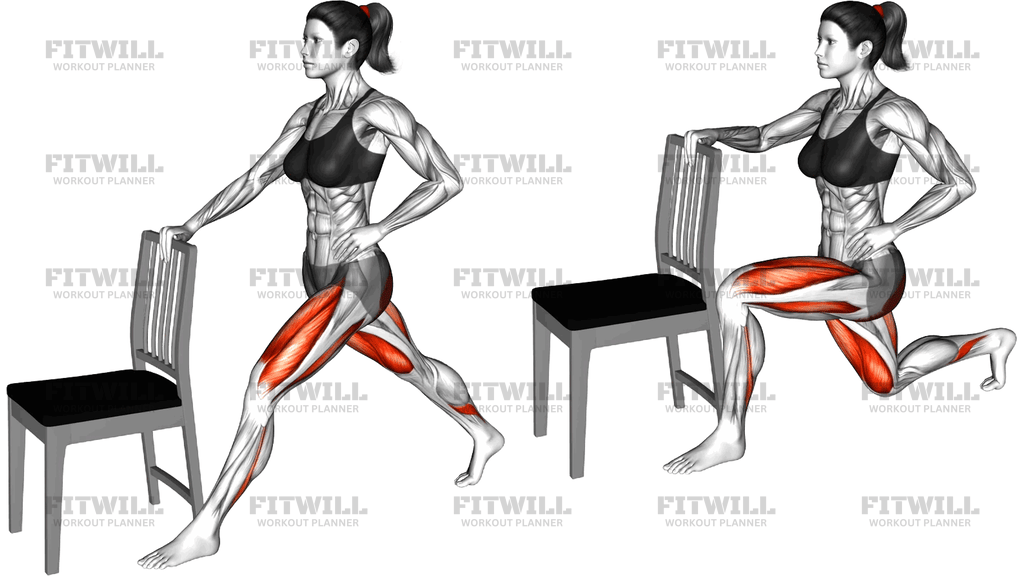
The Wide Stance Split Lunge With Chair Support is a beginner-friendly lunge variation where you place one hand on the back of a sturdy chair for balance while dropping into a long, exaggerated split stance. The chair takes over the balance demands of a normal lunge, so you can focus entirely on learning the leg positions, knee tracking, and depth without wobbling or breaking form.
The wide stance is what separates this from a standard split lunge. Your front foot travels well forward and your rear leg stretches far behind you, which lengthens the hip flexors of the back leg and places a strong stretch-load across the front thigh and glute as you lower. The main work comes from the quadriceps of the front leg, with the glutes and hamstrings assisting on the way back up and the calf of the rear foot stabilizing the trailing leg.
This version is especially useful if you are new to lunges, returning from a layoff, working on balance, or carrying extra body weight that makes unsupported lunges feel risky. It is also a good teaching tool for correcting common lunge faults, because the light hand contact gives you instant feedback when your torso drifts or your stance collapses.
To perform it well, stand sideways or slightly angled to a chair with one hand resting lightly on the chair back and the other hand on your hip. Step the leg closest to the chair far forward and the opposite leg far back, so the distance between your feet is clearly longer than a normal walking stride. Keep your torso tall and only use the chair to steady yourself, not to hold up your body weight.
From there, bend both knees and lower straight down until the front thigh is roughly parallel to the floor and the back knee hovers just above the ground. Press through the front heel to rise back to the tall split stance. Move slowly, especially on the way down, because the long stance amplifies any rushing or leaning.
Use this exercise early in a leg session as a lunge primer, or as a standalone movement when you want single-leg work without loading. Once you can complete your sets smoothly with the chair, progress by resting only your fingertips on it, and then to an unsupported lunge with the same wide stance.
[ Workout Log & Planner ]
Put your next workout in Fitwill
Keep your plan and training log ready when you are.


Instructions
- Place a sturdy chair on a non-slip floor and stand beside it so the chair back is within easy reach of one hand.
- Rest your near hand lightly on top of the chair back and place your other hand on your hip, then step your inside leg far forward and your outside leg far back to build a long split stance, both feet pointing ahead.
- Lift the rear heel so your back knee and the ball of the back foot carry the rear leg, and square your hips to face forward.
- Brace your core, pull your shoulders back, and keep your chest lifted while applying only light pressure to the chair for balance.
- Bend both knees at the same time and lower your hips straight down, letting the front knee travel over the middle of the front foot.
- Continue down until your front thigh is about parallel to the floor and your back knee is just above the ground, keeping your torso upright.
- Press firmly through the front heel and the ball of the back foot to push yourself back up to the starting split stance.
- Exhale as you lower into the lunge and inhale as you drive back up, keeping the breath steady throughout the set.
- Complete all repetitions on one leg, then step your feet together, turn around, and repeat on the other side with your opposite hand on the chair.
Tips & Tricks
- Keep your front shin close to vertical; if the knee juts well past the toes, your front step is too short for this wide stance, so move the front foot farther forward before your next rep.
- The hand on the chair should be for balance only. If you catch yourself pressing down or pulling on it to stand up, reduce your depth until your legs can do the work.
- Do not let the front knee cave inward or roll outward; aim it straight ahead over the second and third toes, which is easier to monitor with the slow tempo this supported version allows.
- Keep the back knee dropping toward the floor rather than pushing forward, which stretches the hip flexor of the rear leg instead of straining the front knee.
- If your rear-leg hip flexor feels overly tight in the long stance, shorten the split slightly at first and lengthen it gradually over the coming weeks.
- Stay tall through the spine. Leaning the torso forward over the front thigh turns the movement into a different lunge and reduces the upright quad focus this setup is built for.
- Lower for two to three counts on every rep. Dropping quickly into a deep wide split is the most common way people lose knee position in this exercise.
- Keep weight evenly spread across the front foot with a slight bias toward the heel; rocking onto the toes makes the front knee take extra stress.
- Wear shoes or use a mat if the ball of your back foot feels uncomfortable, since it stays pressed into the floor for the whole set.
Frequently Asked Questions
What muscles does the Wide Stance Split Lunge With Chair Support work?
The quadriceps of the front leg do most of the work, supported by the glutes and hamstrings as you stand back up. The rear leg also gets a stretch through the hip flexors and works through the calf of the back foot.
Is the chair meant to hold some of my body weight?
No. Rest your hand on the chair back lightly, as you would a handrail. If you are leaning on it or pushing down to rise, the depth or volume is beyond your current strength, so shorten the range.
Why is the stance so wide compared to a normal lunge?
The long split increases the stretch on the rear hip flexor and lengthens the working range for the front thigh and glute. It also slows the movement down, which makes it easier to learn clean lunge mechanics.
Can beginners do this exercise before trying regular lunges?
Yes, that is one of its main uses. The chair removes most of the balance challenge, so you can build leg strength and learn knee and hip positions before progressing to unsupported lunges.
How deep should I lower in the Wide Stance Split Lunge With Chair Support?
Aim for a front thigh roughly parallel to the floor with the back knee just above the ground. If you cannot reach that depth while staying upright, work within a shallower range and deepen gradually.
Should my back knee touch the floor?
A light hover just above the floor is the target. Touching down gently is acceptable on a soft surface, but slamming or resting the knee on the ground each rep takes tension off the legs.
What is the most common mistake with this movement?
Using the chair as a crutch and collapsing the torso forward as fatigue builds. Keep the hand contact light, the chest tall, and stop the set when your form starts to slip.
What can I use if I do not have a suitable chair?
Any stable support at hip height works, such as a railing, countertop, or the back of a bench. Avoid anything with wheels or a lightweight folding chair that could slide or give way.
How do I progress from this exercise to a regular lunge?
First reduce your hand contact to fingertips, then hover the hand just above the chair back without touching it. Once you can complete your sets with the same depth and upright torso, perform the same wide-stance lunge entirely free-standing.
Is it safe for my knees if I have had knee discomfort before?
The chair support and controlled tempo make this one of the gentler ways to load a lunge pattern, but you should still keep the range pain-free, avoid depth that provokes discomfort, and clear any plan with a qualified professional if you have a history of knee problems.