V Hold (Beginner Level)
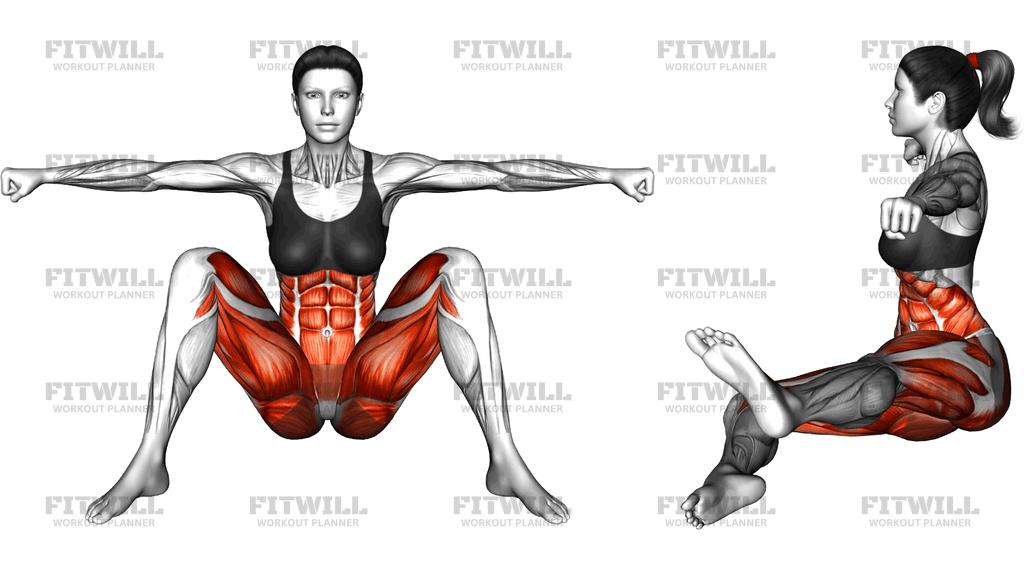
The V Hold (Beginner Level) is an isometric core exercise performed from a seated position on the floor. You balance on your sit bones, lean your torso back to roughly a 45-degree angle, and bend your knees so your feet stay in contact with the ground, forming a wide V shape from your head to your knees. Your arms reach straight forward, parallel to your thighs, and you simply hold that position while breathing steadily. Because the feet remain on the floor, this version strips away the balance and hip strength demands of the full straight-leg V-sit, making it a realistic starting point for almost anyone.
This hold is especially useful for people who can plank comfortably but still struggle to control their trunk when the hips are flexed. That covers a lot of ground: desk workers with weak deep core activation, lifters who crunch heavily but never train anti-extension under hip flexion, and anyone working toward an L-sit or full V-sit. Gymnasts, calisthenics athletes, and martial artists use bent-knee holds as a standard progression ladder, and the beginner version is the first rung.
The primary work comes from the abs, particularly the rectus abdominis, which must stay contracted to hold your torso off vertical. Just as important are the hip flexors, which hold your thighs toward your chest, and the deep core musculature that stabilizes your spine while you balance on a narrow base of contact. You will also feel your thighs and the fronts of your hips working isometrically, and your arms and shoulders contribute lightly as they hold position against gravity.
Setup matters more than most people expect. Where you place your hips, how far back you lean, and how much weight stays in your feet all change the difficulty dramatically. Sitting too far forward on your tailbone rounds the lower back and turns the hold into a strain; sitting tall on the sit bones with a long spine lets the abs do the intended work. Similarly, keeping the feet heavily planted makes the hold easy, while barely grazing the floor with your toes brings it much closer to a true V-sit.
To execute it well, think of holding a shape rather than moving through one. Lean back only as far as you can keep your spine long and your chest open, reach the arms forward with intent, and squeeze the thighs toward the torso. Hold for time, breathe in a slow, controlled rhythm, and lower back down before your position starts to decay. Shakey, shortening holds build bad habits; crisp, shorter holds build the position you actually want.
Practically, this exercise fits well at the end of a core session, as a warm-up primer before pulling or pressing days, or in short daily practice blocks for people building toward straight-leg holds. It requires no equipment beyond a bit of floor space, so it travels well. The main safety note is simple: if your lower back starts to round or you feel the work shifting into your hip crease or lower spine rather than your abdominals, come out of the hold, rest, and reset with a slightly easier version.
[ Workout Log & Planner ]
Put your next workout in Fitwill
Keep your plan and training log ready when you are.


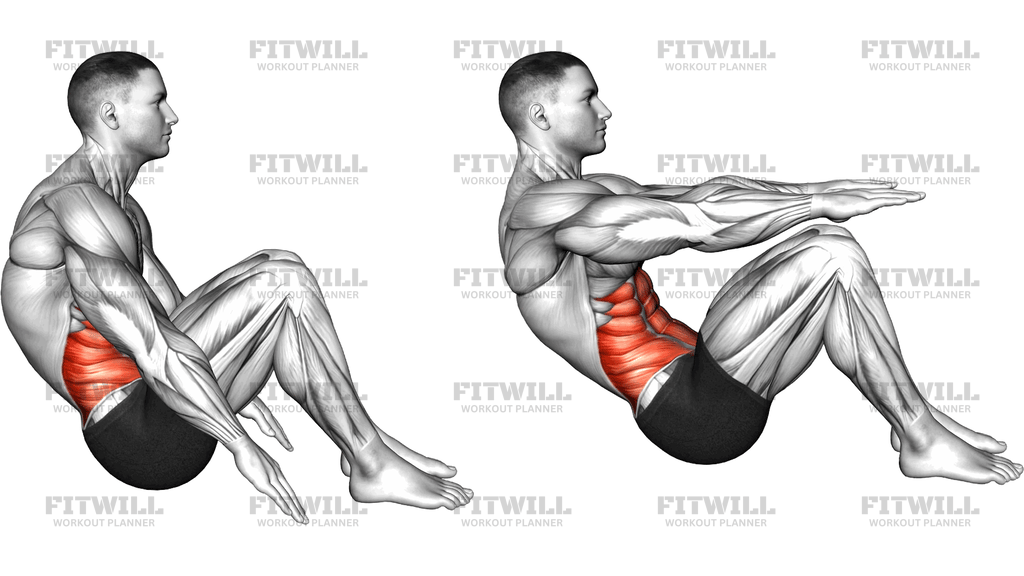
Instructions
- Sit on the floor with your knees bent and feet flat, about hip-width apart, with your hands resting lightly beside your hips to start.
- Sit up tall on your sit bones and draw your shoulders back so your spine is long before you begin to lean.
- Engage your abdominals, then lean your torso back to roughly 45 degrees from the floor, keeping your chest lifted and your lower back from collapsing into a rounded shape.
- Extend both arms straight forward so they run parallel to your thighs, palms facing down or inward, with the shoulders relaxed away from your ears.
- Press your thighs gently toward your torso and let your feet stay in light contact with the floor, bearing just enough weight to keep the position steady.
- Brace your core as if bracing for a light push, and hold this V shape without letting your chest drop or your hips roll backward.
- Breathe slowly and continuously through the hold, avoiding the instinct to hold your breath as tension builds.
- Keep your gaze forward and slightly up to help maintain the open chest position throughout the hold.
- When your form starts to slip, lower your torso back down with control, rest your hands on the floor, and shake out your hips before the next hold.
- Repeat for your planned number of sets, shortening each hold slightly if the last few seconds are noticeably messier than the first.
Tips & Tricks
- A common mistake is leaning back too far too soon; if your lower back rounds and your chest caves in, come up a few degrees and hold a taller V instead.
- If your feet keep sliding or you feel it mostly in your hip creases, you are likely hanging off your hip flexors; re-squeeze the abs and think about pulling your ribs down toward your hips.
- Count quality seconds, not total time; a firm 15-second hold with a long spine beats a 40-second hold where the shape gradually melts.
- Your arms are part of the structure, not decoration; reaching the fingers forward actively helps counterbalance the lean and keeps the shoulders from shrugging.
- If your hamstrings or hip flexors cramp, that usually means the hips are being asked to do too much; shorten the hold and reduce the lean slightly while you build tolerance.
- To make the hold harder without going to a full V-sit, press the feet lighter into the floor or straighten one leg at a time for a single-leg variation.
- To make it easier, place your hands on the floor beside your hips for support or reduce the lean until you can hold the shape cleanly, then progress gradually.
- Do not let your head jut forward to watch your legs; keep the neck in line with the spine and look straight ahead to avoid neck strain.
- Avoid slumping between reps; reset to a tall seated position before each hold so every set starts from the same good shape.
Frequently Asked Questions
What muscles does the V Hold (Beginner Level) work?
The primary muscles are the abs, especially the rectus abdominis, with strong support from the hip flexors holding the thighs toward the torso. The deep core stabilizers, thighs, and to a lesser degree the arms and shoulders also contribute isometrically.
Why are the knees bent in the beginner version of the V Hold?
Bent knees keep the feet on the floor, which shortens the lever arm of the legs and drastically reduces the demand on the hip flexors and abs. It lets you learn the torso position and the V shape before progressing to the straighter, harder variations.
How long should I hold the V Hold (Beginner Level)?
Start with holds of 10 to 20 seconds where you can keep your chest open and spine long the entire time, and complete 3 to 5 sets. As the position feels solid, lengthen the hold toward 30 to 45 seconds or progress toward straighter legs.
Is it normal to feel this more in the front of my hips than in my abs?
It is common early on, because the hip flexors are working hard to hold the thighs up. If it stays dominant, reduce your backward lean, squeeze your ribs down toward your hips, and shorten the holds so the abdominals do a fair share of the work.
What is the most common mistake in this exercise?
Rounding the lower back and sinking into the tailbone as fatigue sets in. This shifts stress away from the abs and toward the spine, so end the hold as soon as your chest starts to drop or your lower back curls.
Do I need any equipment for the V Hold (Beginner Level)?
No, the exercise is done with body weight on the floor. An exercise mat or a patch of carpet is enough to make sitting on your sit bones comfortable.
How do I progress from the V Hold (Beginner Level)?
Once you can hold a clean bent-knee position for 30 to 45 seconds, straighten one leg at a time, then move to both legs slightly bent with the feet lifted, and eventually toward a full straight-leg V-sit. Each step lengthens the leg lever and increases the load on the abs and hip flexors.
What can I do if balancing on my sit bones feels uncomfortable or unstable?
Sit on an exercise mat for cushioning and place your fingertips lightly on the floor beside your hips for a bit of extra support. As your balance improves, lift the fingers away so only your hips and feet contact the ground.
Is the V Hold (Beginner Level) safe for people with lower back sensitivity?
Because it is an isometric hold with the feet supported, it is generally spine-friendly when the torso stays tall and the lean is moderate. If you have a history of back issues, start with a very slight lean and stop any set where your lower back rounds or discomfort appears.