Low Lunge To Hamstring Stretch (Advanced)
Low Lunge To Hamstring Stretch (Advanced) is a flowing body weight movement that moves you from a deep low lunge with the arms reaching overhead into a straight-leg forward fold over the front leg. It blends two of the most useful lower-body stretches into one continuous sequence: the lunge opens the hip flexors of the back leg while the forward fold lengthens the hamstrings and calves of the front leg. Because you flow between the two shapes rather than holding them separately, the transition itself also demands balance, hip control, and core support.
This sequence is especially valuable for anyone who spends long hours sitting, since tight hip flexors and shortened hamstrings are the classic pairing that comes from a chair-bound day. It is equally useful as a warm-up before lower-body training, as a cool-down after running or cycling, and as a standalone mobility session for the hips and posterior chain. The advanced label comes from the transition: moving smoothly between a deep lunge and a standing forward fold over a straight front leg requires a level of flexibility and single-leg control that beginners usually need to build up to.
The setup matters because the position of the feet determines everything that follows. A long stance gives the back hip flexors a real stretch in the lunge, while the front leg must be able to straighten fully for the hamstring portion to work. If the stance is too short, the forward fold turns into a back-rounded slump; if it is too long, the front heel tends to lift and the hips cannot settle into the lunge. Taking a moment to place the feet deliberately pays off in both positions.
To execute the movement well, lower into the low lunge with the back knee resting on or hovering just above the floor, then sweep the arms overhead and lift the chest slightly. From there, shift the weight back over the front leg, straighten the front knee, and fold the torso down toward the extended leg, letting the hands travel toward the floor or the shin. Move with the breath: rise and open on an inhale, fold on an exhale. The return path is the same in reverse, stepping the torso back up and over the front thigh before repeating on the other side.
One practical coaching point worth emphasizing: the goal is a long spine, not a low head. In the forward fold, hinge from the hip and lead with the chest rather than rounding through the lower back to force the hands to the floor. In the lunge, keep the front knee tracking over the ankle and the pelvis slightly tucked so the stretch lands on the hip flexor instead of straining the lower back. Done with that attention, this flow gives you a complete front-and-back-of-the-hip stretch in a single, repeatable movement that you can practice anywhere with no equipment.
Fitwill
Log Workouts, Track Progress & Build Strength.
Achieve more with Fitwill: explore over 9600 exercises with images and videos, access built-in and custom workouts, perfect for both gym and home sessions, and see real results.
Start your journey. Download today!




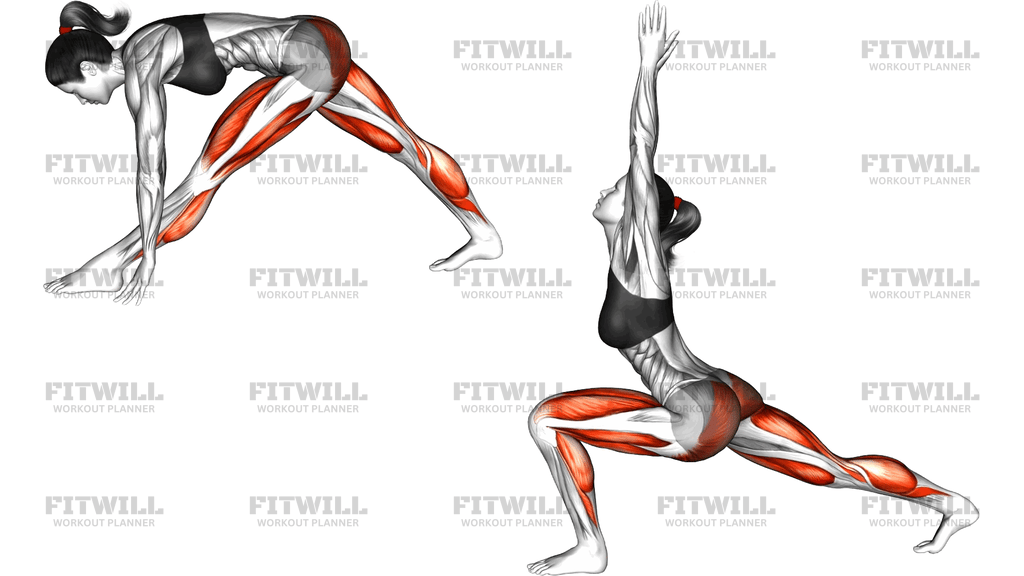
Instructions
- Start in a split stance with the front foot flat and the back knee lowered to or hovering just above the floor, roughly hip-width apart so the hips can drop straight down.
- Set the front shin close to vertical, knee stacked over the ankle, and press the top of the back foot into the floor to stabilize the back leg.
- Brace the trunk lightly, tuck the pelvis slightly, then reach both arms straight overhead and lift the chest to settle into the low lunge, feeling the stretch across the front of the back hip.
- On an exhale, shift your weight back over the front leg and press through the front heel as you begin to straighten the front knee.
- Hinge forward from the hips, keeping the back long, and fold the torso down over the straightened front leg, letting the hands reach toward the floor, shin, or ankle.
- Relax the head and neck in the fold and breathe steadily, letting the hamstrings and calf of the front leg lengthen with each exhale.
- To reverse, press into the front foot, bend the front knee, and sweep the torso back up and slightly forward as the arms rise overhead, returning to the low lunge.
- Inhale as you rise and open the chest, exhale as you fold — sync each transition with the breath rather than rushing between positions.
- Complete the desired number of slow repetitions on one side, then bring the back foot forward and switch legs, repeating the entire flow on the other side.
Tips & Tricks
- If your hands cannot reach the floor in the fold, rest them on the shin or a pair of yoga blocks — rounding the back just to touch down defeats the hamstring stretch.
- Watch for the front heel lifting as you fold; if it comes up, shorten the stance slightly or bend the knee a touch, because a lifted heel shifts the stretch off the hamstring.
- Keep the back knee soft and controlled rather than dropping it hard to the floor — the lunge position should be held by the legs, not caught by the kneecap.
- In the lunge, if you feel the stretch in the lower back instead of the front of the back hip, tuck the tailbone more and draw the back hip forward.
- Move slower than feels necessary; the value of this flow is in the controlled transition, and speeding up turns it into a balance test instead of a stretch.
- Keep weight distributed across the whole front foot rather than dumping into the heel or the toes when you fold, which keeps the ankle and knee aligned.
- If your balance wobbles during the shift from lunge to fold, place your fingertips lightly on the floor or shin earlier in the transition to steady yourself.
- Warm the legs first with a few minutes of light movement, since deep hamstring stretching on cold muscles tends to produce gripping rather than lengthening.
Frequently Asked Questions
What muscles does Low Lunge To Hamstring Stretch (Advanced) target?
The front-leg hamstrings and calf are stretched in the forward fold, while the back-leg hip flexors and quadriceps open in the low lunge. The glutes and core work to control the transition between the two positions.
Why is this version labeled Advanced compared to a regular low lunge stretch?
The advanced element is the flowing transition into a forward fold over a straight front leg, which requires more hamstring flexibility and single-leg balance than holding a static lunge. Beginners can work up to it by keeping the front knee slightly bent.
Can beginners practice Low Lunge To Hamstring Stretch (Advanced)?
Yes, with modifications: keep the front knee bent during the fold, rest the hands on the shin or blocks, and move slowly. Once the hamstrings allow a straighter knee with a flat back, progress toward the full version.
Should my hands touch the floor in the forward fold?
No — the depth of the fold is not the goal. Reaching the shin, ankle, or blocks with a long, hinged spine stretches the hamstrings more effectively than rounding the back to plant the palms.
How long should I hold each position in the flow?
Pause for one or two full breaths in the lunge and one or two in the fold, moving between them on the exhale. For a deeper release, hold the fold for three to five slow breaths.
Is it a mistake to round the lower back when folding over the front leg?
Yes, that is the most common fault. Rounding shifts the stretch into the spine and away from the hamstrings, so hinge from the hips and lead with the chest, accepting a shallower fold with a flatter back.
What can I use instead of Low Lunge To Hamstring Stretch (Advanced) if the transition is too hard?
Practice the two positions separately: a supported low lunge stretch for the hip flexors and a standing or seated forward fold for the hamstrings. Combine them into the flow once both feel comfortable.
Can I do this stretch every day?
Gentle daily practice is generally fine since it uses only body weight and moderate holds. Ease off if you notice persistent soreness in the hamstring attachments or the front of the hip.
When is the best time to use this flow in a workout?
It works well as a warm-up with shorter, moving repetitions and as a cool-down with longer holds. After heavy leg training, keep the holds brief and avoid pushing to end-range while the muscles are fatigued.
Should the back knee rest on the floor during the lunge?
Either is acceptable — resting the knee makes the position more stable and forgiving, while hovering it adds balance and leg strength demand. If your knee is sensitive to pressure, hover it or pad the floor.