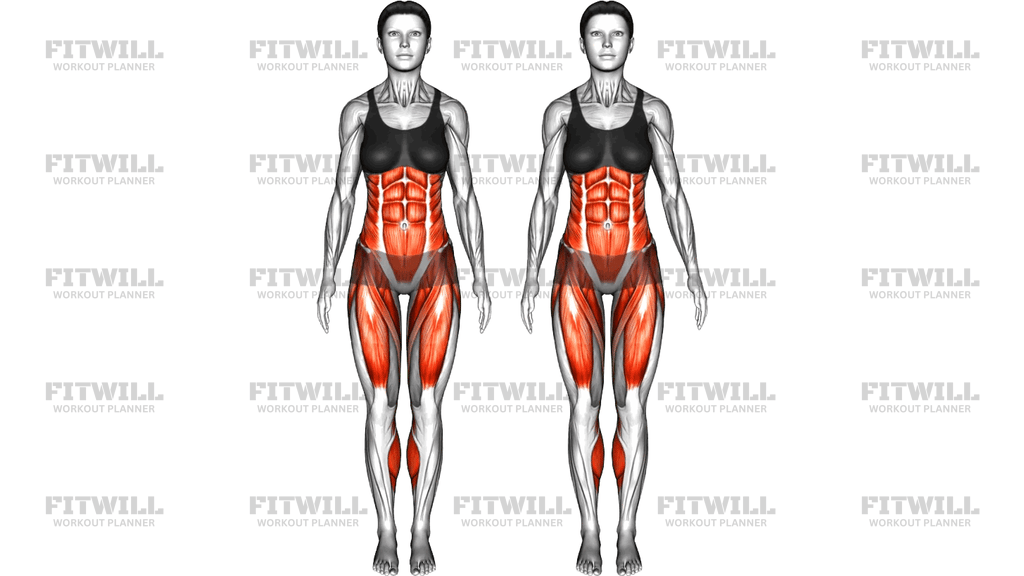
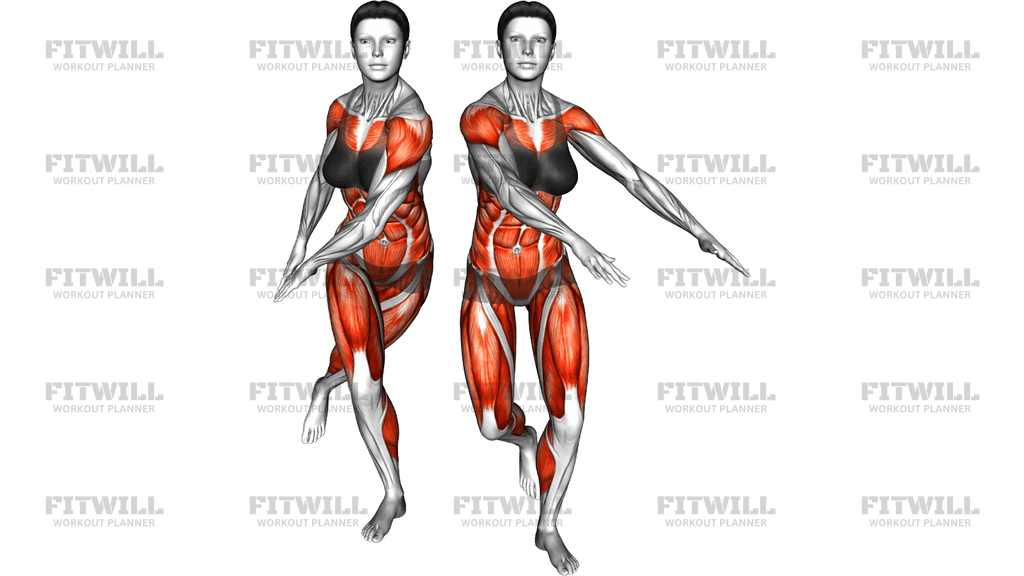
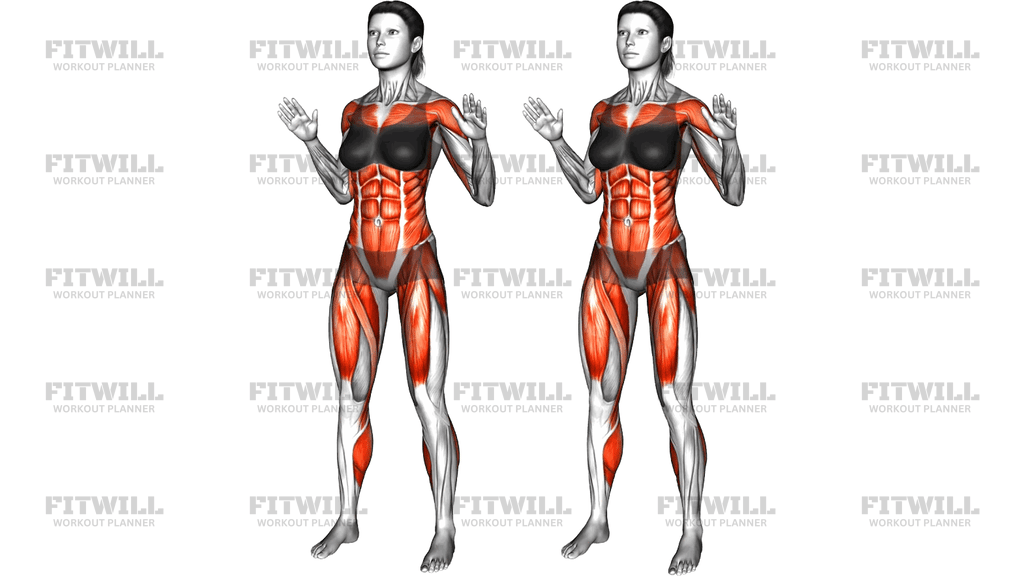
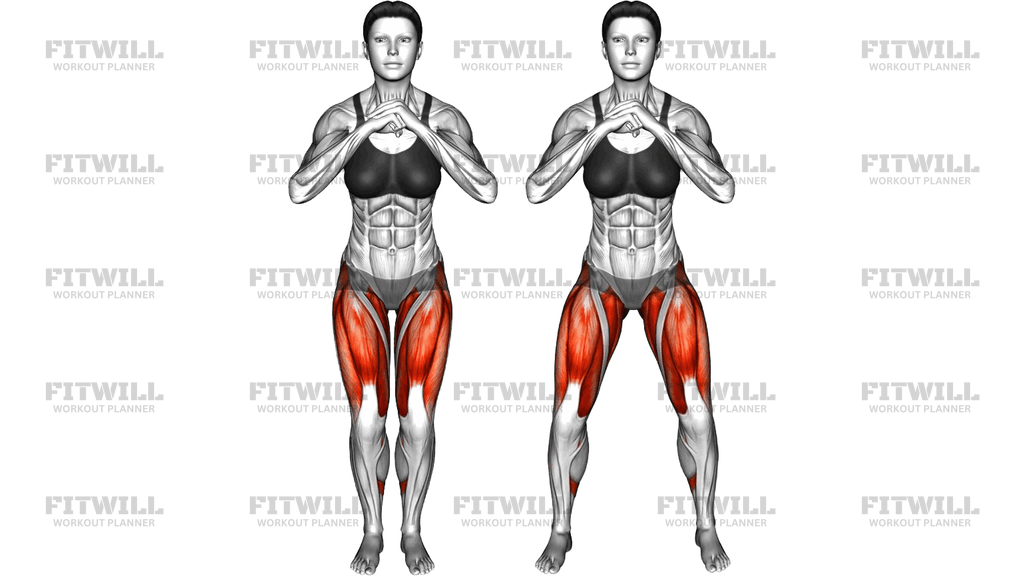
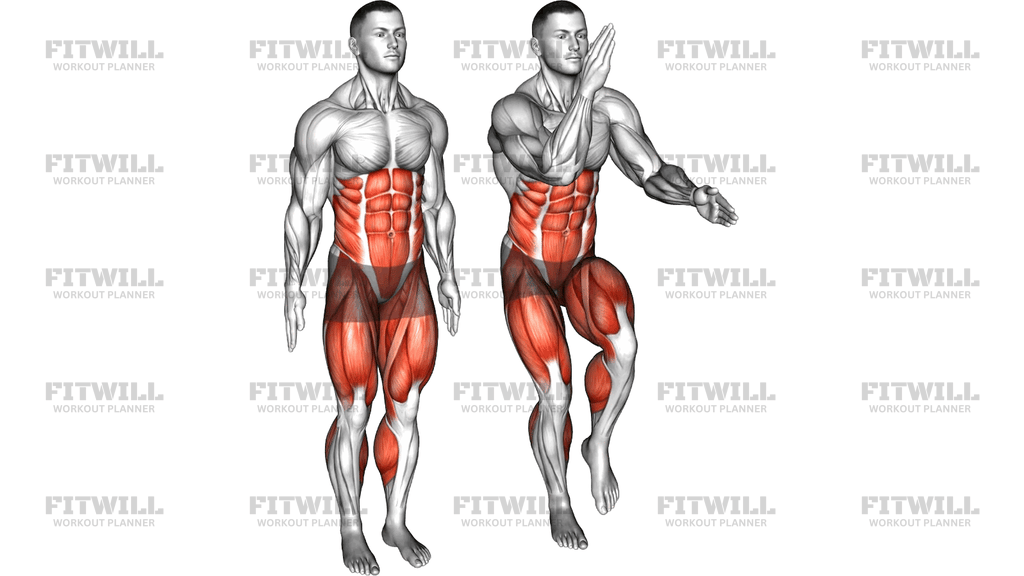
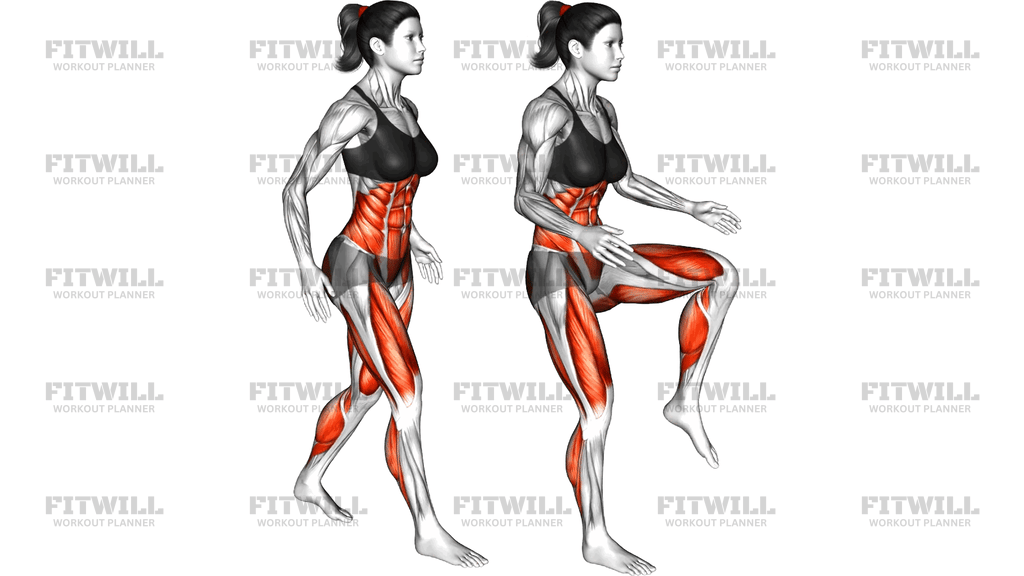
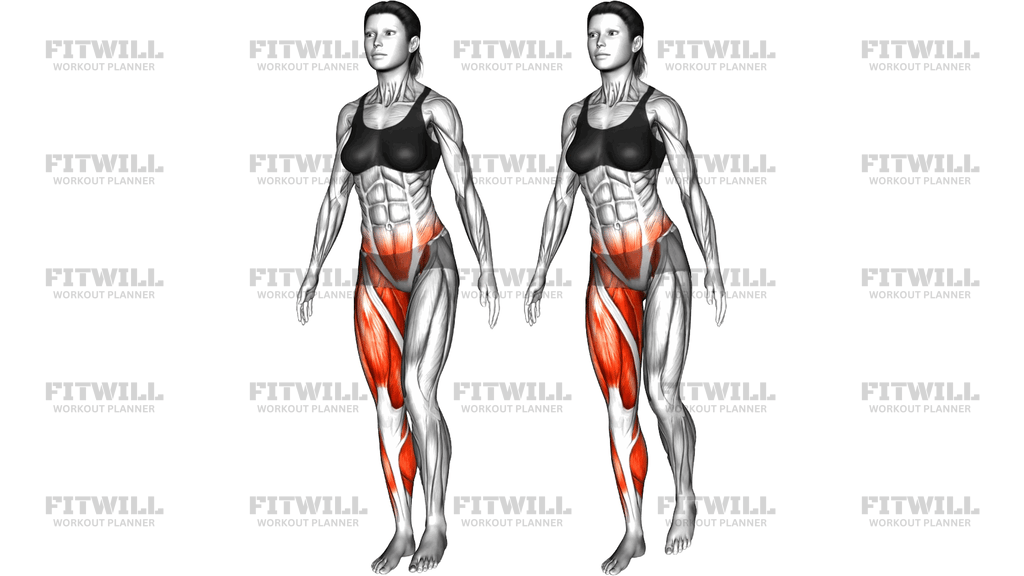
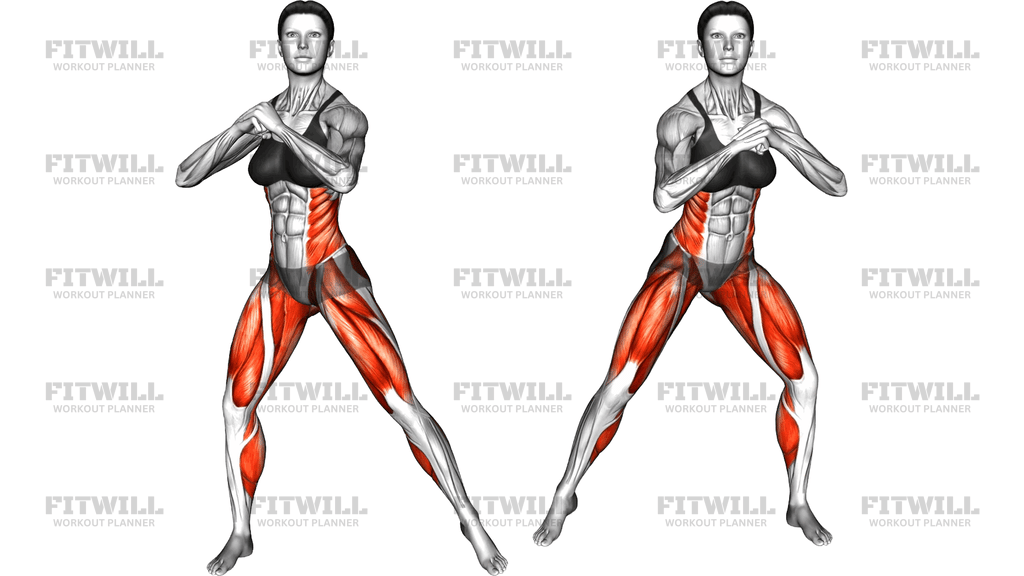
Front Step Half Circle Draw
The Front Step Half Circle Draw is a standing bodyweight movement that combines a controlled forward step with a sweeping half-circle arc of both arms in front of the body. You begin with the arms extended straight out to the sides at shoulder height, step one foot forward, and as the foot lands, both arms trace a smooth半 circular path across the front of your chest before reversing the arc as you step back. It reads as a simple pattern on paper, but coordinating the lower and upper body in one continuous flow makes it surprisingly demanding.
This movement is useful for anyone working on balance, coordination, and clean movement mechanics rather than maximal strength. Because you load one leg at a time while the arms travel across the midline, the front leg's quads and the hip stabilizers on the standing side work to keep you level, while the shoulders and upper back control the arm sweep. The inner thighs also stay active as the legs handle a staggered stance and return to parallel.
The setup matters more than it looks like it would. Standing tall with the arms genuinely at shoulder height sets the arc at the right level; if the arms drift forward or droop, the half circle flattens and the shoulders take over in a poor position. Similarly, the forward step should be long enough to feel weight shift into the front leg but not so long that your stance becomes a strained lunge you cannot smoothly reverse.
To execute it well, think of the arms and the stepping leg as one timed unit: the foot lands as the hands begin to draw, and the hands finish their arc only when the front foot is fully settled. Move slowly enough that you could pause at any point without wobbling. The trunk can rotate a few degrees toward the direction of the sweep, but the hips stay facing forward and the spine stays long.
You will see this style of movement in warm-ups, mobility and balance circuits, older-adult training, mind-body practice, and rehab-style programming where rhythm and cross-body coordination are the goal. It also works well between heavier lower body exercises as an active reset that keeps the hips and shoulders moving.
For safety, keep the working knee tracking over the foot and never let it cave inward as you draw the arms across. If balance is a challenge, shorten the step and slow the arc before adding range. Stop and shorten your stance if you feel pinching at the front of the shoulder or the hip during the sweep.
Fitwill
Log Workouts, Track Progress & Build Strength.
Achieve more with Fitwill: explore over 9600 exercises with images and videos, access built-in and custom workouts, perfect for both gym and home sessions, and see real results.
Start your journey. Download today!




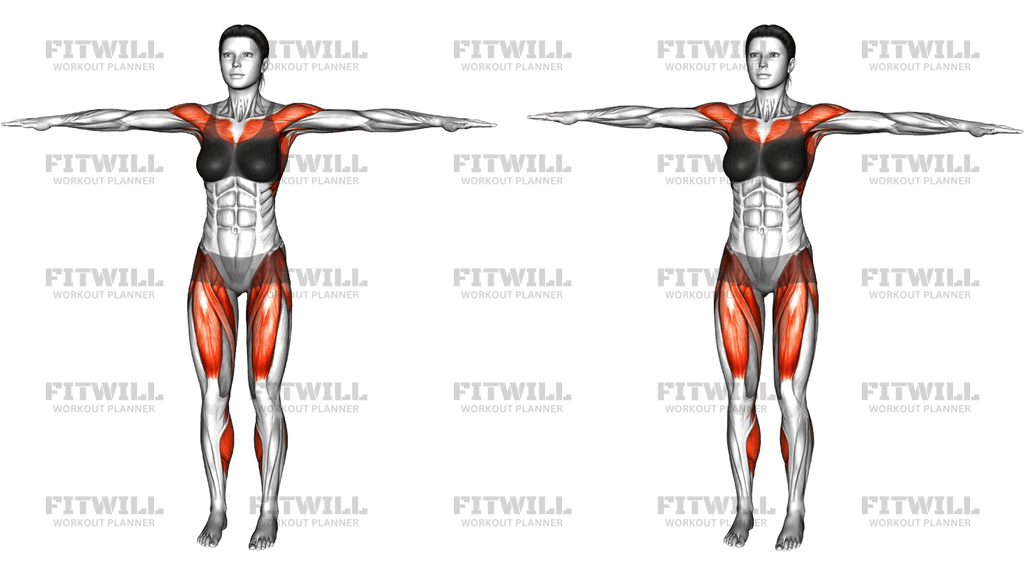
Instructions
- Stand tall with your feet hip-width apart and raise both arms straight out to your sides at shoulder height, elbows soft and palms facing forward or down.
- Draw your shoulder blades gently down your back, brace your core lightly, and fix your gaze on a point ahead at eye level.
- Shift your weight onto your right leg and step your left foot forward a comfortable stride length, placing the foot flat while keeping your torso upright.
- As the left foot lands, begin sweeping both arms forward and across your chest in a smooth half circle, traveling from your right side toward your left.
- Keep the arms nearly straight with the shoulders relaxed and down, letting the arc pass at chest to shoulder height while the trunk turns only a few degrees.
- Finish the arc with both hands reaching toward your left side as the front foot bears your weight, hips level and front knee stacked over the foot.
- Reverse the sweep, drawing the arms back through the half circle to the starting position out to the sides as you step the left foot back beside the right.
- Inhale as you step and begin the draw, and exhale steadily as the arms complete the arc and return.
- Repeat the same step-and-draw pattern leading with the right foot, then continue alternating sides for your target number of repetitions.
Tips & Tricks
- If your arms drop below shoulder height during the arc, the draw loses its shape and the shoulders round forward — cue yourself to sweep at chest level and slightly widen the arc at the ends.
- A common mistake is stepping too narrow, so the feet land almost on one line and balance gets difficult; imagine two parallel tracks a few inches apart instead of a tightrope.
- Do not lock the front knee when the foot lands. Keep a soft bend so the quads control the weight shift instead of the joint hanging on the bone.
- Watch for the hips swiveling with the arm sweep. A small trunk turn is fine, but the hips should stay mostly forward or the half circle becomes a full-body twist.
- If you wobble when the foot lands, pause with the foot flat for a beat before starting the arm draw. Timing the sweep with the landing gets easier once the stance feels stable.
- Keep the sweep continuous rather than segmented. Jerky, stop-start arm motion usually means the shoulders are shrugging — reset the shoulder blades down and slow the tempo.
- Shorten the step if your back heel cannot stay down or the front knee drifts inward. Range in the arc can grow later; stance quality comes first.
- On soft or uneven flooring, expect more ankle and hip work. That is fine, but reduce your speed until the surface feels predictable under the stepping foot.
Frequently Asked Questions
Which muscles does the Front Step Half Circle Draw work the most?
The quads and hip stabilizers of the stepping and standing legs do most of the work, with the adductors helping control the staggered stance. The front shoulders and upper back guide the arm arc, and the core keeps the trunk steady through the sweep.
How big should the forward step be in the Front Step Half Circle Draw?
Step roughly the length of a natural walking stride, long enough that you feel your weight shift into the front foot but short enough to reverse the step smoothly without lunging or losing balance.
Is the Front Step Half Circle Draw suitable for beginners?
Yes, because it uses only body weight and a small range of motion. Beginners should start with a shorter step and a slower arc, and can stand near a wall for light balance support until the pattern feels steady.
How high should my arms be during the half circle draw?
Start with the arms extended straight out to the sides at shoulder height and keep the arc traveling through chest to shoulder level in front of you. Letting the arms droop turns the movement into a low, rounded sweep that strains the shoulders.
Should my torso rotate while the arms draw the half circle?
Allow a few degrees of trunk rotation toward the direction of the sweep so the movement stays fluid, but keep the hips facing forward. If your whole body pivots with the arms, tighten the core and reduce the arc size.
What is the most common mistake in this exercise?
Rushing the timing so the arms sweep before the front foot has settled, which throws off balance. Land the foot first, then begin the draw, and gradually blend the two actions into one smooth motion as control improves.
How does the Front Step Half Circle Draw differ from a lateral raise?
A lateral raise isolates the shoulders with a fixed torso, while this movement ties the arm arc to a forward step and weight shift, so the legs, hips, and core share the workload and the pattern trains coordination rather than a single muscle.
What can I use as a substitute if balance is difficult?
Perform the same half circle arm draw while stepping in place or standing with both feet planted, then reintroduce the forward step once the arm path feels automatic. Holding a light support with one hand is another good regression.
Is it safe to do this movement if my knees are sensitive?
Generally yes, since the step is unloaded and shallow, but keep the front knee bent softly and tracking over the foot, and reduce the step length if you feel any discomfort. Check with a professional if you have a recent knee injury.
How many repetitions should I aim for?
Start with 6 to 10 alternating steps per side, focusing on smooth timing and an even arc. It works well for one to three rounds as a warm-up or as a balance block at the start of a session.