Seated Stick Pass Around Stretch
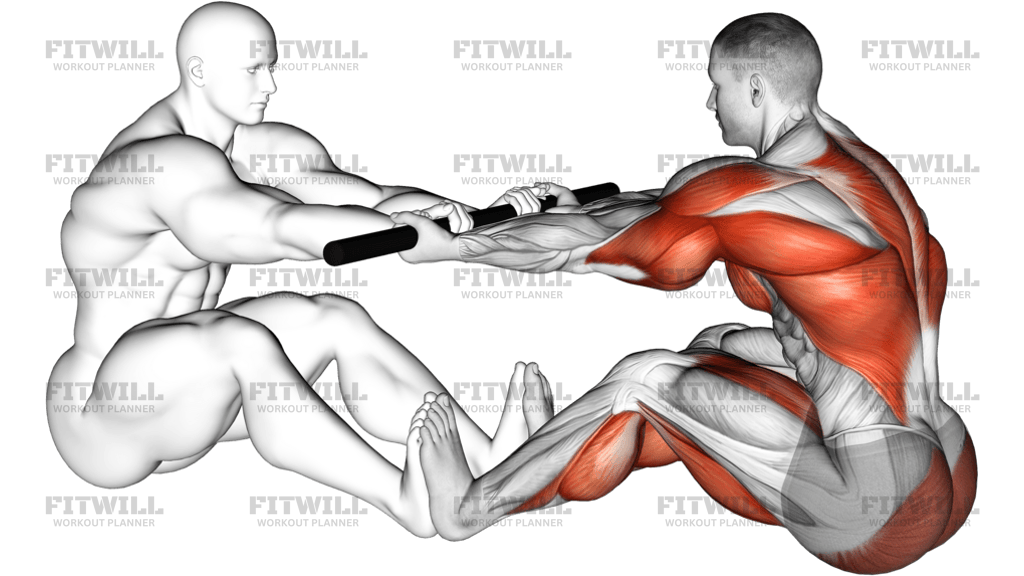
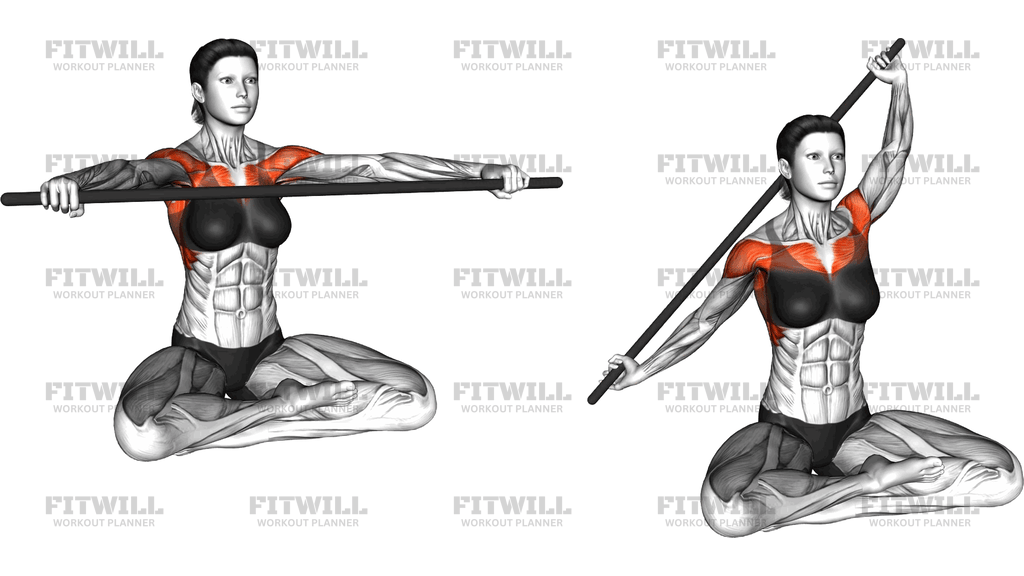
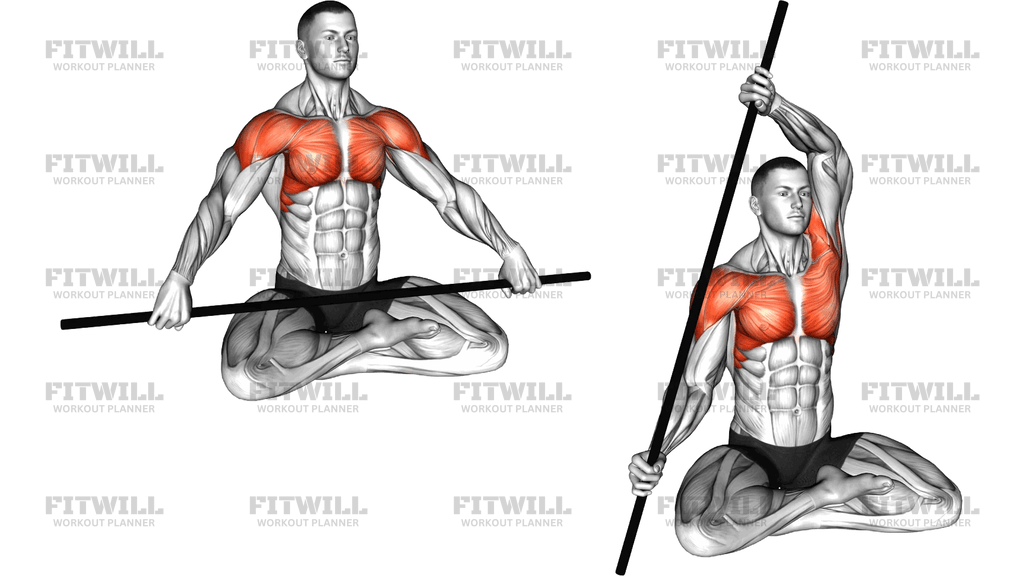
The Seated Stick Pass Around Stretch is a mobility drill that targets the chest and front of the shoulders by moving a stick in a wide arc from the front of your body up and over one shoulder, around behind you, and back to the start. You perform it sitting cross-legged on the floor, which pins your hips and removes any temptation to lean or swing your torso to fake extra range. The stick acts as a fixed-width spacer between your hands, so the stretch happens at your actual shoulder mobility limit rather than wherever you could cheat it to.
This movement is especially useful for anyone whose shoulders roll forward from long hours at a desk, driving, or pressing work in the gym. When the pecs and anterior deltoids get short and tight, overhead reaching and external rotation feel sticky and restricted. Sweeping the stick up and around forces the chest to lengthen while the shoulder travels through a large rotational arc, which is exactly the combination that desk-bound bodies usually lack.
Setup matters more here than in most stretches. A wide grip on the stick keeps the arc gentle; a narrow grip makes the same path dramatically harder on the shoulder joint. Sitting cross-legged with a tall spine keeps your ribcage from flaring and your lower back from arching to compensate when the stick reaches the awkward point behind your shoulder. If your torso starts twisting or your spine buckles, the stretch leaks out of the chest and into your lower back.
To execute it well, hold the stick with an overhand grip slightly wider than shoulder width, arms extended in front of your thighs. Keep both arms relatively straight as you lift the stick up in front of you and guide it over one shoulder, letting it travel down behind your upper back. Then reverse the same arc to bring it back to the front, and repeat on the other side. The hand on the side you are passing over naturally travels higher and bends a little; that is normal, as long as the movement feels like a smooth sweep rather than a crank.
A common use case is as a warm-up before pressing, pulling, or throwing, or as a stand-alone mobility break during the workday. Two to three passes per side per set works well, moving slowly enough that you can feel exactly where the range gets tight. You can also use it as a self-test: over weeks of consistent practice, a grip you can gradually narrow while keeping the same smooth arc is a clear sign your shoulder mobility is improving.
Keep the effort level honest. This is a stretch, not a stretch-your-shoulder-off-the-table contest. Mild tension across the chest and front shoulder is the goal; pinching, sharp pain, or numbness down the arm means the grip is too narrow or you are forcing the arc. Widen your hands, slow down, and let the range grow over sessions instead of within one.
[ Workout Log & Planner ]
Put your next workout in Fitwill
Keep your plan and training log ready when you are.


Instructions
- Sit on the floor with your legs crossed comfortably and your spine tall, resting your sit bones evenly on the ground.
- Hold a stick with an overhand grip about one and a half to two shoulder widths apart, arms extended straight down in front of your thighs.
- Brace your core lightly and pull your ribcage down so your torso stays upright and square to the front.
- Keeping both arms nearly straight, raise the stick up in front of your body toward the ceiling.
- Guide the stick up and over one shoulder, letting it sweep down behind your upper back in a smooth arc.
- Pause briefly at the tightest point behind the shoulder, feeling the stretch across your chest and the front of the shoulder on that side.
- Reverse the same arc to bring the stick back up over the shoulder and down to the starting position in front of your thighs.
- Repeat the pass on the opposite side, continuing to alternate for the desired number of repetitions.
- Breathe steadily throughout, exhaling as the stick travels over the shoulder and inhaling as it returns to the front.
- When finished, set the stick down on the floor beside you and shake out your shoulders before standing.
Tips & Tricks
- Start with a very wide grip, even if it feels easy; narrowing your hands too early is the most common way people turn this into a shoulder joint crank instead of a chest stretch.
- If your torso twists as the stick passes over the shoulder, imagine your chest facing a mirror in front of you the whole time and reduce the arc size until you can keep it square.
- Keep the ribs from flaring upward as the stick goes overhead; if your lower back arches, exhale and gently draw the ribs down before continuing the arc.
- The hand on the same side as the shoulder you are passing over can bend slightly at the elbow near the top of the arc, but the opposite arm should stay extended to keep the stick at a consistent width.
- Move the stick at the speed of a slow wave, not a swing; momentum hides exactly the range of motion you are trying to expose.
- If sitting cross-legged bothers your knees or hips, sit on a low cushion or perform the same stick pass while seated on the edge of a bench with feet flat.
- Expect one side to be noticeably tighter, usually your dominant side; do equal reps on both sides rather than chasing the stiffer side with extra volume.
- A little daily soreness in the chest after starting this drill is normal, but any pinching at the front of the shoulder joint means widen the grip and shorten the arc.
- Track progress by grip width: once a given width feels smooth for ten passes per side, bring your hands in by a few centimeters the next week.
Frequently Asked Questions
What does the Seated Stick Pass Around Stretch mainly stretch?
It primarily stretches the pectoral muscles across the chest, with additional lengthening through the front of the shoulders as the stick sweeps over and behind the shoulder joint.
How wide should my grip be on the stick?
Start about one and a half to two shoulder widths apart so the arc stays comfortable. Narrow the grip gradually over weeks as your shoulder mobility improves, never to the point of pinching.
Can beginners do the Seated Stick Pass Around Stretch?
Yes, it is very beginner friendly as long as the grip stays wide and the arc stays small. The seated cross-legged position also makes it easier to control than standing versions where you can sway.
Why do I have to sit cross-legged instead of standing?
Sitting fixes your hips and stops you from rotating your torso or leaning to fake extra range, so the stretch stays in the chest and shoulders where it belongs.
Is it normal for one shoulder to feel much tighter than the other?
Yes, most people have a side difference, often from carrying bags, sleeping positions, or sport. Perform the same controlled number of passes on both sides and let the tighter side catch up over time.
What should I do if the stick gets stuck behind my shoulder?
Do not force it through. Widen your grip, reduce how far you let the stick travel behind you, and rebuild the arc gradually as the front of the shoulder loosens.
Can I use anything other than a stick?
A broom handle, PVC pipe, or even a rolled towel held taut works fine. The key is a rigid or taut object of consistent length that sets the distance between your hands.
When is the best time to use this stretch?
It works well as a warm-up before upper body training and as a midday mobility break if you sit at a desk. Avoid doing it aggressively right before heavy pressing if your shoulders feel irritable that day.
Is any pain during the Seated Stick Pass Around Stretch acceptable?
Mild stretching tension across the chest is expected, but sharp pain, pinching at the front of the shoulder, or tingling down the arm are signals to stop, widen your grip, and shrink the range.