Seated Stick Pass Around Stretch
The Seated Stick Pass Around Stretch is a mobility drill where you sit cross-legged on the floor, hold a stick or lightweight bar with a wide overhand grip, and pass the stick around your body in a large arc — from in front of your chest, up and over your head, and down behind your back, then reverse it back to the front. The wide grip and long lever of the stick guide your shoulders through a full circular range while your torso stays upright and still, which is what makes it effective as a stretch rather than just an arm swing.
This movement primarily targets the shoulder joint and the muscles that cross it, including the deltoids, pectorals, and upper back. Because the stick forces both arms to travel together through a fixed arc, it also lengthens the triceps and the tissues around the shoulder capsule in positions that everyday movement rarely reaches. The seated cross-legged position matters: it removes your legs from the equation, encourages a tall spine, and stops you from compensating by arching your lower back or twisting your torso to fake extra range.
It is especially useful for anyone whose shoulders feel tight from desk work, pressing exercises like bench presses and push-ups, or sports that demand overhead reach such as swimming, throwing, and volleyball. Lifters often use it as a warm-up before upper-body sessions, and it works equally well as a cooldown to restore range after heavy pressing or pulling days.
Execution is simple but detail-sensitive. Take a grip wide enough that the pass feels smooth rather than forced, keep your ribs stacked over your pelvis, and let the stick — not momentum — determine the path. The wider your hands, the easier the arc; as mobility improves, you can gradually bring your grip inward to deepen the stretch.
Keep the movement slow and controlled, and never push into sharp pain, pinching, or grinding at the shoulder. If one side feels noticeably tighter, that asymmetry is useful feedback — spend a little more time on the restricted side, but keep both arms working together rather than turning it into a one-arm drill.
[ Workout Log & Planner ]
Put your next workout in Fitwill
Keep your plan and training log ready when you are.


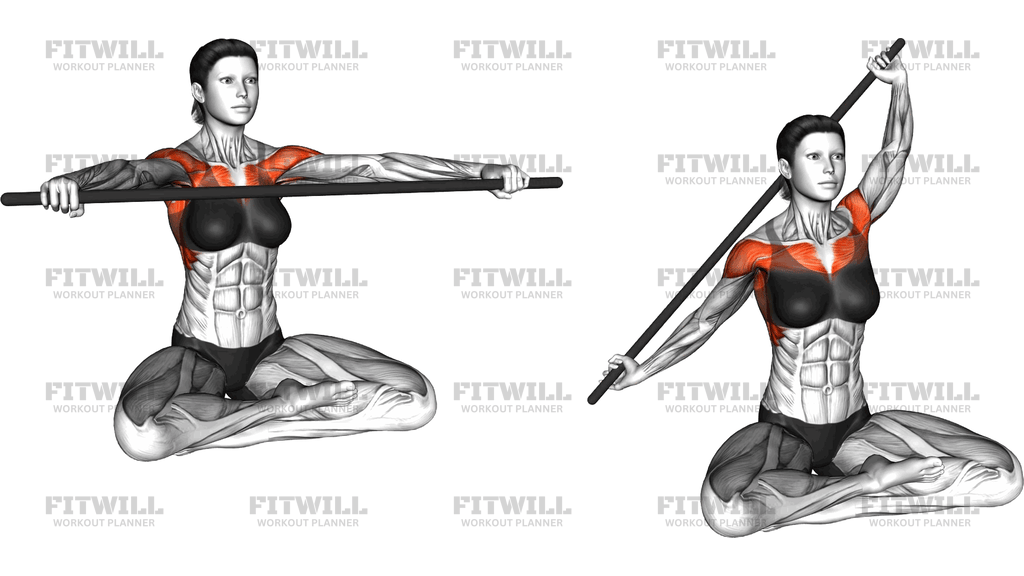
Instructions
- Sit on the floor in a cross-legged position with your sit bones grounded and your spine tall, or sit on a folded mat or low cushion if your hips are tight.
- Hold a stick with an overhand grip, hands set much wider than shoulder width, and raise it to chest height in front of you with your arms nearly straight.
- Brace your core lightly and pull your ribs down so your torso stays upright and does not arch backward during the pass.
- Keeping both arms long, sweep the stick up and over your head in a smooth arc, letting your elbows bend only as much as needed.
- Continue the arc behind your head and down toward your lower back until the stick rests against or near your backside, feeling the stretch across your chest and the front of your shoulders.
- Pause briefly at the back position, then reverse the same path, bringing the stick up over your head and back down to the front of your chest.
- Breathe steadily throughout, exhaling as the stick passes the tightest point of the arc.
- Complete 8-10 full passes, then, if you like, switch the leading direction so the opposite arm initiates the arc.
- Reset your posture between reps if you feel yourself slumping or leaning, and keep your legs relaxed so your hips stay quiet.
- On your final pass, hold the stick at the tightest point of the arc for 10-15 seconds to finish with a static stretch.
Tips & Tricks
- Start with a very wide grip — wider than you think you need. Too narrow a grip is the most common mistake and turns a smooth arc into a strained, jamming motion at the shoulder.
- If the stick cannot reach behind your head without your elbows flaring sharply, widen your hands rather than forcing the pass; range can be narrowed gradually over weeks.
- Watch for rib flare as the stick travels overhead — if your chest lifts and your lower back arches, exhale and re-brace before the next rep.
- Do not let your head jut forward chasing the stick; keep your neck long and let the arms do the traveling around you.
- Keep the stick level as it passes. If one end drops, one shoulder is dodging the stretch — slow down and even out the arc.
- Sit on a small cushion if your cross-legged position collapses; a stable, upright base matters more than achieving the floor seat itself.
- Move at the pace of your breath rather than counting speed — roughly one full pass per two breaths keeps it a stretch instead of a swing.
- If you feel pinching at the front of one shoulder, lower the arc slightly and pass the stick with slightly bent elbows before extending again.
- Treat this as a warm-up drill before pressing or overhead work, not a strength exercise — the stick should stay light.
Frequently Asked Questions
What muscles does the Seated Stick Pass Around Stretch target?
It primarily stretches the shoulders, especially the front of the shoulder joint, along with the chest muscles that get lengthened as the stick passes behind you. The upper back and triceps assist and benefit as well.
How wide should my grip be on the stick?
Start roughly one and a half to two shoulder widths apart. If the stick cannot travel behind your head smoothly, widen your hands; as your shoulder mobility improves, you can narrow the grip over time.
Can beginners do the Seated Stick Pass Around Stretch?
Yes — it is very beginner-friendly because the stick acts as a guide and the wide grip makes the arc manageable. A broomstick, PVC pipe, or even a rolled towel held taut all work as a substitute.
Why do it seated cross-legged instead of standing?
Sitting removes your legs and hips from the movement, which makes it harder to cheat with torso lean or lower-back arching. It keeps the focus on pure shoulder range while encouraging an upright spine.
My stick gets stuck behind my head — what am I doing wrong?
Your grip is most likely too narrow, or you are bending your elbows too much and letting the stick drop behind your neck. Widen your hands and think of drawing a large circle around your body rather than hooking the stick behind your neck.
Is it normal for one side to feel tighter than the other?
Mild asymmetry is common, especially if you favor one arm in sport or training. Keep both arms working together, but slow down on the tighter side and give it a few extra controlled passes.
Should I feel this in my lower back?
No — if you feel strain in your lower back, your ribs are flaring and your spine is arching to compensate for limited shoulder range. Pull your ribs down, brace lightly, and reduce the arc until the movement comes only from your shoulders.
When is the best time to use this stretch?
It works well as a dynamic warm-up before bench presses, overhead presses, or any throwing and swimming activity. It is also useful as a cooldown to restore shoulder range after heavy upper-body sessions.
Is the Seated Stick Pass Around Stretch safe for cranky shoulders?
It can be, as long as you use a wide grip, move slowly, and stay short of any pinching or sharp pain. If you have a current shoulder injury or a history of dislocation, check with a qualified professional before adding it to your routine.
How many reps and sets should I do?
Eight to ten smooth passes in each direction for one to two rounds is plenty. The goal is quality of the arc, not fatigue — stop as soon as the motion stops feeling smooth.