Dynamic Bird Dog
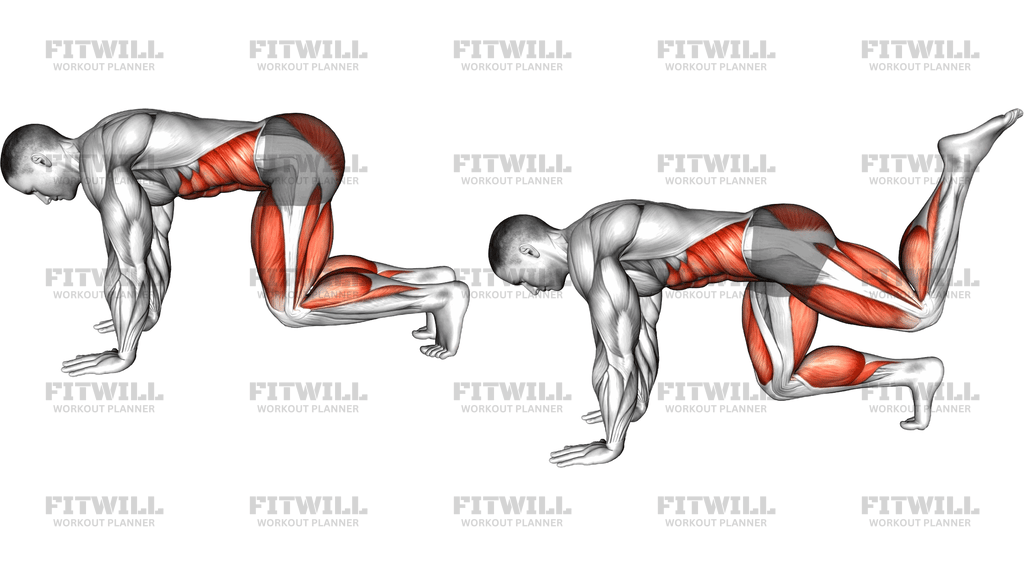
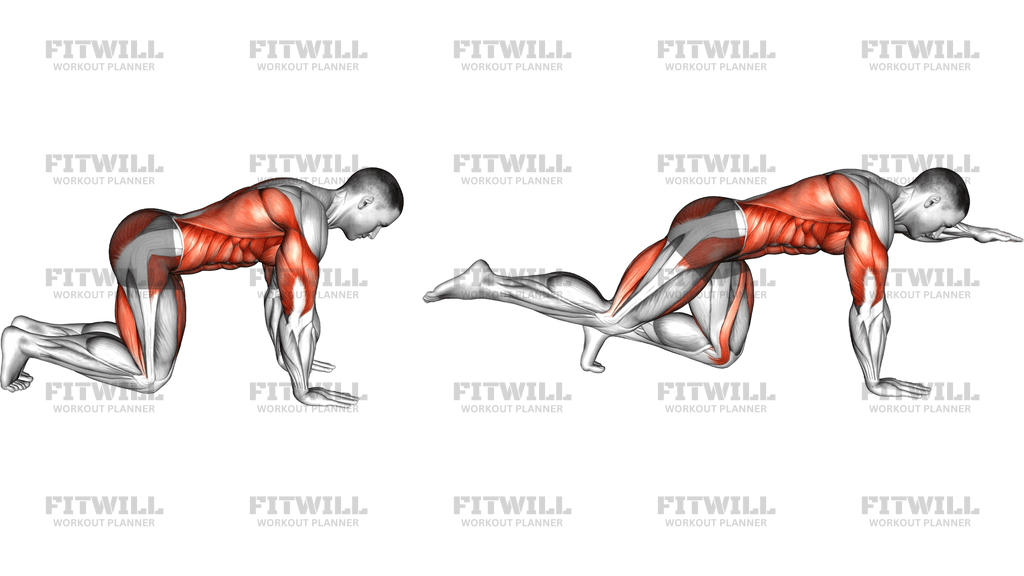
The Dynamic Bird Dog is the flowing version of the classic quadruped stability drill. Instead of extending your opposite arm and leg and holding the position, you move through the range with control on every rep: reach the arm and leg out, then draw them back in under your body, repeating for continuous, deliberate repetitions. The two frames of the movement show the full arc — from an all-fours kneeling position to a long diagonal line from fingertips to heel.
This exercise is a go-to for building anti-rotation and anti-extension control through the trunk. The deep core and lower back musculature work to keep your torso level while a limb leaves the ground on each side, and the glute of the lifted leg drives the extension behind you. The supporting arm and shoulder also work isometrically to keep you stable over one side, which makes this surprisingly demanding even though no equipment is involved.
It suits a wide range of people. Beginners use it to learn how to brace and move the limbs without the hips tipping, desk workers use it to wake up the lower back and glutes after long sitting, and lifters and athletes use it as a warm-up or accessory drill before squats, deadlifts, and running sessions. Because it is low-load and joint-friendly, it is also a common rebuild step for people returning to training who need to re-establish trunk coordination before heavier core work.
Setup matters more than speed here. Your hands sit directly under your shoulders, knees under your hips, with the spine neutral — not sagging and not rounded. If your starting position is off, every rep reinforces a compensation. Move with intention: reach long rather than high, keep the hips square to the floor, and avoid letting the lower back arch when the leg lifts.
Execution should feel like lengthening the body in two directions. The arm goes forward at shoulder height, the leg goes back at hip height, and the torso stays level, as if balancing a glass of water on your lower back. On the return, bring the elbow and knee toward each other under the torso without letting your spine round or your hips shift, then extend again. That in-and-out rhythm is what makes this the dynamic version rather than a held pose.
A few practical points keep it safe and effective. Use a smooth, even tempo — roughly two seconds out, two seconds in — and stop the set when your balance or torso control breaks down rather than when you run out of strength. If your wrists or knees are sensitive, a cushioned surface and spreading the fingers wide will help distribute pressure.
Fitwill
Log Workouts, Track Progress & Build Strength.
Achieve more with Fitwill: explore over 9600 exercises with images and videos, access built-in and custom workouts, perfect for both gym and home sessions, and see real results.
Start your journey. Download today!




Instructions
- Kneel on all fours on a mat or clear floor space, placing your hands directly under your shoulders and your knees directly under your hips.
- Set your spine in a neutral position: eyes down at the floor, back flat, and ribs stacked over the pelvis. Brace your trunk lightly as if bracing for a light push.
- Shift your weight slightly so you feel stable over one hand and one knee before you move.
- Exhale and reach your right arm straight forward to shoulder height while extending your left leg straight back to hip height, thumb toward the ceiling or palm facing in, foot flexed.
- At the end position, form one long diagonal line from fingertips to heel, with hips level and facing the floor — avoid letting the lifted hip open up or the lower back arch.
- Pause briefly at full extension, then inhale and draw the elbow and knee in toward each other under your torso, rounding slightly through the mid-back without collapsing.
- Extend back out to the long diagonal position with the same control, completing the in-and-out rhythm for your target reps on this side.
- Switch sides, extending the left arm and right leg, and match the tempo and range you used on the first side.
- Keep breathing throughout — exhale on the reach, inhale on the tuck — and reset your brace between sides if your torso drifts.
Tips & Tricks
- Reach before you lift: lengthening the arm and leg out (not up) keeps the hips square and stops the lower back from compensating with an arch.
- The most common mistake is the hips rotating open as the leg extends. Fix it by consciously pressing the opposite supporting knee and hand down into the floor.
- If your torso dips toward the extended side, lighten the effort — reach only as far as you can keep both hips level — and rebuild range gradually.
- Rushing the tuck is a frequent fault. The elbow-to-knee draw should be controlled; if you are flinging the limbs, cut your rep speed in half.
- Keep the neck neutral by looking at the floor between your hands rather than craning up toward the extended arm.
- Spread your fingers wide and grip the floor lightly with the supporting hand to reduce wrist pressure and improve balance.
- If your knees ache on a hard surface, kneel on a mat or fold a towel under them — the position itself should not change.
- Squeeze the glute of the extended leg at full reach instead of relying on lower back extension to raise the leg.
- Stop the set when you can no longer keep the hips level; a wobbly last rep trains the wobble, not the stability.
Frequently Asked Questions
What muscles does the Dynamic Bird Dog work?
It primarily trains the core and lower back stabilizers, especially the deep trunk muscles and the erector spinae, with the glutes driving the leg extension. The supporting shoulder and arm work isometrically to hold you steady.
How is the Dynamic Bird Dog different from the standard Bird Dog?
The standard version holds the extended arm-and-leg position for several seconds per rep, while the dynamic version moves continuously between full extension and an elbow-to-knee tuck. The repeated transitions make it more of a controlled movement drill than a static hold.
Is the Dynamic Bird Dog good for beginners?
Yes, it is one of the best beginner core drills because the load is low and the feedback is immediate — if your hips rotate or your back arches, you feel it right away. Start with a smaller reach and only extend as far as you can keep your torso level.
Should my lifted leg go higher than my hips?
No. The leg should extend straight back roughly level with your hips; lifting it higher usually comes from arching the lower back instead of glute activation. Reach long, not high.
Why do my hips rotate during the Dynamic Bird Dog?
Rotation usually means the trunk is not braced or the reach is too ambitious for current control. Press the supporting hand and knee firmly into the floor, and imagine balancing a cup of water on your lower back as the limbs move.
How many reps and sets should I do?
Six to ten controlled in-and-out repetitions per side for two to three rounds is a solid starting point. Prioritize smooth tempo and a level torso over total reps.
Can I do the Dynamic Bird Dog if my wrists hurt?
Yes — spread your fingers wide, shift weight slightly toward the heel of the palm, or make fists and support on your forearms instead. If knee pressure is the issue rather than the wrists, kneel on a folded mat or towel.
When is the best time to use this exercise in a workout?
It works well as a warm-up drill before lower body or lifting sessions, and it also fits as a low-fatigue core finisher. Either way, do it while you are fresh enough to keep the torso perfectly level.
What can I substitute if the Dynamic Bird Dog is too hard?
Do the standard held Bird Dog first, extending only one limb at a time — arm alone, then leg alone — before combining them. Once you can hold a level torso with both limbs out, progress back to the dynamic version.
Is the Dynamic Bird Dog safe for people with lower back issues?
It is generally a gentle, low-load drill, but form is critical: a neutral spine, no forced leg height, and no pain during the movement. If you have a diagnosed back condition or feel sharp pain, get clearance from a qualified professional before adding it to your routine.