Lying Alternate Back Raise
The Lying Alternate Back Raise is a prone body weight exercise performed face down on the floor with the arms extended overhead. Instead of lifting the whole torso at once, you raise one side of your upper body at a time — lifting one arm and the chest on that same side off the floor while the other arm and shoulder stay anchored down. You then switch sides in a slow, alternating rhythm, which makes it a gentle but focused way to train the muscles that extend and stabilize the spine.
The main work comes from the erector spinae running along the lower and mid back, with strong support from the mid traps, rhomboids, and rear shoulders as the raised arm reaches long overhead. Because only one side lifts at a time, the obliques and deep core also work to keep your hips and torso square to the floor, which is something a standard two-arm superman does not demand to the same degree.
This is a low-load movement, so it suits people building foundational back strength, those spending long hours seated who want to wake up the posterior chain, and lifters who want a controlled warm-up before heavier pulling or hinging work. It is also a common choice in general conditioning circuits because it needs no equipment beyond a floor or mat and carries a low technical barrier.
Setup matters more than it might seem. Lying flat with your legs together, arms stretched overhead, and forehead or nose facing the floor sets a long, neutral spine position. If your hips twist or your neck cranes upward, the lift stops being a back exercise and starts loading joints it was never meant to stress. Keep the movement small and precise: a few centimeters of lift with a deliberate squeeze at the top beats a big, jerky arch every time.
To execute it well, think about reaching rather than lifting. As one arm extends forward and up, imagine lengthening your body from fingertips to opposite toes. The chest peels off the floor because the back muscles contract, not because you throw the shoulder upward. Hold the top briefly, lower with control, and only then begin the lift on the other side. Breathing should stay smooth — exhale as you lift, inhale as you lower.
The most common mistakes are rushing the alternation, lifting too high and hyperextending the lower back, and pressing the free hand into the floor for leverage. Treat this as an endurance and control exercise rather than a power move: moderate reps, short pauses, and strict hips will give you far more benefit than chasing height or speed.
[ Workout Log & Planner ]
Put your next workout in Fitwill
Keep your plan and training log ready when you are.


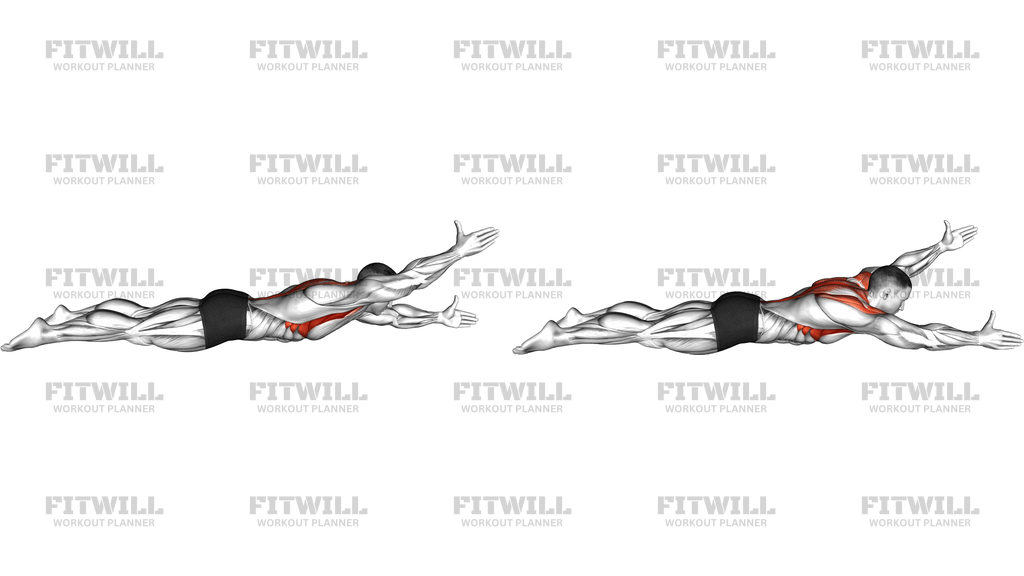
Instructions
- Lie face down on an exercise mat or the floor with your legs straight and together, toes pointing down.
- Extend both arms straight overhead so they form a long line with your body, palms facing each other or the floor.
- Rest your forehead lightly toward the floor and relax your neck so you are looking down, not forward.
- Brace your abdominals gently and squeeze your glutes to set your pelvis in a neutral position before moving.
- Exhale and lift your right arm and the right side of your chest off the floor, reaching forward and up as one unit while your left arm and both legs stay down.
- Pause for one to two seconds at the top, feeling the contraction along the right side of your lower and mid back.
- Lower the right side back to the floor under control, without letting your shoulders slump or your hips shift.
- Repeat the lift on the left side, keeping your hips square to the floor throughout the switch.
- Continue alternating sides for your target number of reps, inhaling on the lower and exhaling on each lift.
- When finished, bring both arms down to your sides and gently press back into a child's pose or hip hinge stretch to reset.
Tips & Tricks
- Reach long before you lift high — extending through the fingertips naturally recruits the back muscles and keeps the range honest.
- If your hips rock side to side as you switch, widen your feet slightly or slow the transition between sides until you can keep the pelvis still.
- Do not press the resting hand hard into the floor for leverage; let it hover or rest lightly so the lifting side does the real work.
- Keep your neck in line with your spine by leaving your forehead close to the floor — looking up turns the lift into a neck extension.
- A small lift is enough. If your ribs flare and your lower back pinches at the top, you have gone past the range your spine can control.
- Squeeze the glutes lightly on both sides the entire set; this locks the pelvis and prevents the lower back from over-arching.
- If your shoulders feel pinchy with the arms fully overhead, lower them to a Y or T position — the back muscles still work, with less stress on the shoulder.
- Breathe continuously rather than holding your breath at the top; the pause should come from muscle tension, not breath-holding.
- Tempo matters more than reps here — try a one-second lift, two-second hold, and two-second lower to keep the back muscles under tension without momentum.
Frequently Asked Questions
Which muscles does the Lying Alternate Back Raise target?
The primary mover is the erector spinae along the lower and mid back. The mid traps, rhomboids, and rear shoulders assist as the raised arm reaches overhead, and the glutes and obliques stabilize the pelvis and torso.
How is the Lying Alternate Back Raise different from a standard Superman?
A Superman lifts both arms and the whole torso together, while this version raises one side at a time. The alternating pattern adds a rotational stability demand, so your hips and core work harder to stay square.
Should I lift the opposite leg while raising the arm?
As shown here, the legs stay on the floor and only the arm and chest lift. Adding the opposite leg is a valid progression once you can keep your hips completely still during the arm-only version.
How high should I lift my chest during the Lying Alternate Back Raise?
Only a few centimeters — just enough for the hand and shoulder on the lifting side to clear the floor. Lifting higher usually means over-arching the lower back rather than working the back muscles better.
Is this exercise suitable for beginners?
Yes, it is a low-load body weight movement that is easy to scale. Beginners should start with 8-10 slow reps per side and focus on keeping the hips and neck quiet before adding reps or holds.
Why do my hips twist when I switch sides?
Twisting usually means the alternation is too fast or the glutes are not engaged. Squeeze both glutes lightly, slow the switch, and imagine pressing the top of the resting thigh into the floor as the other side lifts.
What can I use instead of the Lying Alternate Back Raise?
A standard Superman works the same muscles with both sides together, while a bird dog trains a similar alternating pattern from a quadruped position. Reverse flyes or back extensions cover the upper and lower back from different angles.
How many reps and sets should I do?
Because this is an endurance-focused movement, 2-3 sets of 10-15 alternating reps with short top pauses works well. It fits nicely as a warm-up before deadlifts or rows, or as a finisher on back days.
Can I do the Lying Alternate Back Raise if my lower back feels tight after sitting?
Many people use it as a gentle activation drill for exactly that reason. Keep the range small and pain-free, and if any sharp or radiating discomfort appears, stop and choose a lower-demand position such as a quadruped bird dog.
Where should my arms be during the movement?
Both arms start extended straight overhead in line with your body, and the lifting side reaches forward and up while the other stays resting on the floor. If overhead reaching bothers your shoulders, bring the arms into a Y or T shape instead.