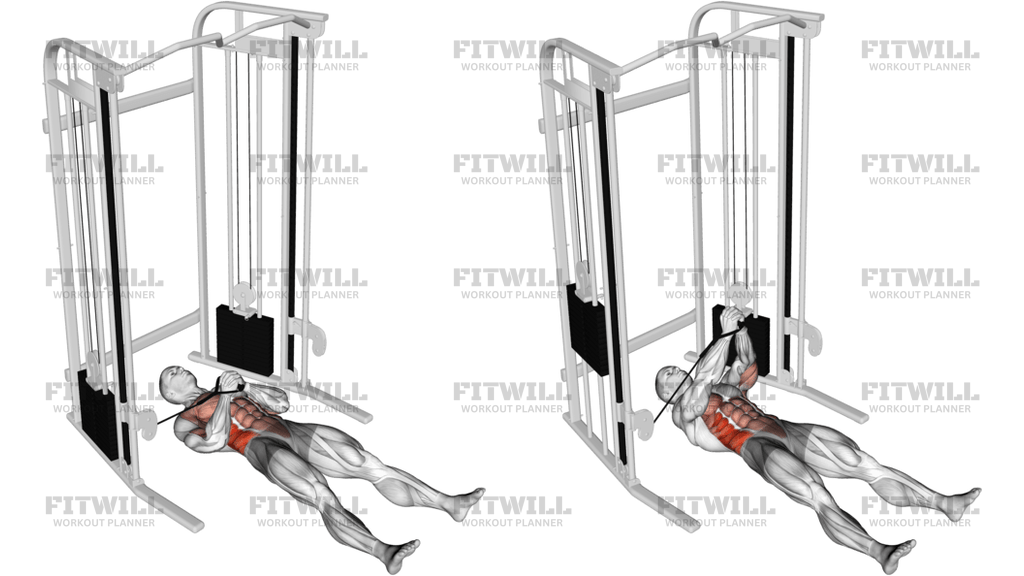
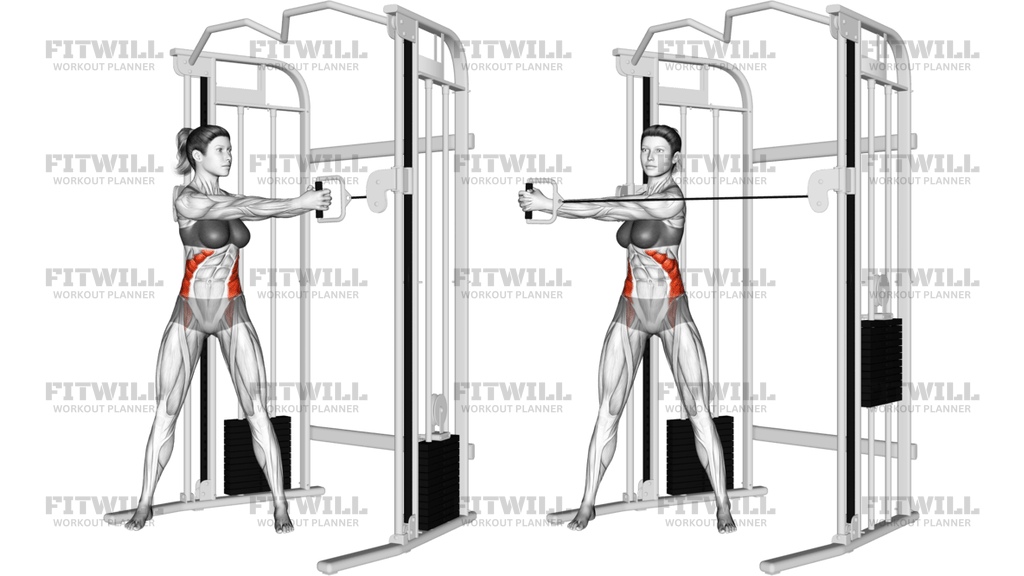
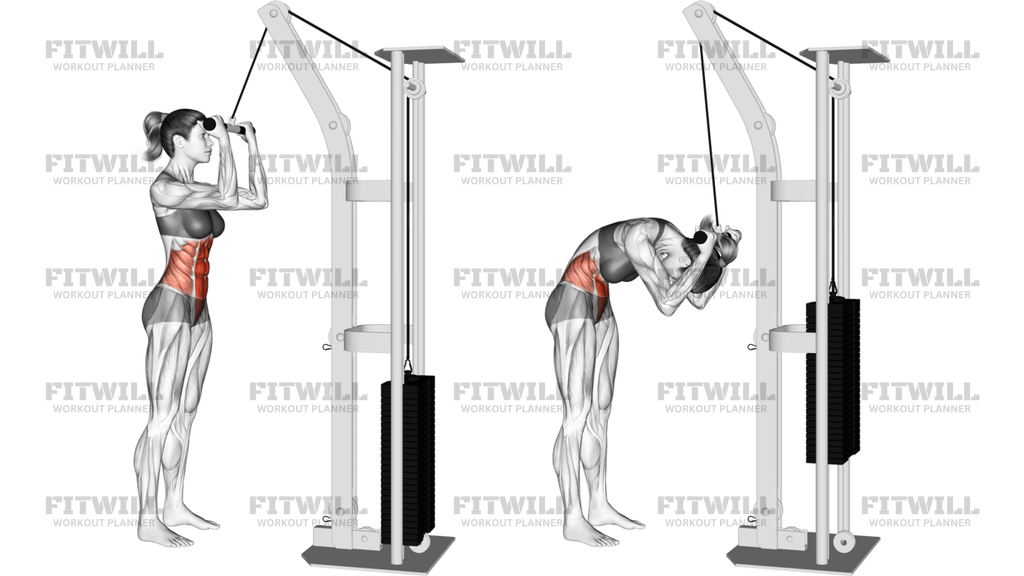
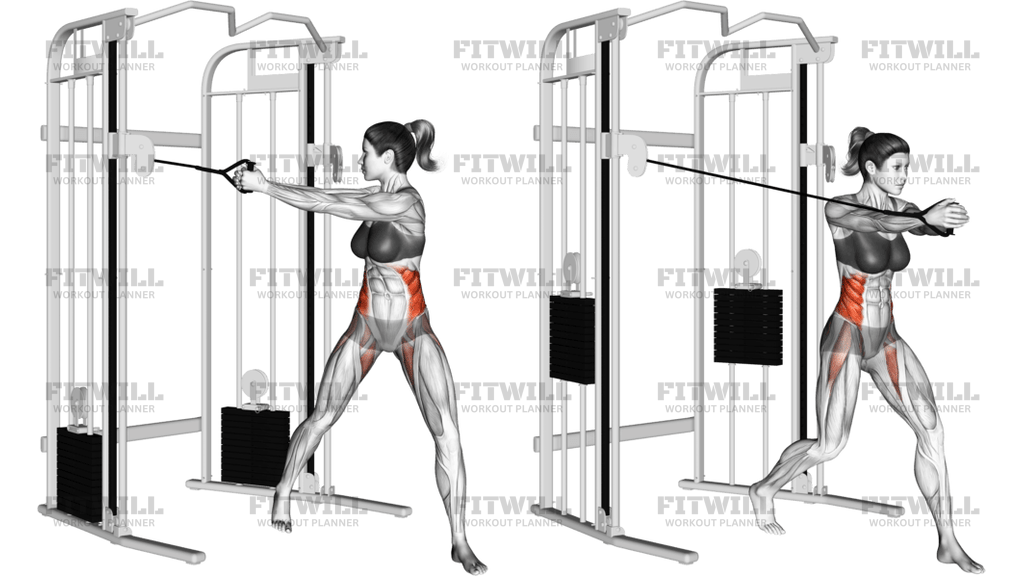
Cable Twist (Up Down)
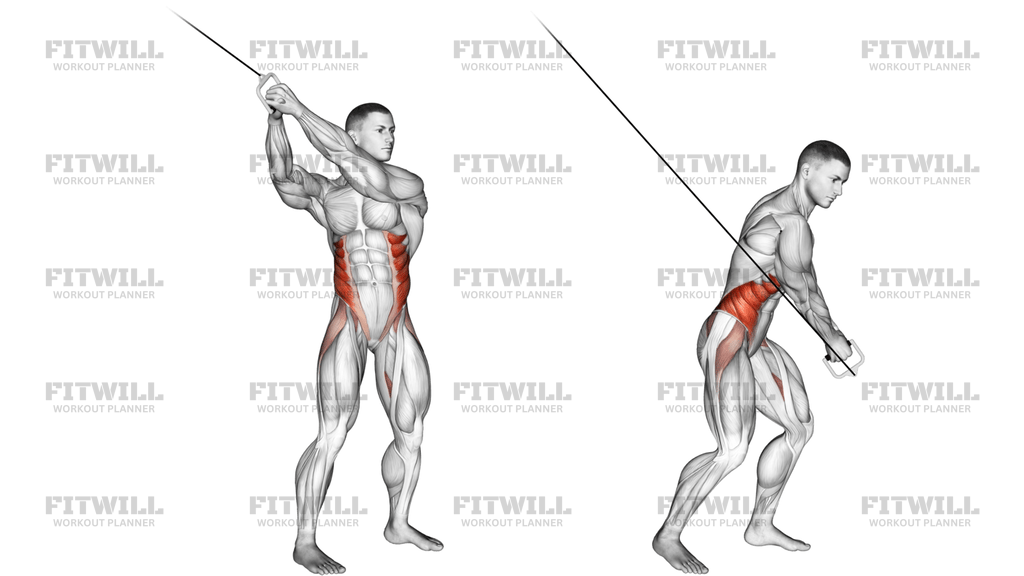
The Cable Twist (Up Down) is a standing rotational exercise performed with a single handle attached to a high cable pulley. You start facing sideways to the machine with both hands gripping the handle up and out to one side, then pull it diagonally down across your body until it ends near the opposite hip, rotating your trunk and hips together. It is essentially a high-to-low woodchop pattern, and the "up down" in the name refers to this high starting point and low finishing point of the handle.
This movement earns its place in a rotation program because it trains the trunk the way it actually works in sport and daily life: diagonal, from the outside in, with the hips contributing rather than staying frozen. The obliques on the working side do the bulk of the rotating, the rectus abdominis helps flex the trunk as you pull down, and the glutes and hip muscles drive the turn. The shoulders and arms mostly transfer force from the cable to your torso, so they work hard isometrically even though they are not the target.
Setup matters more here than in most core exercises because the cable pulls you out of position before you even start the rep. Stand far enough from the machine that the weight stack cannot yank you back, keep a soft bend in the knees, and brace your midsection like you are about to take a light push. If your stance is too narrow or your torso is slack at the start, the movement turns into an arm pull with a little torso wiggle at the end, which is the most common way people dilute this exercise.
Execution should feel like one connected sweep. Pull the handle across in an arc, letting your arms stay long and your eyes follow your hands, while your back heel lifts and your hips rotate toward the direction of the pull. The handle finishes low near your opposite thigh, and the deceleration at the bottom is part of the work. Return the handle back up the same arc under control, resisting the cable the whole way rather than letting it wind you back up.
The Cable Twist (Up Down) suits anyone building rotational strength: field and racquet sport players, golfers, fighters, and lifters who want a trunk that transfers force instead of leaking it. It also works well as a conditioning finisher with lighter weight and higher reps. Because the cable provides tension in both directions, it is friendlier to control than swinging a weight, but it still demands respect for load selection.
For safety, keep the weight moderate until your timing is clean, never round or wrench your lower back to chase a bigger arc, and stop the set as soon as your trunk starts collapsing on the return. Rotate through your hips and thoracic spine, not by grinding the lumbar spine into extreme end-range twist.
[ Workout Log & Planner ]
Put your next workout in Fitwill
Keep your plan and training log ready when you are.


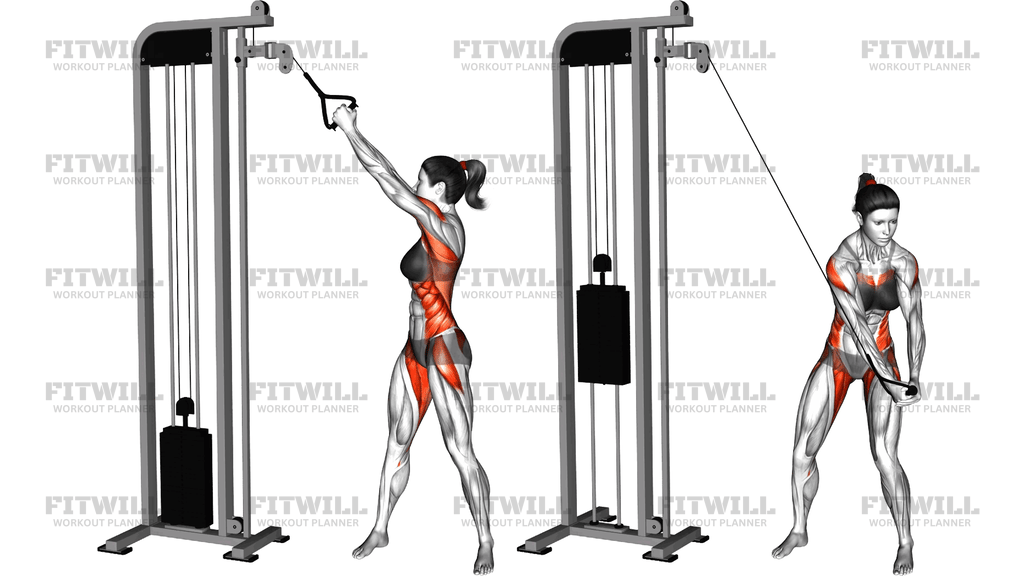
Instructions
- Attach a single handle to the highest pulley of a cable machine and select a light to moderate weight to start.
- Stand side-on to the machine, roughly an arm's length away, with the handle up and out toward the pulley; grip it with both hands, fingers overlapping or stacked, arms extended and slightly above shoulder height.
- Set your feet about shoulder-width apart, toes angled slightly outward, knees softly bent, and hold the cable taut so there is no slack at the start.
- Brace your abdominal wall and keep your chest tall before initiating any pull.
- Pull the handle down and across your body in a smooth diagonal arc, rotating your torso and hips together so your arms travel from up high near one side to low by the opposite hip.
- Let your back heel rise and your back knee bend slightly as you rotate, keeping your arms long so the trunk, not the elbows, drives the handle.
- Finish with the handle beside your opposite thigh, chest turned toward that side, and pause briefly to own the end position.
- Reverse the arc slowly back to the starting position, controlling the cable instead of letting it pull your shoulders around, and keep your torso braced through the return.
- Exhale as you pull down and across, inhale on the controlled return.
- Complete all reps on one side, then re-grip and repeat the same number of reps facing the opposite direction.
Tips & Tricks
- The most common error is yanking with the arms and elbows. Keep your arms long and think of your hands as hooks attached to a rotating torso.
- If the weight stack slams down on the return, you are being wound back by the cable rather than controlling it; drop the load one plate and slow the eccentric.
- Keep the handle far enough from your body that the arc stays wide. Letting it drift close to your chest shortens the lever and steals tension from the obliques.
- Your hips should rotate with your shoulders. If your pelvis stays planted square to the machine while your trunk twists, the work piles onto your lower back.
- Let the back heel lift naturally as you rotate. Forcing the foot flat blocks hip rotation and forces the lumbar spine to compensate.
- Do not chase a huge range by hunching over at the finish. Bend from the hips slightly, but keep the spine neutral from start to end.
- Start each rep from the same tall, braced position. Reps that begin with a slouched torso get progressively sloppier as fatigue builds.
- Match volume on both sides. Rotational work exposes imbalances quickly, and doing more reps on your stronger side only widens the gap.
- For sport-specific power, use moderate weight and accelerate through the down-and-across portion; for core endurance, go lighter and emphasize the slow return.
Frequently Asked Questions
What muscles does the Cable Twist (Up Down) work?
The obliques are the primary movers, with the rectus abdominis assisting trunk flexion and rotation. The glutes and hip muscles turn the pelvis, while the shoulders and arms work isometrically to hold and transfer force through the handle.
Is the Cable Twist (Up Down) suitable for beginners?
Yes, provided the weight starts light and the emphasis stays on rotating hips and torso together. Beginners often benefit more from the movement pattern itself than from heavy load, so master the arc before adding plates.
Where should the cable pulley be set for the Cable Twist (Up Down)?
Set the pulley at its highest position so the handle starts above shoulder height. The exercise is defined by the high-to-low diagonal, so a mid or low pulley changes the movement into a different exercise entirely.
How is the Cable Twist (Up Down) different from a woodchop?
They share the same diagonal high-to-low pattern and largely the same muscles. Names vary by source, but if you are pulling a cable handle from above one shoulder down across the body to the opposite hip, you are performing essentially the same movement.
Should my feet move during the Cable Twist (Up Down)?
Your feet stay planted in the same spot, but the back heel lifts and the back knee bends as the hips rotate. Keeping the rear foot glued flat usually forces excessive twist through the lower back.
Why do my arms feel this exercise more than my abs?
That usually means the load is too heavy and you are pulling with the elbows, or your torso is starting each rep unbraced. Lighten the weight, keep the arms long, and initiate every rep by turning the trunk and hips first.
Can I substitute the Cable Twist (Up Down) with a band?
Yes. Anchor a resistance band high on a rack or door frame and perform the same down-and-across arc. The band offers less consistent tension at the bottom, but the pattern and coaching cues carry over directly.
How many sets and reps should I do?
For strength and power, 3 sets of 6 to 10 controlled reps per side works well. For core endurance or conditioning, 2 to 3 sets of 12 to 15 per side with a lighter load is more appropriate.
Is it safe for my lower back?
It is generally safe when the spine stays neutral, the rotation comes from the hips and ribcage, and the load is controlled on the return. Avoid wrenching into extreme end-range twist, and stop if you feel pinching or sharp discomfort rather than muscle effort.