V Flutter Kick
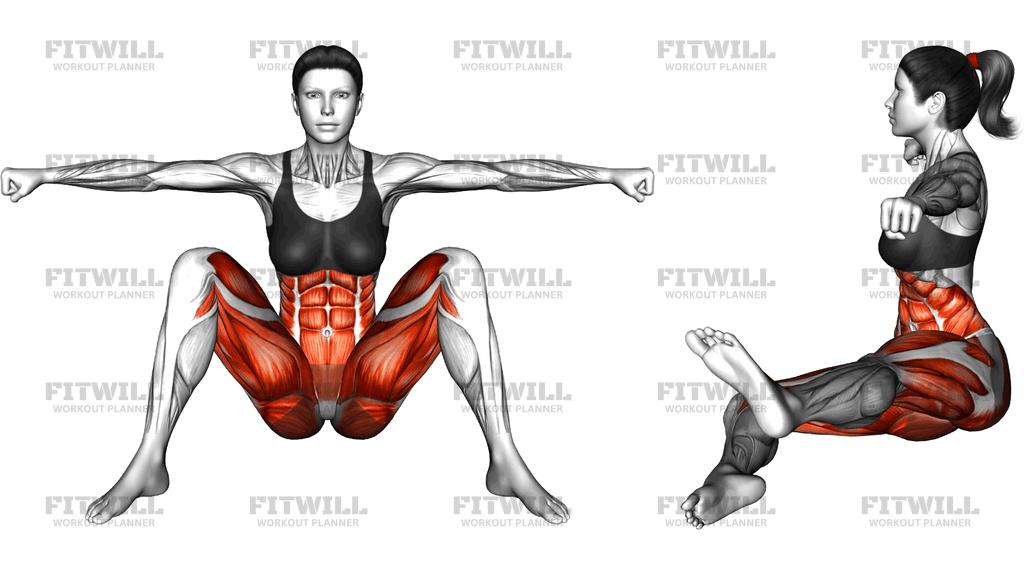
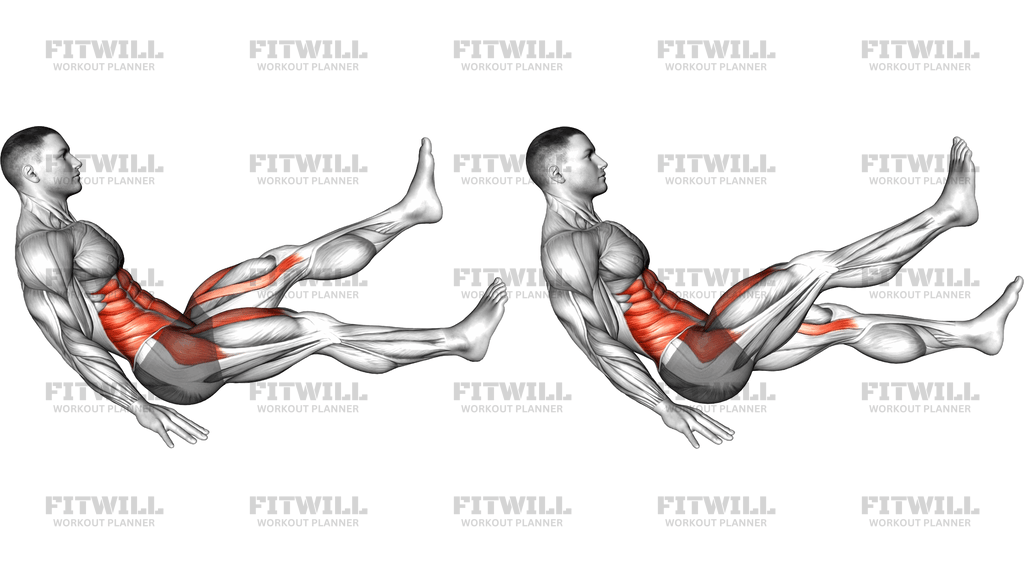
The V Flutter Kick is a seated core exercise performed from a V-sit position, where you lean your torso back, lift both legs off the floor, and then alternate small, rapid up-and-down kicks with each leg. It takes the classic floor flutter kick and removes the support of a reclined torso, forcing your abdominal wall and hip flexors to hold a V-shaped body line while the legs keep moving. In practice, it feels like holding a boat pose while your legs pedal against gravity.
Because the torso stays lifted and only the sits bones contact the floor, this is a significantly harder variation than the standard supine flutter kick. The static demand on the abs is constant, and the alternating leg action adds a dynamic challenge on top of it. This makes the movement a good fit for intermediate to advanced trainees, calisthenics practitioners, swimmers, and martial artists who need strong hip flexors and a trunk that resists collapsing under fatigue.
The primary muscles working are the abs, especially the lower portion of the rectus abdominis, which has to keep the trunk from folding or rounding as the legs travel. The hip flexors drive each kick, the quads help keep the knees straight, and the deep core stabilizers work to keep your spine in one piece throughout the set. Your arms usually hover at your sides or reach forward, so the shoulders also contribute to holding the V position.
Setup matters more here than in most ab exercises. The angle of your torso determines the difficulty: the more upright you sit, the easier the hold; the lower you lean back with legs higher in the V, the longer the lever arm and the greater the load on the abs and hip flexors. If your lower back rounds or your pelvis tucks under, you lose the training effect and put unnecessary strain on the lumbar spine, so start with a slightly higher torso angle and only progress down as your control improves.
Execution is about rhythm and precision, not speed. The kicks should be short, controlled, and roughly equal in range, with the legs staying fully extended and the heels never touching the floor between reps. Breathing stays steady and continuous, since holding your breath will spike tension in your neck and shoulders and cut the set short. A typical set lasts 20 to 45 seconds, and it is far better to end early with clean kicks than to grind out extra seconds with a sagging torso.
Use the V Flutter Kick as a finisher after heavier compound lifts, as one station in a core circuit, or as a progression step toward V-sits, L-sits, and other straight-leg holds. Common practical cautions: keep the hands light or hovering rather than gripping your thighs for support, stop if you feel the work shifting into your lower back, and on hard floors use a mat to protect your tailbone and sits bones.
[ Workout Log & Planner ]
Put your next workout in Fitwill
Keep your plan and training log ready when you are.


Instructions
- Sit on an exercise mat with your knees bent and feet flat on the floor, hands resting lightly beside your hips.
- Lean your torso back to roughly a 45-degree angle, lift your chest, and raise both legs off the floor so your body forms a wide V, knees fully straight.
- Brace your abs as if bracing for a light punch, and pull your shoulders down away from your ears; let your arms hover at your sides or reach forward for balance.
- Balance on your sits bones and find a still point before moving, so your torso is not rocking with each kick.
- Keeping both knees locked straight, lower one leg a few inches toward the floor while raising the opposite leg slightly higher in the same moment.
- Reverse the positions with a quick but controlled switch, so the legs alternate in a steady flutter rhythm without the heels ever touching down.
- Breathe in a continuous, even pattern throughout, exhaling on every second or third switch rather than holding your breath.
- Keep your chest tall and your torso angle fixed for the whole set; if you feel yourself sinking, either shorten the set or raise your torso slightly and continue.
- When finished, bend your knees and place both feet back on the floor with control instead of collapsing backward.
- Rest briefly, reset your brace, and repeat for the desired number of sets.
Tips & Tricks
- If your tailbone hurts on a hard floor, sit slightly forward on a folded mat or towel so bone is not pressing directly into the ground.
- The most common mistake is letting the torso sink toward the legs as fatigue builds; film yourself from the side and stop the set the moment your chest starts to drop.
- If your heels keep drifting toward the floor, reduce the drop range and think about making small, six-to-eight-inch kicks instead of large scissor sweeps.
- Bent knees silently shrink the difficulty by shortening the lever; if you catch your knees softening, straighten them fully and point your toes to reinforce the line.
- Grabbing behind your thighs turns this into a supported hold and removes much of the ab work; keep your hands hovering or reaching forward instead.
- Tension in the neck usually means you are leading with your chin; look straight ahead at a fixed point rather than up at the ceiling or down at your legs.
- Start with a more upright torso angle and a narrower V, then gradually lean back over weeks of practice to increase the lever length on your abs.
- Count reps by leg switches rather than time at first; a target of 20 to 30 clean switches is a better gauge of quality than a 60-second clock with sagging form.
- If you lose balance and rock side to side, widen your arm position slightly or slow the kick tempo until your trunk steadies.
Frequently Asked Questions
Which muscles does the V Flutter Kick work the most?
The abs, especially the lower portion of the rectus abdominis, do most of the static work of holding the V position. The hip flexors drive each alternating kick, with the quads assisting to keep the knees straight.
How is the V Flutter Kick different from a regular flutter kick?
A regular flutter kick is done lying on your back with the floor supporting your torso, while the V Flutter Kick holds your torso and legs off the floor in a V-sit. That removes the support and makes the abs work far harder just to maintain position.
Can beginners do the V Flutter Kick?
Yes, with modifications. Bend your knees slightly, sit more upright, or hold the legs higher in the V to shorten the lever, then progress to straight legs and a lower torso angle as your control improves.
Why does my lower back strain instead of my abs during this exercise?
That usually means your pelvis is tucking under and your lower back is rounding as the legs drop. Raise your torso angle, reduce how far the legs travel downward, and actively press your lower back into a long, neutral line before resuming.
How long should I hold or perform the V Flutter Kick?
Start with sets of 15 to 30 seconds or 20 to 30 leg switches and build gradually. Quality of the V position matters more than duration, so end the set when your torso begins to sink or your knees bend.
Should my hands support my legs during the V Flutter Kick?
No, holding your thighs removes a large part of the ab demand. Keep your hands hovering at your sides or reaching forward, and only use them lightly for balance if you are still learning the position.
What can I use as a substitute for the V Flutter Kick?
Supine flutter kicks, hollow body holds, and seated V-sit holds all train similar muscles at lower difficulty. Progress from those to the V Flutter Kick once you can hold a hollow position with straight legs.
How fast should I kick my legs in the V Flutter Kick?
Use a quick but controlled rhythm where you stay in charge of both legs at every point of the switch. If the movement turns into bouncing or your torso starts rocking, slow down until the kicks are clean.
Is the V Flutter Kick safe for people with lower back issues?
It places a sustained load on the trunk and hip flexors, so anyone with a history of back problems should get clearance from a qualified professional first. Starting with bent knees and a higher torso angle reduces the demand on the lumbar spine.
Where does the V Flutter Kick fit in a workout?
It works best as a mid-session or finishing core movement, after your main strength lifts, or as one station in a core circuit. Pair it with a static hold like a plank or V-sit to cover both dynamic and static trunk strength.