Bird Dog Plank
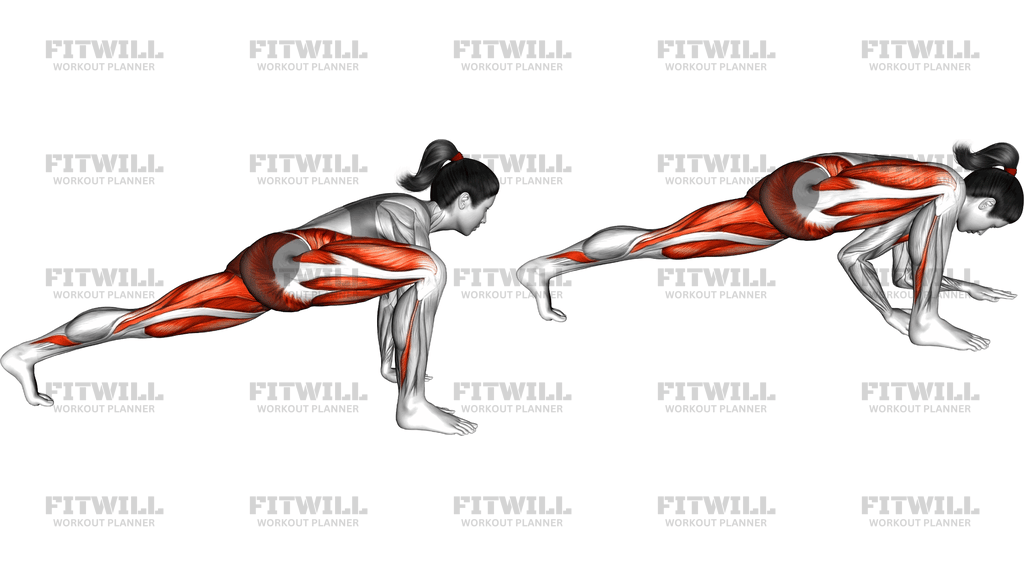
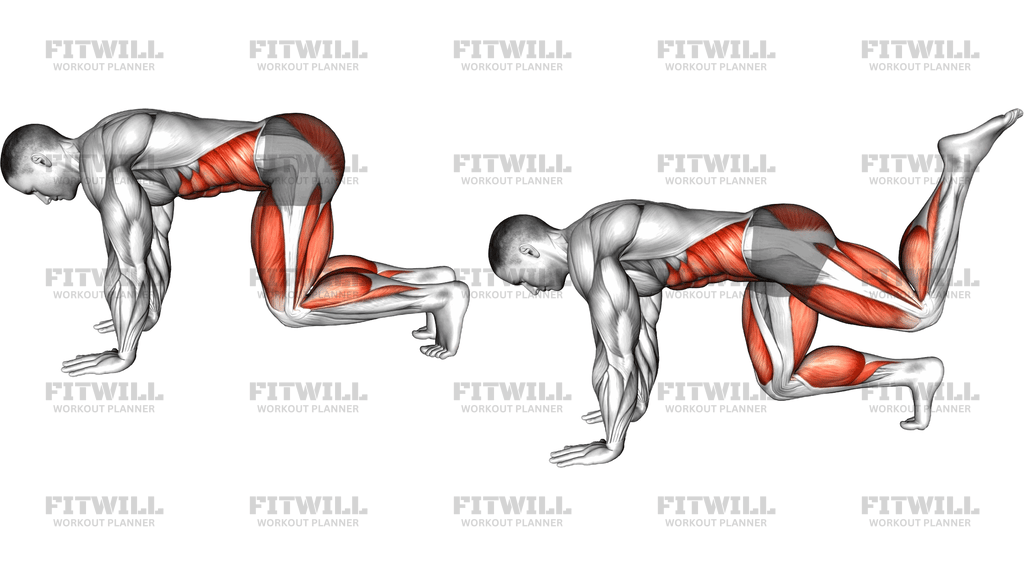
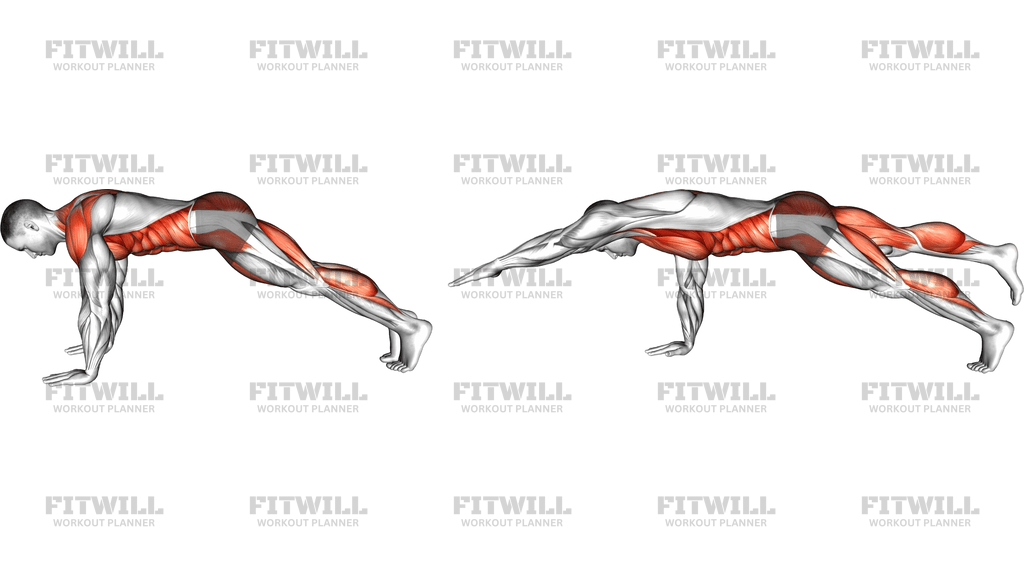
The Bird Dog Plank takes the classic quadruped bird dog and moves it into a full high plank, which raises the stability demand considerably. From a push-up position with your hands under your shoulders and your body on your toes, you extend one arm straight forward while lifting the opposite leg off the floor, hold briefly, and return under control before switching sides. Because your base of support shrinks from four contact points down to two diagonal ones, your trunk has to work hard simply to keep your hips and shoulders level.
This is an anti-rotation and anti-extension exercise at heart. The deep core muscles — especially the transverse abdominis — brace to stop your torso from twisting, while the glutes and spinal stabilizers hold the lifted leg in line with your torso. The supporting shoulder and forearm of the planted arm also work isometrically, which makes this a useful drill for anyone whose planks have become easy but who still struggles to keep a rigid trunk under shifting load.
It suits a wide range of trainees. Lifters use it as warm-up activation before pressing or squatting days, runners and field-sport athletes use it to build the cross-body stability that running and changing direction demand, and general fitness users like it because it challenges the midsection without any equipment or spinal loading. If you already hold a solid high plank for 30 seconds or more, this is a natural next step; if not, master the standard plank and the kneeling bird dog first.
Setup details matter more than speed here. Hands should sit directly under the shoulders with fingers spread, feet about hip-width apart, and your body forming one straight line from head to heels — no sagging hips or piked waist. As the arm and leg reach, the temptation is to let the hips tilt and rotate; your job is to keep them square to the floor, as if balancing a glass of water on your lower back. A mat under your hands and toes makes the hold more comfortable, especially on hard floors.
Execute each rep slowly: reach long with the fingertips and press back through the heel of the lifted foot rather than just hiking the leg up. Breathe steadily throughout, exhaling as you extend, and pause two to three seconds in the full position before drawing the limbs back in. Three sets of 6-10 controlled reps per side is a realistic working range, and the exercise loses most of its value the moment rushing turns it into a flailing, hip-swiveling race.
From a safety standpoint, keep the neck neutral by looking at the floor slightly ahead of your hands, and stop the set if your lower back starts to arch or your planted shoulder collapses. Small ranges performed crisply beat large ranges performed loosely with this movement.
[ Workout Log & Planner ]
Put your next workout in Fitwill
Keep your plan and training log ready when you are.


Instructions
- Set up in a high plank on a mat or floor: hands directly under your shoulders with fingers spread, arms straight, and your body supported on your toes with feet about hip-width apart.
- Form one straight line from head to heels — engage your thighs and glutes so your hips are neither sagging toward the floor nor pushed up toward the ceiling.
- Brace your core firmly, as if bracing for a light punch to the stomach, and set your gaze on the floor just in front of your hands to keep your neck neutral.
- Shift your weight slightly toward the side that will stay planted, then slowly extend your right arm straight forward to shoulder height while lifting your left leg straight back behind you.
- In the end position, your arm, torso, and lifted leg should form one long diagonal line, with your hips and shoulders staying square to the floor and the toes of your planted foot still supporting you.
- Hold the extended position for two to three seconds, reaching forward through the fingertips and back through the heel of the lifted foot.
- Exhale as you extend, then breathe steadily while holding; do not hold your breath.
- Draw the arm and leg back in with control until your hand and toes return to the starting plank, avoiding any drop or bounce of the hips.
- Repeat on the opposite side — left arm with right leg — and continue alternating for equal reps per side.
- Reset your plank line and brace between reps if you feel your hips twisting or your lower back arching.
Tips & Tricks
- The most common failure is hip rotation: when the right arm goes forward, the right hip tends to rise. Imagine your hips are headlights pointing at the floor and keep them level throughout.
- Do not lift the leg higher than trunk height — driving the foot toward the ceiling arches the lower back and turns the drill into a hyperextension. Reach long behind you instead.
- If your planted shoulder collapses toward the floor, push the floor away actively and spread your fingers; the supporting arm should feel locked, not slumped.
- Widen your feet to hip-width or slightly wider if you wobble badly. As your control improves, narrow the stance to make balancing harder.
- Keep the movement slow enough that you could pause at any point. If momentum is swinging you into position, the core is being bypassed, not trained.
- Squeeze the glute of the lifted leg rather than relying on your lower back to hold the leg up — this keeps the spine neutral and targets the hip extensors properly.
- If holding a high plank while moving is too demanding, drop to a kneeling bird dog first or perform the reaches from an incline with hands on a bench.
- Start with the arm-only and leg-only versions if the full diagonal reach breaks your plank line — building the two halves separately is faster than practicing a sloppy combined rep.
- Place a mirror to your side rather than in front of you; hip sway is far easier to spot from a side view than head-on.
Frequently Asked Questions
What muscles does the Bird Dog Plank work?
The deep core, especially the transverse abdominis, does most of the bracing work, supported by the glutes and lower back stabilizers that control the lifted leg. The planted shoulder, triceps, and supporting forearm also work isometrically to hold the plank.
How is the Bird Dog Plank different from the regular bird dog?
The regular bird dog is done on hands and knees, while the Bird Dog Plank starts from a high plank on hands and toes. Removing the knee support makes the base far less stable, so the core and shoulders must work much harder to keep the torso from rotating.
Is the Bird Dog Plank suitable for beginners?
It can be, but most beginners should first own a solid 30-second high plank and a controlled kneeling bird dog. If the full version causes hip sway or lower back arching, regress to the kneeling version or perform the arm and leg lifts separately from the plank.
Should my lifted leg go higher than my hips?
No. The leg should reach straight back so it lines up with your torso. Lifting the foot toward the ceiling arches the lower back and shifts work away from the core.
Why do my hips rotate to one side during the Bird Dog Plank?
Rotation usually means the brace is too soft or the reach is too fast. Slow the rep down, deliberately squeeze the glutes on both sides, and shift your weight slightly over the planted limbs before extending.
How long should I hold the extended position?
Two to three seconds per rep is enough to challenge stability without fatiguing your shoulders. Longer holds are fine once your form is solid, but form tends to break down into hip rotation as holds get longer.
What can I use instead of the Bird Dog Plank if I don't have a mat?
Any non-slip floor works; the mat is purely for comfort under the palms and toes. If hard floors bother your wrists, you can use folded towels under your hands or perform the movement on grass or carpet.
Can the Bird Dog Plank help with lower back strength?
It trains the spinal stabilizers and glutes in a safe, unloaded way, which is why it appears in many back-care and core-stability routines. Stop if the movement itself causes back discomfort, and keep the leg reach at trunk height to protect the spine's neutral position.
How many reps and sets of the Bird Dog Plank should I do?
Three sets of 6-10 slow reps per side works well, either as warm-up activation before lifting or as a core finisher. Prioritize crisp, hip-level reps over higher numbers with twisting form.