Mountain Climber Cross Kick
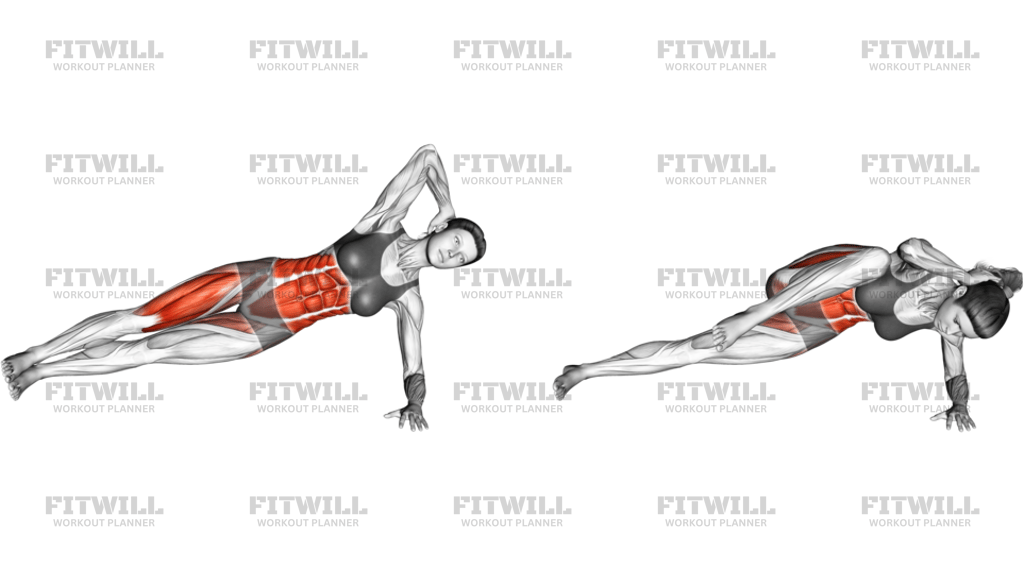
Mountain Climber Cross Kick is a dynamic, ground-based core exercise performed from a high plank. Instead of driving the knee straight forward as in a standard mountain climber, you pull one knee across your body toward the opposite hand, adding a rotational element that forces the obliques and deep core to work much harder. The movement keeps your heart rate elevated, so it doubles as a conditioning drill while still demanding precise trunk control.
This variation is useful for anyone who already feels comfortable holding a plank and wants to make it more athletic. Because the knee travels diagonally across the midline, your trunk has to resist both extension and rotation at the same time, which is exactly what most sports and daily movements require. It is a popular choice in circuit training, HITP-style intervals, and warm-ups for combat sports, tennis, and other rotational activities.
The main muscles at work are the abs, with strong involvement from the obliques as they rotate and stabilize the torso on every rep. The hip flexors power the knee drive, the quads assist as the leg comes forward, and the shoulders, chest, and arms hold the plank position isometrically throughout. Your supporting leg and glutes work to keep the hips from sagging or twisting as the other knee crosses over.
Setup matters more than speed here. Hands should be stacked directly under the shoulders with fingers spread, and the body should form one straight line from head to heels before the first rep begins. If your hands drift forward or your hips sit too high, the cross-body path becomes awkward and the rotational benefit largely disappears.
To execute the movement well, brace your trunk as if bracing for light contact, then drive one knee across your body toward the opposite elbow or wrist, letting your torso rotate slightly. Return that foot to the plank and immediately switch sides, keeping the rhythm smooth and the hips quiet. The knee should move on a diagonal, not straight up the middle.
A few practical points will keep this exercise productive. Start at a moderate pace until the diagonal path feels natural, because rushing usually turns the movement into a sloppy knee bounce with a collapsing lower back. If your wrists or shoulders complain, shift your weight slightly back toward the feet or shorten your sets. On a hard floor, an exercise mat under the hands and toes makes the position much more comfortable for longer intervals.
Fitwill
Log Workouts, Track Progress & Build Strength.
Achieve more with Fitwill: explore over 9600 exercises with images and videos, access built-in and custom workouts, perfect for both gym and home sessions, and see real results.
Start your journey. Download today!




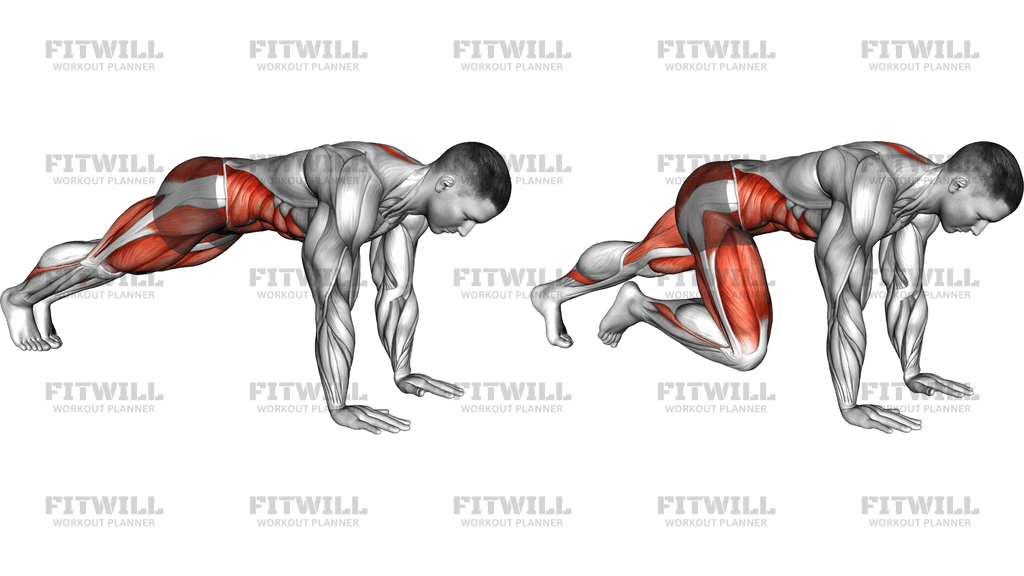
Instructions
- Place an exercise mat on the floor and set up on your hands and knees, then walk your feet back until your body forms a straight line from head to heels in a high plank.
- Position your hands directly under your shoulders with fingers spread wide, feet about hip-width apart, and press the floor away so your upper back is active rather than sunk between the shoulder blades.
- Brace your abs and squeeze your glutes lightly so your hips are level and your lower back is neither sagging nor rounded.
- Exhale and drive your right knee across your body toward your left hand, letting your torso rotate a few degrees while keeping both arms straight and planted.
- Pull the knee as far across as you can without letting the hips pike upward or the shoulders shift past the supporting wrist.
- Inhale and return the right foot to the starting plank position under control, keeping the foot from slamming down.
- Immediately repeat the same diagonal drive with your left knee toward your right hand to complete one rep on each side.
- Continue alternating sides in a steady rhythm, breathing out on every knee drive and in on every return.
- Finish the set by bringing both feet back to the plank, then stand up or push your hips back to rest rather than letting your lower back drop mid-fatigue.
Tips & Tricks
- A common mistake is letting the knee travel straight forward instead of across the body; aim it at the opposite wrist so the obliques actually get the rotational work.
- If your hips pike up toward the ceiling as the knee crosses, think about pressing the crown of your head forward and your heels back to lengthen the plank as you drive.
- Keep the working foot hovering slightly above the floor as it crosses, rather than dragging the toes, so the hip flexors and quads do the lifting.
- Spread your fingers and grip the floor; wrist discomfort in this exercise usually comes from collapsed weight over the heel of the hand instead of an even press across the palm.
- Slow the tempo down for the first few sessions of Mountain Climber Cross Kick — speed on top of a poor diagonal path just trains a bad pattern.
- Watch your supporting arm: if your shoulder drifts sideways as the knee crosses, broaden your hand position slightly and keep the elbow stacked over the wrist.
- Breathe with the legs rather than holding your breath; the pattern of exhaling on the drive keeps your trunk braced without spiking tension in the neck.
- If your lower back starts to arch as fatigue builds, end the set or switch to slow alternating plank knee taps until your endurance improves.
Frequently Asked Questions
What muscles does Mountain Climber Cross Kick work?
The abs and obliques do most of the work because the knee crosses the midline, while the hip flexors and quads drive the leg forward. The shoulders, chest, and arms hold the plank isometrically throughout the set.
How is Mountain Climber Cross Kick different from a regular mountain climber?
In a regular mountain climber the knee drives straight toward the chest, while the cross kick version drives the knee diagonally toward the opposite hand. That diagonal path adds trunk rotation, which shifts more of the demand onto the obliques and deep core.
Is this exercise suitable for beginners?
Yes, if you can hold a solid high plank for at least 20 to 30 seconds. Beginners should perform the movement slowly and deliberately before adding speed, and can shorten the range by aiming the knee at the same-side hand first.
Should my shoulders rotate a lot when the knee crosses over?
A small amount of rotation is natural, but the shoulders should stay roughly stacked over the wrists. If your upper body swings noticeably from side to side, reduce the knee height and focus on bracing the trunk harder.
Why do my hips rise when I drive the knee across?
The hips usually lift because the abs are not braced enough to control the rotation, so the body pikes to shorten the lever. Cue yourself to press the floor away with both hands and keep the heels reaching back as the knee travels.
Can I do Mountain Climber Cross Kick if my wrists hurt in a plank?
You can shift your weight slightly toward the heels of your hands, use a mat for cushioning, or perform the movement on fists or light dumbbells to keep the wrists neutral. Persistent wrist pain should be checked before continuing.
How many reps should I do?
Work in time intervals rather than counting reps, starting with 20 to 30 seconds of continuous alternating drives and resting between rounds. As your plank endurance improves, build toward 40 to 60 seconds per set.
What can I substitute if the cross-body path is too difficult?
Standard mountain climbers or slow alternating knee drives in a plank are good regressions because they train the same braced plank position with less rotational demand. Spiderman plank knee drives toward the same-side elbow are another step toward the full movement.
Can this exercise be used as cardio?
Yes, once the diagonal path feels automatic, speeding up the leg switches raises your heart rate quickly, which is why it appears in many interval and circuit workouts. Keep the trunk braced even at higher speeds so the cardio benefit does not come at the cost of form.