Slight Squat Front Raise
The Slight Squat Front Raise is a bodyweight combination movement that pairs a shallow squat with a simultaneous front raise of both arms. From a standing position, you bend at the hips and knees into a partial squat while sweeping your straight arms forward and up to roughly shoulder height, then reverse the motion to stand back up with your arms returning to your sides. Because the arm and leg actions happen together, the exercise teaches your upper and lower body to move as one coordinated unit rather than as separate pieces.
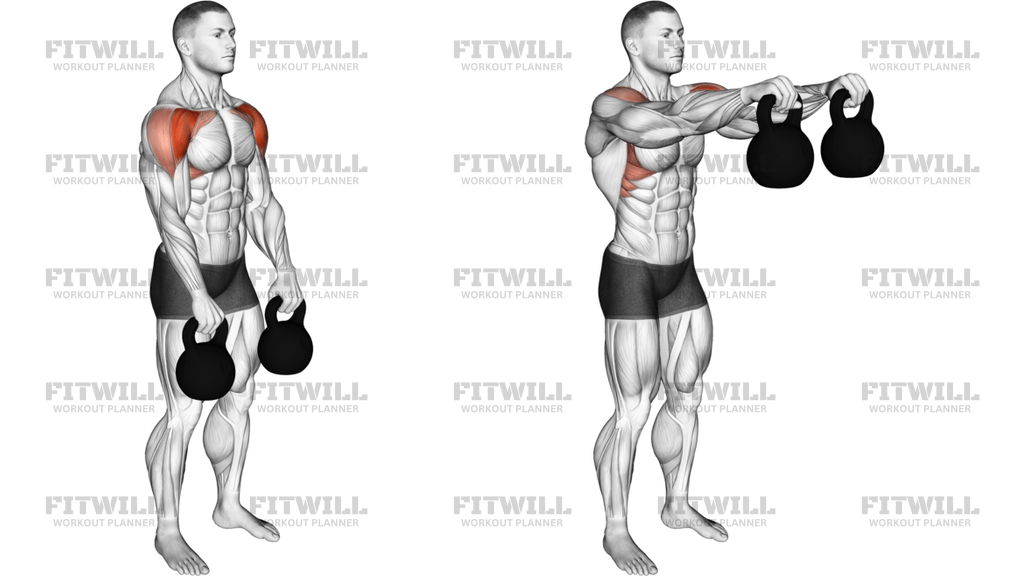
The main work is shared between the front of the shoulders, which lift the arms against gravity, and the thighs and glutes, which control the squat portion. Your core stays busy the entire time, bracing to keep your torso upright as your center of mass shifts backward and forward. The image highlights exactly this: the anterior shoulders and quadriceps take the brunt, with the glutes and abdominal wall supporting throughout.
This movement suits beginners learning squat mechanics, since the reaching arms act as a natural counterbalance that helps you sit back with a neutral spine. It also works well as a warm-up before lower-body or shoulder training, and as a low-impact conditioning drill when performed for higher repetitions. Anyone training at home without equipment can use it to build coordination, endurance, and control in one economical pattern.
Setup matters more than it looks. Your stance width and foot angle determine whether the squat portion feels smooth or cramped, and keeping the arms straight and level with the shoulders at the bottom ensures the front delts actually do the lifting instead of the traps shrugging to compensate. A shallow squat depth is intentional here — you only need to descend far enough that your hips shift back and your knees bend comfortably, not to a deep bottom position.
To execute it well, think of the arms and hips as connected: as you sit back, the arms float up; as you stand, they lower. Move at a steady tempo rather than letting gravity drop you into the squat or yank your arms back down. Exhale as you rise, and reset your stance and posture at the top before the next repetition.
Common use cases include home workouts, warm-up circuits, active recovery days, and teaching progressions toward loaded squats. For safety, keep your knees tracking over your toes, avoid rounding your lower back at the bottom, and stop the arm raise at shoulder height rather than forcing the arms higher, which can irritate the shoulder joint over time.
Fitwill
Log Workouts, Track Progress & Build Strength.
Achieve more with Fitwill: explore over 9600 exercises with images and videos, access built-in and custom workouts, perfect for both gym and home sessions, and see real results.
Start your journey. Download today!




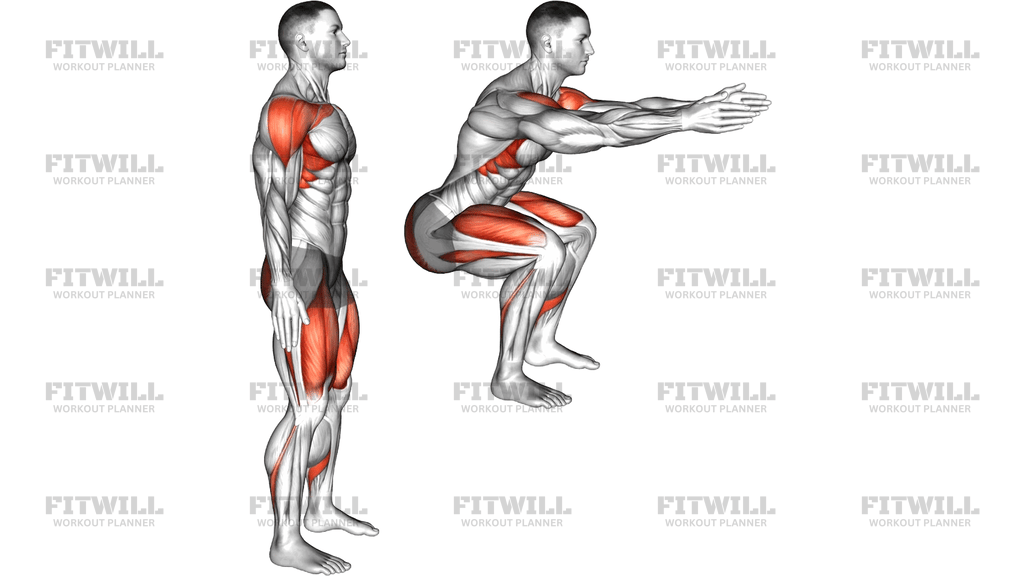
Instructions
- Stand with your feet about hip-width to shoulder-width apart, toes turned out slightly, and let your arms hang relaxed at your sides.
- Set your gaze forward, lift your chest, and brace your abdominal wall as if preparing for a light push to the midsection.
- Begin the rep by pushing your hips back and bending your knees into a slight squat — a partial descent where your hips shift back and your thighs engage, not a deep squat.
- At the same time, raise both straight arms forward and upward in front of your body, palms facing each other or down.
- Stop the arm raise when your hands reach roughly shoulder height, level with the floor, keeping your shoulders down away from your ears.
- Hold the bottom position for a brief moment with arms parallel to the floor, knees bent, and chest tall.
- Reverse the motion by pressing through your whole foot to stand tall while lowering your arms in a controlled arc back to your sides.
- Exhale as you stand and inhale as you descend into the next repetition.
- Reset your stance and brace at the top before continuing, keeping each rep smooth rather than rushed.
Tips & Tricks
- If your heels lift as you squat, widen your stance slightly and turn your toes out a few more degrees — the shallow depth should let your whole foot stay planted.
- A common mistake is shrugging the shoulders as the arms rise; consciously pull your shoulder blades down so the front delts, not the upper traps, do the lifting.
- Keep the arm raise at or just below shoulder height. Forcing the hands higher turns the movement into an impingement risk for no extra benefit.
- Do not let your knees cave inward as you bend; think of gently spreading the floor with your feet to keep the knees tracking over the toes.
- Match the timing of the two limbs: if your arms reach shoulder height before your hips stop moving back, slow the arms down so both arrive together.
- Avoid leaning the torso too far forward. The slight squat only needs a modest hip hinge — a deep forward lean shifts work away from the thighs and strains the lower back.
- Keep a small, soft bend at the elbows rather than locking the arms rigid, but do not turn the movement into a bent-arm swing.
- For conditioning, use a steady two-count descent and one-count rise; for warm-up, keep the reps slow and the range modest.
- If your lower back rounds at the bottom, reduce the squat depth until you can keep your spine neutral through every rep.
Frequently Asked Questions
What muscles does the Slight Squat Front Raise work?
The front shoulders drive the arm raise, while the quadriceps and glutes handle the squat portion. The core works isometrically to keep your torso upright as your hips move back and your arms extend forward.
How deep should the squat be in the Slight Squat Front Raise?
Only partial depth is needed — descend until your hips shift back and your knees bend comfortably, roughly a quarter to a third of a full squat. The emphasis is coordination and control, not maximum squat depth.
Is the Slight Squat Front Raise good for beginners?
Yes. The forward reach acts as a counterbalance that makes it easier to sit back with a neutral spine, which is why it is often used to teach squat mechanics before adding load.
Why should I stop the front raise at shoulder height?
Raising straight arms above shoulder height under tension offers little extra work for the front delts and increases the chance of shoulder discomfort. Level with the shoulders is the effective and joint-friendly end point.
Can I do the Slight Squat Front Raise every day?
Because it uses only your bodyweight at moderate intensity, it can be performed frequently, such as in daily warm-ups or mobility circuits. Just reduce volume if your thighs or shoulders feel consistently sore.
What can I use instead of the Slight Squat Front Raise?
A plain bodyweight squat trains the legs without the shoulder component, while a standing front raise with light dumbbells trains the shoulders without the squat. Combining the two substitutes closely if you want added load.
Should my palms face down or toward each other during the raise?
Either works. Palms facing each other is usually more comfortable for the shoulder joint, while palms down gives a slightly stronger feel in the front delts — choose the version that keeps your shoulders relaxed.
Why do my shoulders shrug when my arms come up?
The upper traps take over when the front delts fatigue or when you rush the raise. Slow the tempo, keep your shoulder blades pulled down, and reduce reps until you can lift the arms without the shoulders creeping toward your ears.
Can I add weight to the Slight Squat Front Raise?
Yes, once your form is consistent you can hold light dumbbells or a weight plate to increase the demand on the shoulders and legs. Start very light, since the front raise portion becomes limiting quickly.