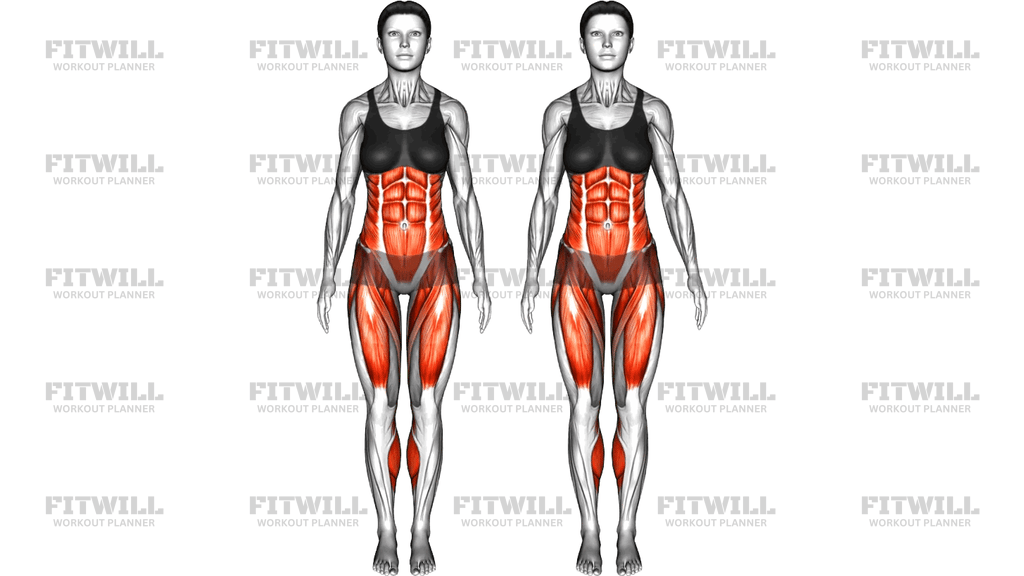
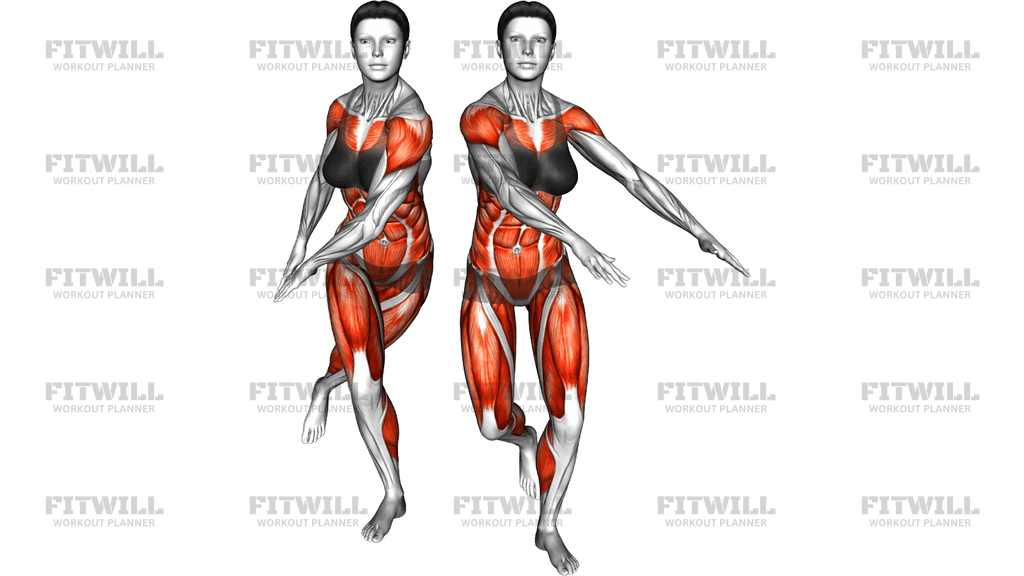
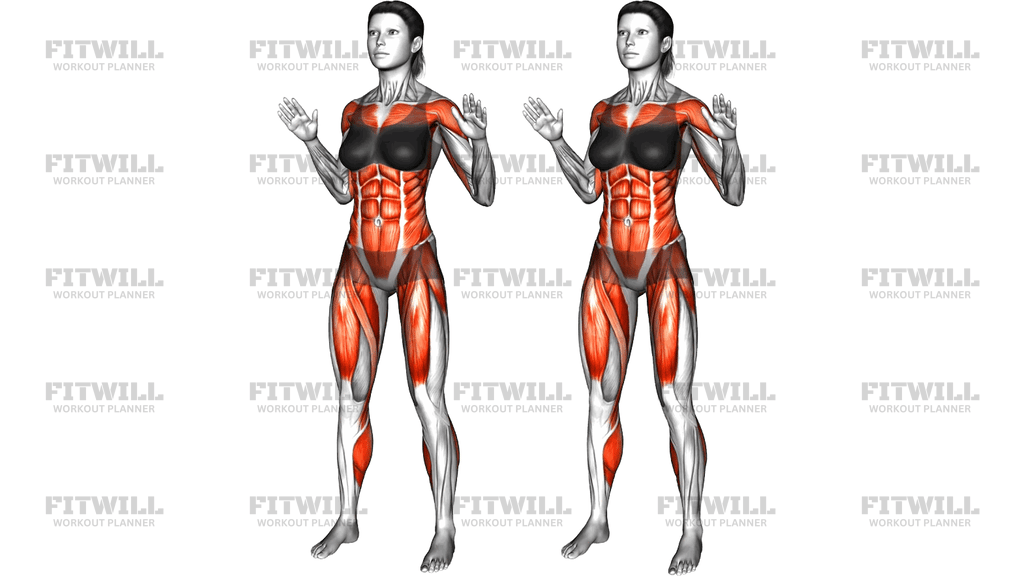
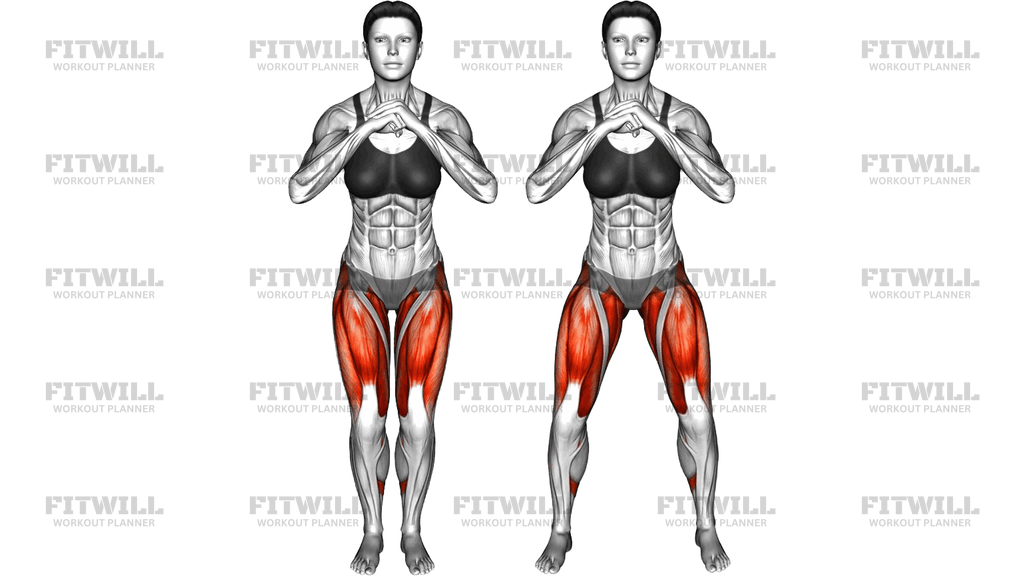
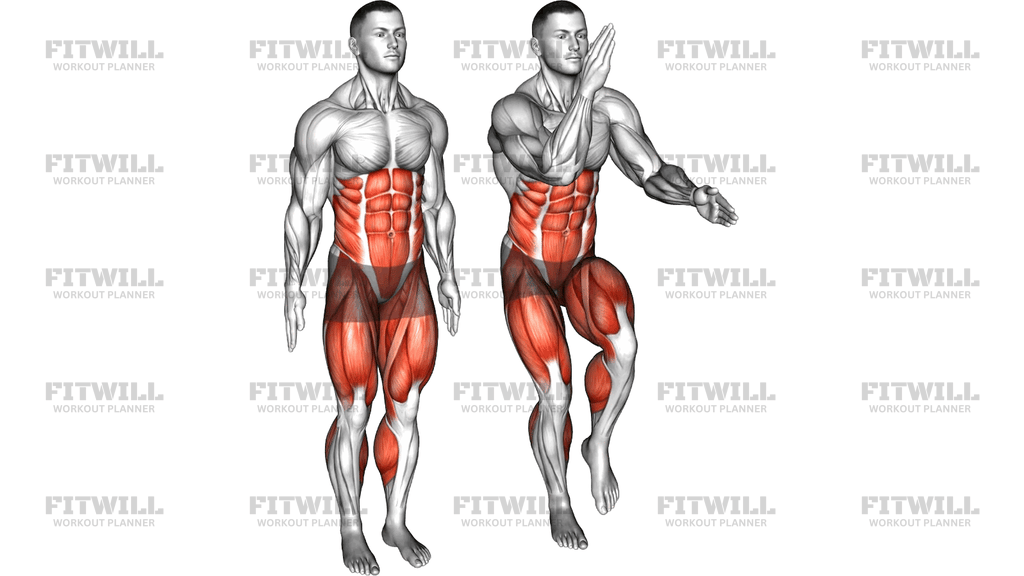
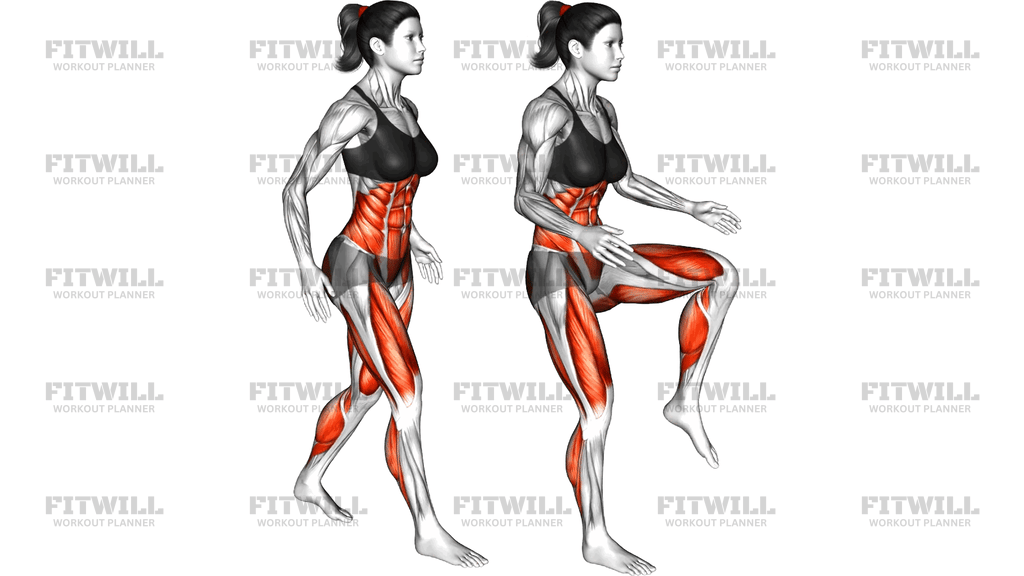
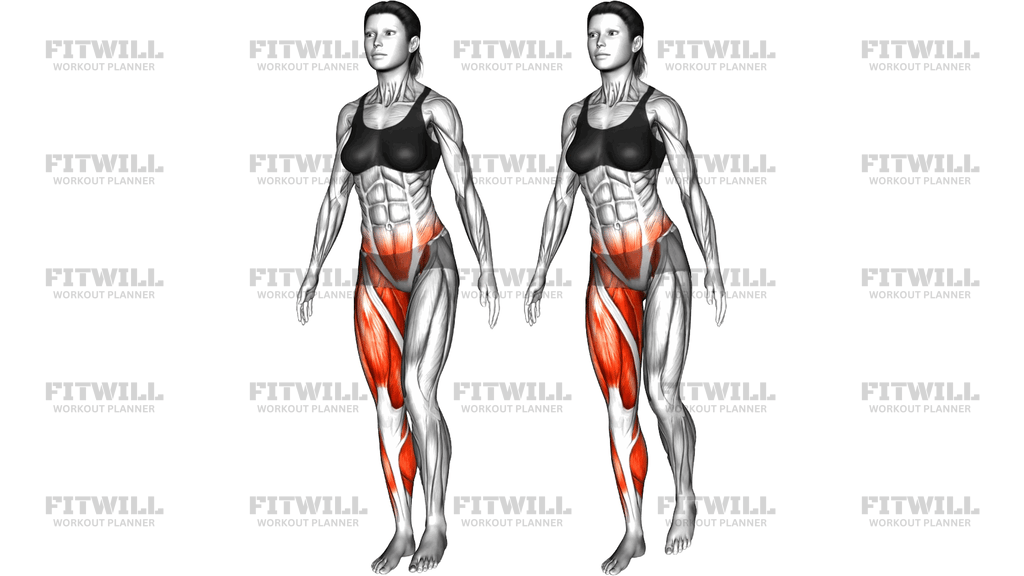
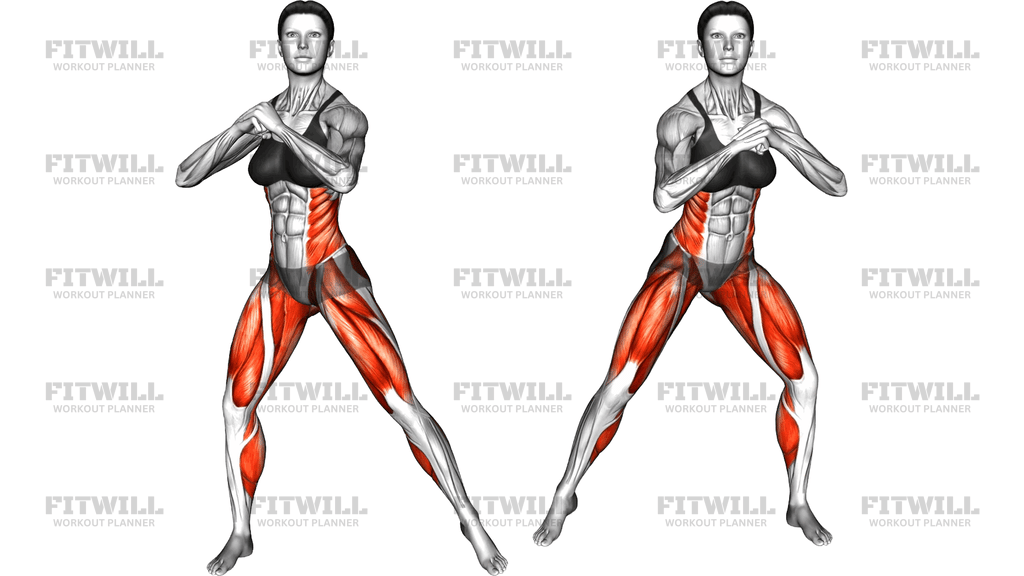
Walking On Spot Small Kick
Walking On Spot Small Kick is a low-impact, body weight marching movement performed entirely in place. You stand tall, alternately lift each knee, and finish each lift with a small, controlled kick of the lower leg before the foot returns to the floor. Because there is no forward travel and no jumping, the exercise keeps the workload on the thigh muscles while the heart and lungs do steady, moderate work in the background.
The movement mainly targets the quadriceps at the front of the thigh, which drive each knee lift and control the leg as it comes back down. The hip flexors raise the thigh, the calves handle the repeated push-off and landing at the ankle, and the hamstrings and glutes assist on the small kick and the return step. Holding an upright posture also asks the core to stay quietly engaged so the torso does not sway from side to side.
Setup matters more than most people expect for an exercise this simple. Standing with the feet roughly hip-width apart, weight balanced over the whole foot, and the ribcage stacked over the pelvis gives each lift a stable base. If you lean back or slump forward, the knee lifts get shorter and the lower back starts doing work the hips should be handling. Arms can swing naturally at your sides or bend into a light running arm action to add rhythm.
To perform it well, march at a pace you could hold for a minute or more, lifting each knee to about hip height or slightly lower, then extending the lower leg into a small, relaxed kick forward before setting the foot down under your body. The kick should be a short, easy extension from the knee, not a hard swing, and the landing should feel soft through the ankle and knee. Breathing stays even and conversational throughout.
This movement fits well as a warm-up before leg training, as an active recovery drill between harder sets or intervals, or as a standalone low-impact cardio option for beginners, older adults, or anyone who needs to keep training indoors without equipment. Because the intensity is easily scaled by pace and knee height, it works in almost any training space with nothing more than enough room to stand.
The main safety points are keeping the landing soft, avoiding any lockout snap at the knee during the kick, and stopping the set if your form shortens the steps or your posture breaks down. Slower, taller repetitions beat fast, slouched ones every time.
[ Workout Log & Planner ]
Put your next workout in Fitwill
Keep your plan and training log ready when you are.


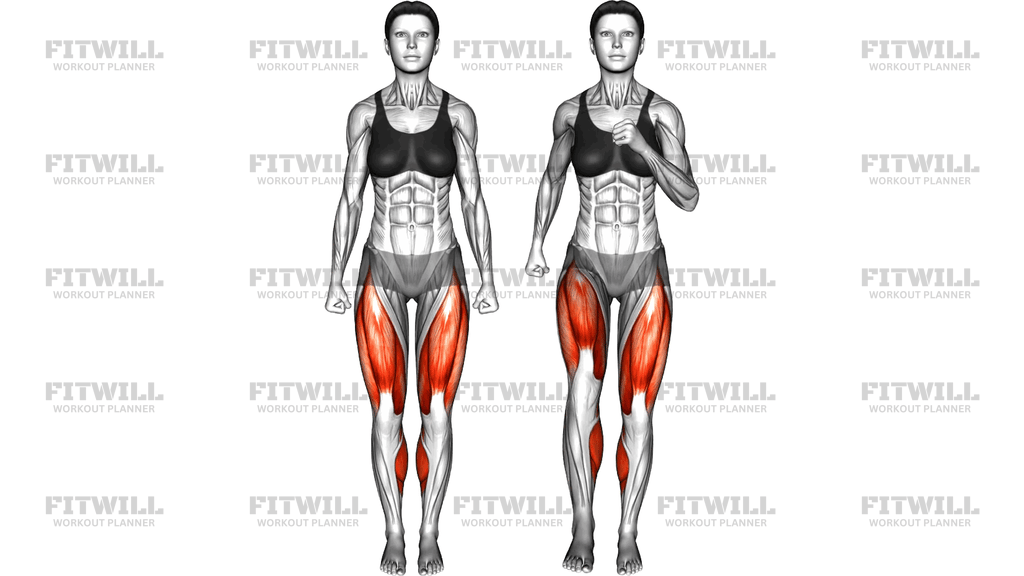
Instructions
- Stand upright with your feet hip-width apart, arms relaxed at your sides, and your weight spread evenly across both feet.
- Draw your shoulder blades gently back, lift the chest, and brace your core lightly so your ribcage sits directly over your pelvis.
- Shift your weight slightly onto your left foot and lift your right knee up to roughly hip height, keeping your torso tall.
- From the lifted-knee position, extend your right lower leg forward into a small, controlled kick, keeping the movement easy and unhurried.
- Lower your right foot back to the floor directly under your body, landing softly through the ball of the foot first.
- Repeat the same lift-and-kick pattern with the left leg, keeping your arms swinging naturally or bent in a light running arm action.
- Continue alternating legs at a steady rhythm, matching one breath cycle to every two to four steps.
- Keep the kick small, around a few inches of knee extension, so the knee never snaps fully straight under speed.
- When you finish, slow the pace down for several steps, bring both feet together, and stand still for a moment to let your breathing settle before moving on.
Tips & Tricks
- A common mistake is kicking hard and snapping the knee straight at the end of the movement; the kick should be a short, relaxed extension, not a strike.
- If your knees drift inward or collapse as you lift, imagine pressing the standing knee slightly outward and keep the lifting knee tracking over your toes.
- Watch for leaning back as the knee comes up; if you feel your lower back arch, reduce the knee height until you can stay stacked.
- Keep the landing under your hips rather than out in front, which turns each step into a soft heel-to-ball contact instead of a hard heel slam.
- Small quick steps at moderate height beat a few big high-knee attempts; the exercise rewards rhythm, not range.
- If your shoulders creep up toward your ears, let the arms swing from the elbow and consciously drop the shoulder blades down your back.
- On a hard floor, keep the landings even softer or use a mat, since the repeated low-grade impact adds up over a long set.
- To raise the difficulty, slightly increase pace or knee height; to lower it, shorten the kick and slow the tempo rather than stopping altogether.
- If you feel the work only in your hip crease and not in your thighs, pause a beat at the top of each lift so the quadriceps control the descent.
Frequently Asked Questions
What muscles does Walking On Spot Small Kick work?
The quadriceps at the front of the thigh do most of the visible work on each lift and lower, with the hip flexors raising the thigh. The calves, hamstrings, and glutes assist, and the core stays engaged to keep the torso upright.
How high should I lift my knee in Walking On Spot Small Kick?
Aim for about hip height or slightly lower as a default. If your back arches or your stride shortens, reduce the height until you can lift cleanly every repetition.
How big should the small kick actually be?
Just a few inches of knee extension, enough to feel the lower leg open out without snapping the knee straight. It is a rhythm element, not a strength movement, so keep it relaxed.
Is Walking On Spot Small Kick good for beginners?
Yes, it is one of the easiest low-impact cardio movements to learn because you stay in place and control the pace completely. Beginners can start with 20 to 30 seconds of slow marching and build from there.
Can I use Walking On Spot Small Kick as a warm-up?
It works well as a warm-up before squats, lunges, or running because it raises the heart rate and takes the hips, knees, and ankles through a natural gait range without impact.
What is the most common mistake with this movement?
Rushing the kick so the knee snaps into full extension, or leaning back as the knee lifts. Both issues are fixed by slowing the tempo and keeping the ribcage stacked over the pelvis.
How is Walking On Spot Small Kick different from high knees?
High knees emphasize rapid, forceful lifts with more impact and a higher heart rate response. This version stays lower impact, adds the small kick for rhythm and hamstring involvement, and is easier to sustain for longer periods.
What can I do if I need an easier version?
Lower the knee height, remove the arm swing, slow the pace, or hold onto the back of a sturdy chair for balance. Each adjustment reduces the demand without changing the movement pattern.
Is it safe to do this exercise every day?
For most people, yes, since it is low intensity and low impact at a moderate pace. If you have knee, hip, or ankle issues, keep the kick small, land softly, and stop if the joints complain rather than push through discomfort.