Double Woodchopper
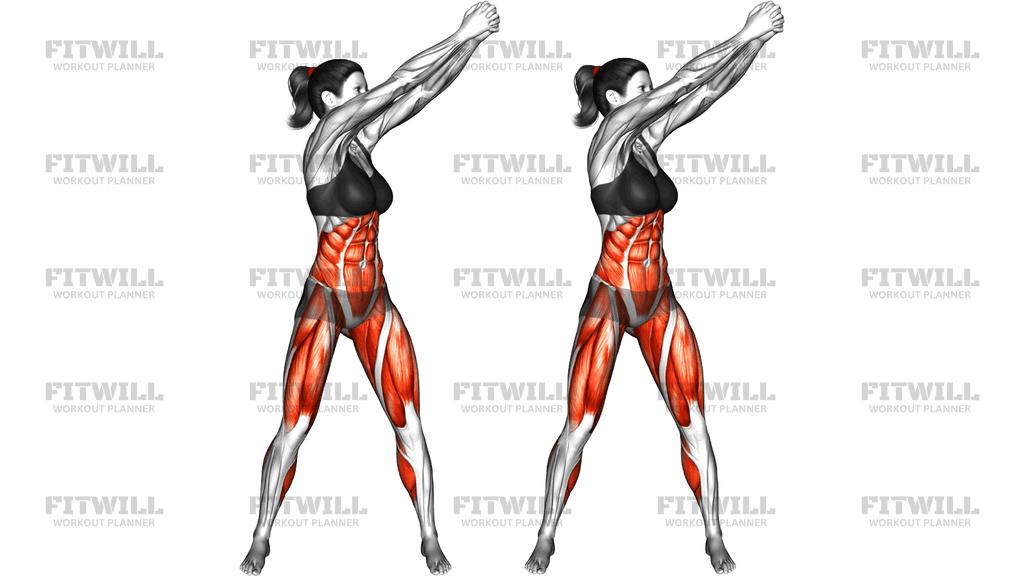
The Double Woodchopper is a bodyweight rotational exercise that mimics the diagonal swing of chopping wood, but with both hands clasped together instead of holding a tool. From a wide, bent-knee stance, you sweep your clasped hands in a long diagonal arc across your body, finishing with your arms extended overhead on the opposite side, then reverse the path back down. It is essentially a chop and lift pattern performed on both sides, which makes it one of the simplest ways to train rotation without any equipment.
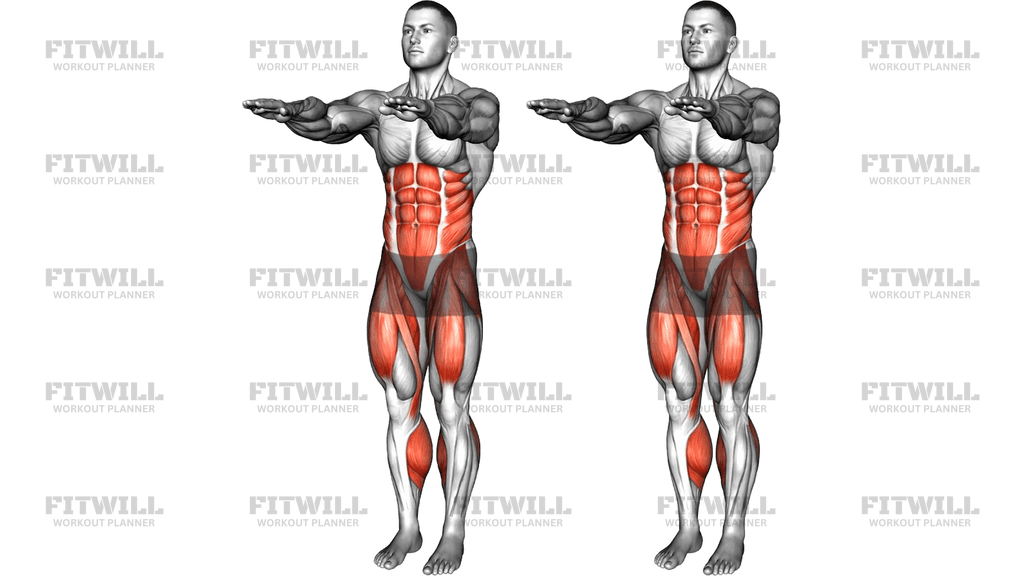
Because no load is required, this movement works well for warm-ups, home workouts, group classes, and anyone rebuilding rotational strength after spending most of their training on linear exercises like squats and presses. The wide stance with a deep knee bend loads the thighs and glutes isometrically, while the sweeping arm path drives rotation through the waist. The rectus abdominis controls the flexion component, the internal and external obliques handle the twist, and the shoulders and upper back work to keep the arms long and the arc smooth.
Setup matters more than it looks. Your feet position determines how much rotation your hips can contribute, so planting them wide with toes turned slightly out lets you pivot naturally instead of forcing the twist through your knees or lower back. Keep the spine long as you hinge, and let the movement come from the hips and waist rather than from rounding or collapsing forward.
To execute it well, think of your hands as the head of an axe and your torso as the handle. The arms stay nearly straight throughout, and the power comes from driving the hips through as the hands travel the diagonal. Rushing the swing is the most common error; the return leg of the arc is where the core does its best work, so lower the hands with the same control you used to raise them.
A practical way to program the Double Woodchopper is to alternate sides each rep or complete all reps on one side before switching, aiming for 10 to 15 controlled repetitions per side. It pairs nicely with planks and bridges in a core circuit, or it can open a lower body session as an active warm-up that raises your heart rate while mobilizing the hips and thoracic spine.
[ Workout Log & Planner ]
Put your next workout in Fitwill
Keep your plan and training log ready when you are.


Instructions
- Stand with your feet roughly twice shoulder-width apart, toes turned out slightly, and soften your knees into a shallow, sustainable bend.
- Clasp your hands together with arms extended long in front of your thighs, as if gripping the handle of an axe with both hands.
- Brace your abdominal wall and hinge your hips back slightly, keeping your chest tall and your weight spread across both feet.
- Begin the chop by shifting your weight toward one leg and sweeping your clasped hands in a diagonal arc up across your body.
- Finish with your arms extended overhead toward the opposite side, hips fully extended and standing tall at the top of the arc.
- Reverse the exact same path, lowering your hands under control back down across your body toward the starting side.
- Exhale as you sweep upward, and inhale as you lower the hands back down through the arc.
- Keep your heels grounded and let your back foot pivot naturally as your torso rotates; avoid twisting through the knee joint.
- Complete your reps on one side or alternate sides each repetition, resetting your stance and brace between sets.
Tips & Tricks
- If your lower back complains at the top of the arc, shorten the diagonal slightly rather than leaning backward; the finish should feel tall, not arched.
- A common mistake is bending and straightening the elbows to fake the swing. Locked-long arms force the obliques and hips to actually produce the rotation.
- Keep your weight centered over the whole foot. Shifting onto the toes as you rotate usually means the stance is too narrow for your hip mobility.
- Move deliberately on the downward sweep. Letting the arms free-fall back to the start removes most of the core work from the exercise.
- If your shoulders tire before your waist does, imagine the hands being pulled by the torso instead of lifted by the shoulders.
- For a bigger thigh and glute contribution, deepen the knee bend at the start of each rep and drive up through the floor as the hands rise.
- Widen your grip by overlapping the hands rather than interlacing the fingers; interlaced fingers tend to pull the shoulders inward as you swing.
- If your hips feel pinched in the wide stance, reduce the width and turn your toes out a little more so the rotation comes from the hip, not the knee.
Frequently Asked Questions
Which muscles does the Double Woodchopper work the most?
The abdominal wall, especially the rectus abdominis and the internal and external obliques, drives the rotation. The quads and glutes hold the wide bent-knee stance, while the shoulders and upper back keep the arms extended through the arc.
Is the Double Woodchopper suitable for beginners?
Yes, because it uses no external load and the resistance comes from your own body control. Beginners should use a narrower stance and a shorter arc until the hip rotation feels smooth and pain-free.
Should I alternate sides each rep or finish one side first?
Both work. Alternating sides each rep keeps the movement fluid and works well in warm-ups, while completing all reps on one side makes it easier to notice and correct left-right imbalances.
Why is the stance so wide in the Double Woodchopper?
The wide stance creates a stable base and gives your hips room to rotate, which protects the knees and lower back. It also keeps the quads and inner thighs engaged isometrically throughout the set.
Can I add weight to the Double Woodchopper?
Yes, holding a light medicine ball, plate, or dumbbell between the clasped hands is a natural progression. Only add load once you can keep the arms long and control the return phase for all prescribed reps.
Why do my knees twist when I chop overhead?
This usually means the feet are planted straight ahead and too narrow, forcing rotation into the knee joint. Turn the toes out slightly and let the back heel lift and pivot naturally as the torso rotates.
What can I use instead of the Double Woodchopper if I have a cable machine?
A cable woodchopper or lift-to-chop with a single handle trains the same diagonal pattern with adjustable resistance. The bodyweight version remains valuable because both sides work symmetrically with no setup time.
How does the Double Woodchopper differ from a regular wood chop exercise?
A standard wood chop typically uses one arm or a weighted implement from high to low, while the Double Woodchopper uses both hands together and travels low to high and back. The double-arm version spreads the demand across both sides of the body evenly on every rep.
Is it safe for my lower back?
When performed with a braced core, tall chest, and rotation coming from the hips and waist rather than spinal rounding, it is a controlled rotational drill. Keep the arc within a comfortable range and avoid jerky, ballistic swings, especially at the top.