Weighted Bottle Standing Shrug
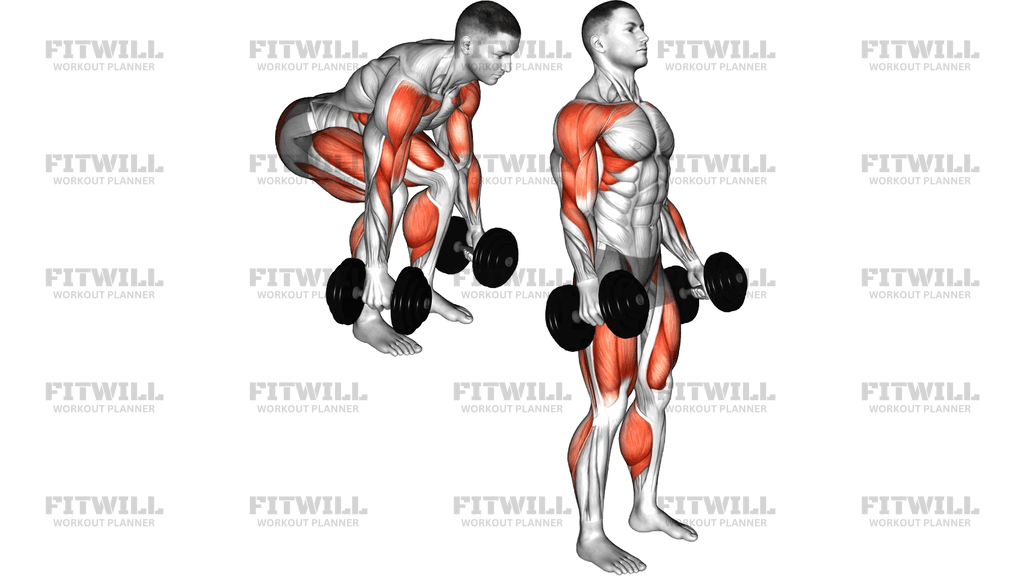
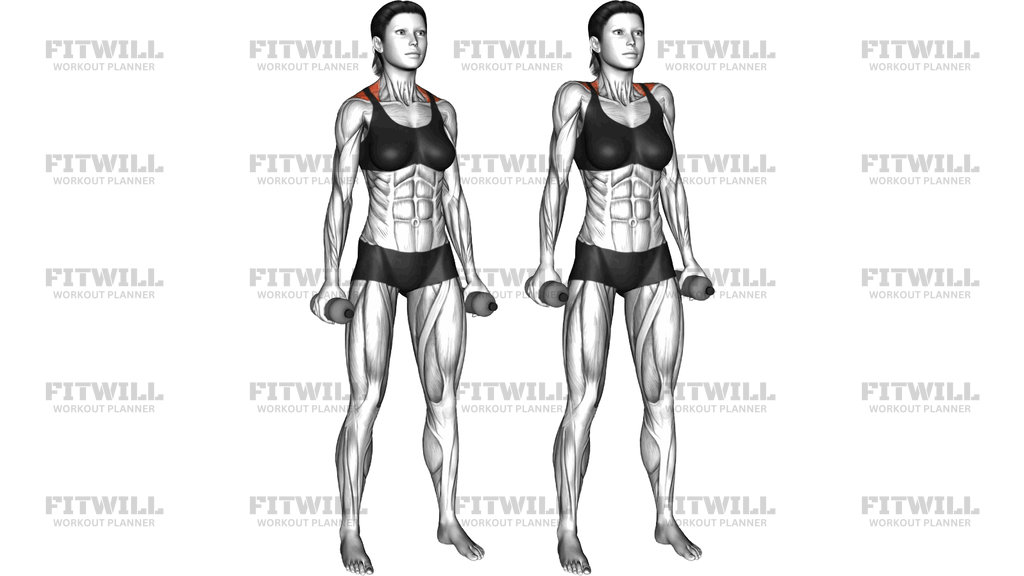
The Weighted Bottle Standing Shrug is a simple upright shrug performed while holding a weighted bottle or light dumbbell in each hand at your sides. From a tall standing position, you lift your shoulders straight up toward your ears, pause briefly at the top, and lower them back down under control. Because the resistance hangs directly at your sides, the movement stays in a straight vertical line, which makes it one of the easiest shrug variations to learn and to load gradually.
The main muscle at work is the upper trapezius, the diamond-shaped muscle that runs from the base of your skull and along the top of your shoulders. The middle traps assist as you hold the top position, while your forearms and grip work the entire set just to hold onto the weight. Since the arms stay relaxed and straight, there is very little elbow or shoulder joint involvement, which keeps the stress focused on the traps themselves.
This version suits beginners especially well because the bottles are light, easy to hold, and comfortable to grip compared to a loaded barbell. It is also useful for desk workers who carry tension in the shoulder and neck area and want a controlled way to strengthen the upper traps, or for lifters who want a high-rep finishing movement after heavier trap work.
Setup matters more than it looks. Standing with your feet about hip-width apart, a braced torso, and the weights hanging at arm's length beside your thighs keeps the pull vertical. If you lean back, crane your neck, or let the weights drift forward, your shoulders stop doing the work and you start recruiting other muscles or straining the neck.
To execute the movement well, think of shrugging up, not rolling. Raise your shoulders as high as they will go without bending your elbows, hold for a beat, then lower all the way down until you feel a slight stretch at the bottom before starting the next rep. Small, clean reps beat big bouncing ones every time.
In practice, this exercise appears in warm-up blocks, posture-focused programs, and light conditioning circuits. Its low technical demand means you can perform it almost anywhere, and its controlled range makes it a safe first introduction to direct trap training.
[ Workout Log & Planner ]
Put your next workout in Fitwill
Keep your plan and training log ready when you are.


Instructions
- Stand tall with your feet about hip-width apart and hold one weighted bottle in each hand, palms facing your body.
- Let your arms hang fully straight at your sides so the bottles rest just outside your thighs, and set your feet flat on the floor.
- Draw your shoulder blades down slightly, brace your abdominal muscles, and keep your ribs stacked over your hips.
- Keep your chin level and your eyes forward, avoiding any urge to push your head forward or down as you lift.
- Exhale and raise both shoulders straight up toward your ears as high as possible without bending your elbows.
- Pause for one to two seconds at the top, squeezing the traps hard.
- Inhale as you lower your shoulders slowly back down until your traps feel slightly stretched at the bottom.
- Complete your target number of reps with a brief stop at the bottom of each rep to prevent bouncing.
- When finished, set the bottles down on the floor by hinging at your hips with a flat back, then shake out your shoulders and neck before your next set.
Tips & Tricks
- Do not bend your elbows to gain height; bent elbows turn the movement into a partial lateral raise and steal work from the traps.
- Avoid rolling your shoulders backward or forward in circles; the weighted bottle shrug works best as a straight up-and-down path.
- If you feel the work in your neck rather than the top of your shoulders, reduce the range slightly and focus on lifting the shoulder blades rather than jamming your head down.
- Keep the bottles from drifting in front of your thighs; if the weight swings forward, your shoulders are rotating internally and the pull line is broken.
- Do not bounce out of the bottom; the slight stretch at the lowest point is where a lot of trap fibers get loaded, and bouncing skips it.
- If your grip gives out before your traps feel tired, use a firm but relaxed hold and consider a bottle with a wider or textured body rather than cutting the set short.
- Keep your torso perfectly still; leaning back to heave the weights up turns the exercise into a back and hip movement.
- Higher reps with a one-second top squeeze work well here since the load is light; chase muscle tension, not total weight.
- If one shoulder rises higher than the other, slow down and perform a few single-arm sets to even out the movement.
Frequently Asked Questions
What muscles does the Weighted Bottle Standing Shrug work?
The upper trapezius is the primary muscle, with the middle trapezius assisting at the top of the lift. Your forearms and grip work continuously just to hold the bottles.
Is the Weighted Bottle Standing Shrug good for beginners?
Yes. The vertical movement path, light load, and comfortable bottle grip make it one of the easiest shrug variations to learn proper trap control before progressing to heavier dumbbells or a barbell.
How high should I lift my shoulders during the Weighted Bottle Standing Shrug?
Lift them as high as they comfortably travel toward your ears without tilting your head or bending your elbows. A one- to two-second pause at the top matters more than extra height.
Why do I feel the Weighted Bottle Standing Shrug in my neck instead of my traps?
This usually happens when the head pushes forward or down as you shrug, shifting tension to the neck muscles. Keep your chin level and think about lifting the shoulder blades up rather than pressing your head into your shoulders.
Should I roll my shoulders while doing the Weighted Bottle Standing Shrug?
No. Shoulder rolling adds no extra trap benefit and puts your shoulder joints through a loaded circle. A straight vertical shrug with a pause at the top is safer and more effective.
Can I substitute the Weighted Bottle Standing Shrug with dumbbells or a barbell?
Yes. Any weight held at your sides works, and heavier dumbbells are a natural step up. A barbell shrug loads more weight but requires a front-of-thigh hold, so the bottles version remains easier on the grip.
How many reps should I do of the Weighted Bottle Standing Shrug?
Because the load is typically light, sets of 12 to 20 reps with a controlled pause at the top work well. Stop the set when you can no longer reach your full shrug height.
Is it safe to do the Weighted Bottle Standing Shrug every day?
Light shrugs are generally well tolerated, but the traps still need recovery like any muscle. Two to four sessions per week with at least a day between direct trap work is a sensible rhythm.
My grip fails before my traps do on the Weighted Bottle Standing Shrug. What should I change?
Hold the bottles firmly but without squeezing excess tension into your forearms, and consider using containers with a slightly wider body. You can also use lifting straps once you progress to heavier dumbbells.