Sitting Press Up On A Chair
The Sitting Press Up On A Chair is a simple bodyweight exercise where you sit upright on a sturdy chair, place your palms flat on the seat directly beside your hips, and press down through your hands to lift your body slightly off the seat. Your arms straighten as your hips and thighs rise a few centimeters into the air, then you lower yourself back down with control. It looks almost too easy to be effective, but that short vertical press is a genuine upper-body pushing movement, and the highlighted muscles in the demonstration show exactly why: the chest and front of the shoulders drive the press while the triceps finish the lift.
Because it uses a chair you already have and a range of motion of only a few inches, this exercise is an excellent entry point for people who are new to strength training, returning after a long break, or working out at home without any equipment. It is also useful for older adults who want to maintain the arm strength needed for everyday tasks like rising from a low seat, pushing off a bed, or lifting themselves out of a bath. The seated position takes load off the legs entirely, so it isolates the upper-body push pattern in a way that full standing push-ups do not.
The setup matters more than it appears. Your hands need to be placed right next to your hips, fingers pointing forward or slightly outward, with your knuckles level with the edge of the seat. If your hands drift too far forward toward your knees, the press turns into an awkward lean and puts unnecessary strain on the shoulders. Sit tall with a neutral spine, feet flat on the floor about hip-width apart, and your head stacked over your ribcage before you begin pressing.
Execution is straightforward but benefits from precision. Exhale as you press firmly through your palms, straighten your elbows, and let your hips float up off the seat until your arms are nearly fully extended. Pause briefly at the top, then lower yourself down slowly rather than dropping back onto the chair, taking two to three counts for the descent. That controlled lowering phase is where much of the strength benefit lives, so resist the urge to let gravity do the work.
Common use cases include home circuits, desk-break routines, warm-ups for heavier pressing work, and chair-based programs for seniors or people in rehabilitation settings under professional guidance. Practical safety points are few but important: choose a chair without wheels and with a solid, stable seat, keep the movement small and pain-free at the shoulder joint, and stop if you feel any sharp sensation in the wrists, elbows, or shoulders. As your strength grows, you can slow the tempo, add a longer pause at the top, or progress toward full dips and push-ups using the same chair.
[ Workout Log & Planner ]
Put your next workout in Fitwill
Keep your plan and training log ready when you are.


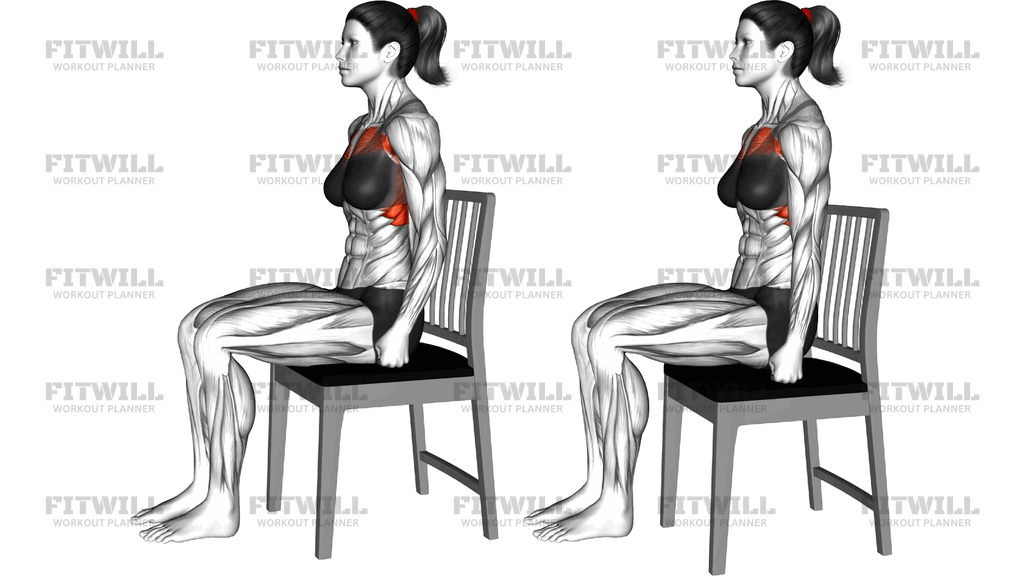
Instructions
- Choose a stable, armless chair on a non-slip floor and sit on the front half of the seat with a tall, upright torso.
- Place both palms flat on the seat directly beside your hips, fingers pointing forward, with the edge of the seat brushing the outside of each hand.
- Set your feet flat on the floor about hip-width apart with your knees bent to roughly ninety degrees.
- Draw your shoulder blades gently down and back, brace your abdominal muscles, and keep your gaze straight ahead so your head stays in line with your spine.
- Exhale and press firmly down through your palms, straightening your elbows to lift your hips and thighs a few centimeters off the seat.
- Hold the lifted position for one to two seconds with your arms nearly fully extended and your shoulders pressed away from your ears.
- Inhale as you bend your elbows slowly and lower your body back onto the seat over two to three controlled counts.
- Briefly release the tension, reset your posture, and repeat for your target number of repetitions.
- Keep your hips and torso moving straight up and down over the seat; avoid leaning forward or letting your shoulders round as you press.
Tips & Tricks
- The most common mistake is placing the hands too far forward toward the knees, which turns the lift into a forward lean and loads the shoulder joint awkwardly; keep your palms level with the sides of your hips.
- Avoid shrugging your shoulders up toward your ears at the top of the press — actively push the seat away and keep your upper traps relaxed.
- Do not drop back onto the chair after the lift; the slow lowering phase builds triceps and chest strength just as much as the press itself.
- If your wrists complain, turn your fingers slightly outward or grip the front edge of the seat with your thumbs beside your thighs to keep the wrists straighter.
- Keep the lift small and honest: a clean three-centimeter rise with straight elbows beats a bigger hop that comes from bouncing your legs.
- Press your thighs together lightly and engage your glutes as you lift so your lower body moves as one solid unit instead of dangling.
- Breathe out on the press and in on the lowering; holding your breath is a common sign the set is too hard for your current strength.
- If a wooden chair slides on a smooth floor, put it against a wall or place a non-slip mat under the legs before you start.
- When bodyweight presses become easy, slow the tempo to a four-second lower, or elevate your hands slightly on two stacked firm books to increase the range.
Frequently Asked Questions
What muscles does the Sitting Press Up On A Chair work?
The main movers are the triceps, which straighten your elbows, supported by the chest and the front of the shoulders. The upper back and core stabilize your torso as you lift and lower.
Is the Sitting Press Up On A Chair suitable for complete beginners?
Yes, it is one of the most accessible upper-body presses because the range of motion is short and your legs stay supported on the floor. Start with a small lift and focus on smooth, controlled lowering.
How far should my hips rise during the Sitting Press Up On A Chair?
Only a few centimeters — just enough to clear the seat with straight elbows. Lifting higher usually means leaning forward or kicking off your legs, which shifts the work away from the arms and chest.
Why do my shoulders shrug when I press up from the chair?
This usually means the upper traps are taking over because the arms are not yet strong enough to do the press alone. Lower the height of the lift and consciously push the seat away while keeping your shoulder blades drawn down.
What kind of chair is safe for the Sitting Press Up On A Chair?
Use a sturdy, armless chair with four legs, a flat seat, and no wheels, ideally placed against a wall on a non-slip surface. Folding chairs and rolling office chairs are not stable enough for this movement.
My wrists hurt when pressing up on a chair — what should I change?
Turn your fingers slightly outward and make sure your palm sits fully flat on the seat so the wrist is not bent sharply to one side. If discomfort persists, reduce the range or work on wrist mobility before continuing.
How does the Sitting Press Up On A Chair compare to a regular push-up?
The chair version is far easier because your legs support part of your weight and the range of motion is much shorter. It is a logical stepping stone before progressing to incline or full floor push-ups.
How many repetitions of the Sitting Press Up On A Chair should I do?
Start with two to three sets of eight to twelve controlled repetitions, resting about a minute between sets. Adjust the number so the last two reps of each set feel challenging but still smooth.
Can I do the Sitting Press Up On A Chair if I am older or recovering from a break in training?
It is often used in chair-based and senior strength programs because it rebuilds practical pushing strength for daily tasks. If you are returning from an injury or surgery, check with your doctor or physical therapist before adding it to your routine.