Standing Front Leg Lift Cross Toe Touches Side Ben
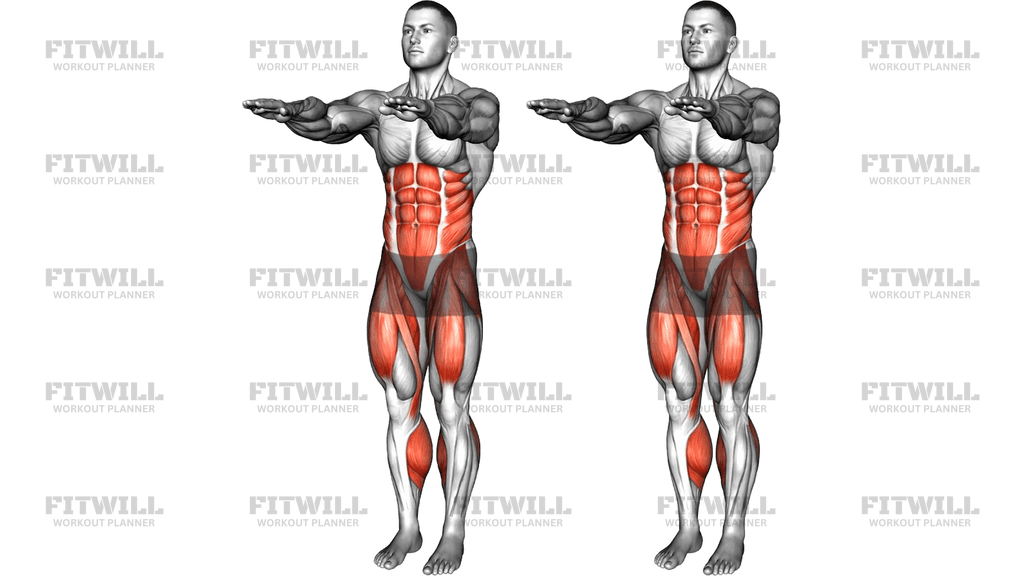
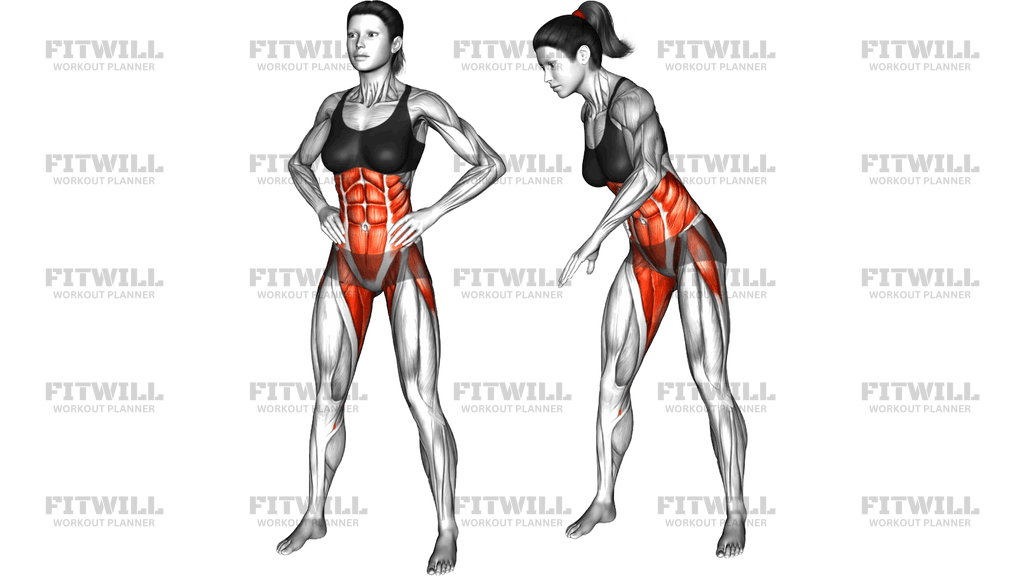
Standing Front Leg Lift Cross Toe Touches Side Bend is a body weight core exercise that combines three challenges into one flowing movement: holding one leg lifted in front of you, reaching the opposite hand across your body toward the toes of that lifted foot, and bending sideways through the torso. Your arms stay extended out to your sides in a T position, which acts as a counterbalance and makes every wobble immediately obvious. Because there is no equipment involved, the only resistance is your own body, and the difficulty comes from controlling your torso and leg against gravity.
The muscles doing most of the work are the abdominals, which brace and shorten as you reach across, and the obliques, which drive the side bend and the cross-body rotation. The hip flexors and quadriceps of the lifted leg work hard isometrically to keep the foot raised for the entire rep, while the standing leg and the small stabilizers around the ankle and hip handle balance. This is why the exercise trains far more than just the front of the stomach: it teaches your trunk and lower body to coordinate under unstable conditions.
This movement suits people who want core strength that carries over to standing, real-world tasks rather than only floor-based crunching. It is useful in warm-ups, circuit training, and general conditioning programs, and it is particularly valuable for anyone whose training lacks single-leg balance work. Athletes in sports with rotational demands, such as tennis, golf, or throwing sports, will recognize the cross-body reaching pattern. At the same time, beginners can scale it easily by lifting the leg lower and reducing the reach.
Setup matters more than it looks. Stand tall with your feet together or nearly together, arms raised straight out to shoulder height, and your weight centered over the whole foot of the standing leg. Before you move, brace your stomach as if preparing for a light push. If you start the rep with a loose trunk, the first side bend will collapse you toward the lifted leg instead of reaching over it with control, and you will feel it in your lower back rather than your abs.
To execute it well, lift one leg straight out in front to roughly hip height or slightly lower, keep the knee extended, and pause long enough to feel stable. Then exhale, reach the opposite hand across your body toward the toes of the lifted foot, letting your torso side bend and rotate slightly while the other arm sweeps back for balance. Return along the same path to the T position, lower the leg with control, and repeat on the other side. The tempo should be smooth and deliberate; the reaching portion should take a full second or more rather than a quick swipe.
A few practical points will keep this exercise productive. Move within a range where your torso stays long and your ribs do not flare or crunch downward, and stop the reach at the point where your toes can no longer be approached without rounding your whole spine. If your lifted leg drops as you reach, that is a sign the combination is too demanding right now, so shorten the reach instead of sacrificing the leg position. Perform equal reps on both sides, and expect the balance demands to feel different on each side, which is normal for single-leg standing work.
[ Workout Log & Planner ]
Put your next workout in Fitwill
Keep your plan and training log ready when you are.


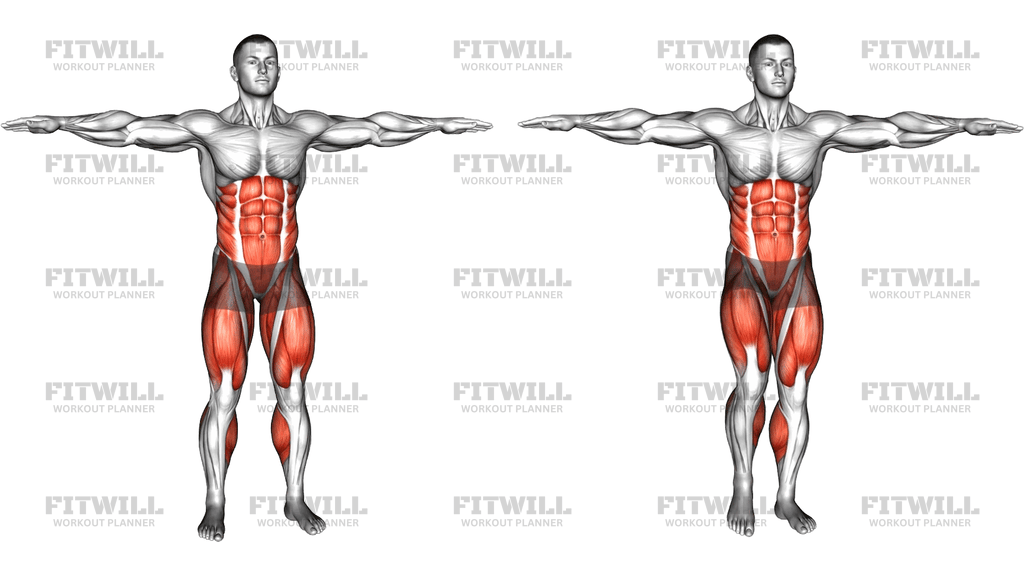
Instructions
- Stand upright with your feet together or hip-width apart and your weight spread evenly across the whole foot of what will be your standing leg.
- Raise both arms straight out to your sides until they are level with your shoulders, forming a T shape with your torso.
- Brace your abdominal muscles and pull your shoulder blades gently back so your torso is long and stable before any movement begins.
- Shift your weight onto one leg and lift the other leg straight out in front of you to about hip height, keeping the knee extended and the toes pulled back.
- Hold the lifted position briefly until you feel balanced on the standing leg.
- Exhale and reach the hand opposite to the lifted leg across your body toward the toes, allowing your torso to side bend and rotate slightly while the opposite arm swings back to counterbalance.
- Pause for a moment at your deepest controlled reach, keeping the lifted leg from dropping and the standing knee from caving inward.
- Inhale and slowly return your torso upright and your arm back out to the T position while the leg stays lifted.
- Lower the lifted leg to the floor with control, reset your stance and brace, then repeat the reach on the opposite side.
- Breathe steadily throughout, exhaling on the reach and inhaling on the return, and complete an equal number of repetitions per side.
Tips & Tricks
- A common mistake is dropping the lifted leg as you reach across, which turns the exercise into a simple side bend. If this happens, lift the leg slightly lower so you can hold its height through the entire reach.
- Do not let the reach collapse your chest down toward the knee. Think of reaching across and over the toes with a long spine rather than curling your upper back.
- If you wobble badly on the standing leg, widen your base by placing the non-working foot a few inches from the standing leg between reps instead of holding a narrow stance the whole set.
- Avoid locking the standing knee hard. A soft knee with tension in the thigh and glute keeps the hip steady and protects the joint during the side bend.
- Keep both shoulders away from your ears with arms genuinely straight at shoulder height; shrugging turns the T position into a trap-dominant hold and tires your neck.
- The reach should feel like it happens at your waist and ribs. If you feel a strain in your lower back, reduce the range of the side bend and re-brace before continuing.
- Control the tempo deliberately: about one second to reach, a brief pause, and one second back. Rushing turns the exercise into momentum-driven swinging.
- Point the toes of the lifted foot toward the ceiling rather than letting the foot flop, which helps keep the quadriceps and hip flexors engaged.
- If balance is the limiting factor, hold the T position with one hand lightly resting on a wall or sturdy frame until your single-leg stability improves.
Frequently Asked Questions
What muscles does Standing Front Leg Lift Cross Toe Touches Side Bend work?
The abdominals and obliques do the main work during the reach and side bend, while the hip flexors and quadriceps hold the lifted leg in place. The standing leg muscles and ankle stabilizers contribute to balance throughout.
Is the Standing Front Leg Lift Cross Toe Touch Side Bend suitable for beginners?
Yes, as long as the range is scaled down. Beginners can lift the leg to knee height, shorten the reach, and stand near a wall for support until balance and core control improve.
Why do my arms stay out to the sides in this exercise?
The T-shaped arm position acts as a counterbalance during the single-leg stance and lengthens the lever your torso must control during the side bend. Dropping the arms makes the movement significantly easier but less effective.
How high should I lift the front leg during Standing Front Leg Lift Cross Toe Touches?
Aim for roughly hip height with a straight knee, but choose whatever height lets you keep the leg elevated through the full reach. Height matters less than holding the position without the leg sinking.
Can I touch my toes, or should I just reach toward them?
Actual contact with the toes depends on your flexibility and limb length, and it is not required. Reach across toward the toes to the point where your torso stays long and the side bend comes from your waist rather than rounding your whole back.
Why do I feel this more in my lower back than my abs?
This usually means the side bend is happening at the lumbar spine because the trunk is not braced, or the reach is too deep. Stop earlier in the range, tighten your stomach before lifting the leg, and keep your chest tall throughout the reach.
What can I substitute for the Standing Front Leg Lift Cross Toe Touch Side Bend?
Standing cross-body toe touches without the leg lift work if balance is the limiting factor, and standing oblique crunches or lying cross-toe touches train similar trunk muscles with less stability demand.
How many reps should I do per side?
Eight to twelve controlled repetitions per side is a practical starting range. Because the exercise is body weight and balance-dependent, prioritize smooth tempo and equal work on both sides over high rep counts.
Is it a problem that one side feels harder than the other?
No, slight side-to-side differences in balance and reach are common. Train both sides with the same number of quality repetitions rather than adding extra reps to your weaker side.