Standing Quadriceps Stretch With A Chair
The Standing Quadriceps Stretch With A Chair is a supported standing stretch that targets the quadriceps on the front of the thigh, with extra attention to the rectus femoris, the quad muscle that crosses both the hip and the knee. Instead of grabbing your ankle with your hand as in the classic standing quad stretch, you rest the top of your rear foot on a chair seat behind you, which lets gravity and your body position do the work. This makes it a solid option for anyone who struggles to reach their ankle, has tight shoulders or limited wrist mobility, or simply wants a more stable and controllable stretch.
The setup is straightforward: stand facing away from a sturdy chair, place the top of one foot on the seat, and keep your standing leg planted in front of you. From there you adjust the intensity by moving your front foot forward, bending the front knee, or lowering the back knee toward the floor. Because the chair takes over the job of holding the foot, your hands are free to rest at your sides, on your hips, or lightly on a wall for extra balance.
This stretch is especially useful for runners, cyclists, and anyone who spends long hours sitting, since prolonged sitting shortens the rectus femoris and the hip flexors and can leave the front of the thigh feeling tight and heavy. It also fits well into a leg day warm-down, a general mobility routine, or a rehab-style program after the quad muscles have been loaded with squats, lunges, or sprint work. Because it is performed standing and one leg at a time, it gently challenges balance and hip stability as well.
The position of the chair matters more than most people expect. Placing the chair close enough that the rear shin hangs fairly vertical puts the emphasis squarely on the quads, while allowing the rear knee to drift back adds a hip flexor component. Keep your torso tall and your ribs stacked over your pelvis; if you lean the chest forward or arch the lower back to chase a bigger sensation, you actually shorten the rectus femoris at the hip and reduce the effectiveness of the stretch.
Move into the stretch gradually and breathe steadily while you hold it. A mild to moderate pulling sensation along the front of the thigh is the goal, never sharp pain in the knee or a pinching feeling at the front of the hip. Hold each side for roughly 20 to 40 seconds, and repeat on the tighter leg if needed. If your balance is shaky at first, practice next to a wall so you can place a fingertip on it for support.
[ Workout Log & Planner ]
Put your next workout in Fitwill
Keep your plan and training log ready when you are.


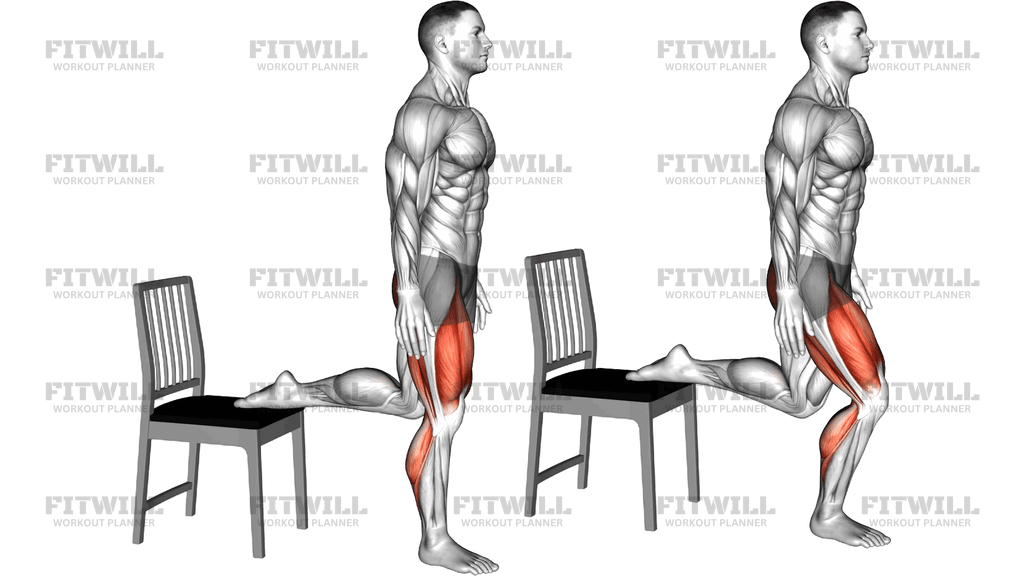
Instructions
- Place a sturdy chair behind you with the seat at roughly knee height, and make sure it will not slide on the floor.
- Stand facing away from the chair, then bend your right knee and rest the top of your right foot on the seat so your shoelaces face down and your toes point back.
- Step your left foot forward until you can stand tall with your feet roughly hip-width apart in the front-to-back direction, keeping your weight through the standing leg.
- Engage your core gently and tuck your tailbone slightly so your lower back stays neutral and your ribs stay stacked over your pelvis.
- Bend your left knee and sink your hips straight down, letting the right knee travel toward the floor behind you until you feel a steady pull along the front of the right thigh.
- Keep your torso upright throughout; do not lean your chest forward or let the lower back arch as you deepen the position.
- Hold the end position for 20 to 40 seconds, breathing slowly and evenly, letting the exhale help the muscle release a little more.
- To come out, press through your left foot, straighten the front leg, and lift the right foot off the chair with control.
- Switch sides and repeat the stretch on the left leg, using the same chair position and hold time.
- If you wobble, place one hand lightly on a wall or the chair back for balance rather than forcing the position.
Tips & Tricks
- If you feel the stretch mostly in the knee rather than the thigh, the chair is probably too far away or your rear knee is tracking too far back; bring the front foot slightly closer and keep the rear knee pointing straight down.
- Keep the hips square to the front. Many people let the pelvis rotate open toward the rear leg, which turns the stretch into more of a hip flexor stretch and reduces the pull on the quads.
- The tuck of the pelvis is what separates a productive stretch from a wasted one. Squeezing the glute of the stretching leg flattens the lower back and lengthens the rectus femoris across the hip.
- Do not force the rear knee all the way to the floor on the first attempt. Start with a small descent and let the range improve over several sessions.
- If the top of your foot feels uncomfortable on the chair edge, slide it back slightly so more of the shin rests along the seat edge, or place a small towel on the chair.
- Avoid the urge to grab your ankle with your hand in this variation. The whole point of the chair is to keep your hands free and your torso easier to keep upright.
- The standing leg should stay strong and quiet. Excessive wobble usually means your front foot is too narrow or too close to the chair; widen your base slightly.
- Hold the stretch without bouncing. Repeated pulsing at the end range tends to make the quad guard rather than lengthen.
- If the front of the hip pinches, reduce the depth and focus purely on keeping the pelvis tucked before sinking any lower.
Frequently Asked Questions
Which muscles does the Standing Quadriceps Stretch With A Chair target?
The main target is the quadriceps on the front of the thigh, especially the rectus femoris, which crosses both the hip and the knee. Because of the split stance and pelvis position, the hip flexors at the front of the hip also get a useful lengthening stimulus.
Why use a chair instead of grabbing my ankle for a quad stretch?
The chair supports the rear foot so your hands stay free and your torso can stay tall, which makes it easier to keep the pelvis in the position that actually lengthens the quads. It also works well if reaching back to the ankle is uncomfortable or difficult.
How high should the chair seat be?
A standard chair at around knee height works well for most people. A higher seat increases the knee bend on the rear leg and makes the stretch stronger, so start lower and progress only as your flexibility allows.
How long should I hold the Standing Quadriceps Stretch With A Chair?
Hold each side for 20 to 40 seconds and repeat one to three rounds per leg. If you are using it as part of a cool-down, longer holds at a gentler intensity tend to feel best.
I feel this stretch in my knee instead of my thigh. What should I change?
Sharp or localized pulling at the knee usually means the rear knee is bending too far, too fast. Reduce the depth, keep the rear knee pointing straight down toward the floor, and only lower as far as the front of the thigh, not the joint, feels the work.
Can beginners do this stretch safely?
Yes, as long as the chair is stable and the depth is modest. Beginners should start with a shallow position and keep a fingertip on a wall for balance until they are comfortable holding the split stance.
When is the best time to use this stretch, before or after training?
It works well after running, cycling, or leg training when the quads are warm. Long static holds are generally better saved for after a workout rather than right before heavy lifting.
What can I use instead of a chair?
Any stable surface at a similar height, such as a bench, ottoman, or the edge of a bed, will work. Avoid anything with wheels or anything that can tip, since your rear foot will be bearing part of your weight.
Should my hands be on the chair during the stretch?
Lightly touching a wall or the chair back is fine for balance, but try not to lean on it. The support should be a safety net, not something you load your weight into.
How far apart should my feet be in this stretch?
Aim for a stance similar to a comfortable split squat, with the front foot far enough forward that you can sink straight down without the front knee jamming past the toes. Adjust the front foot position to tune the intensity of the stretch.