Lying Prone Trapezius Press Back Extension
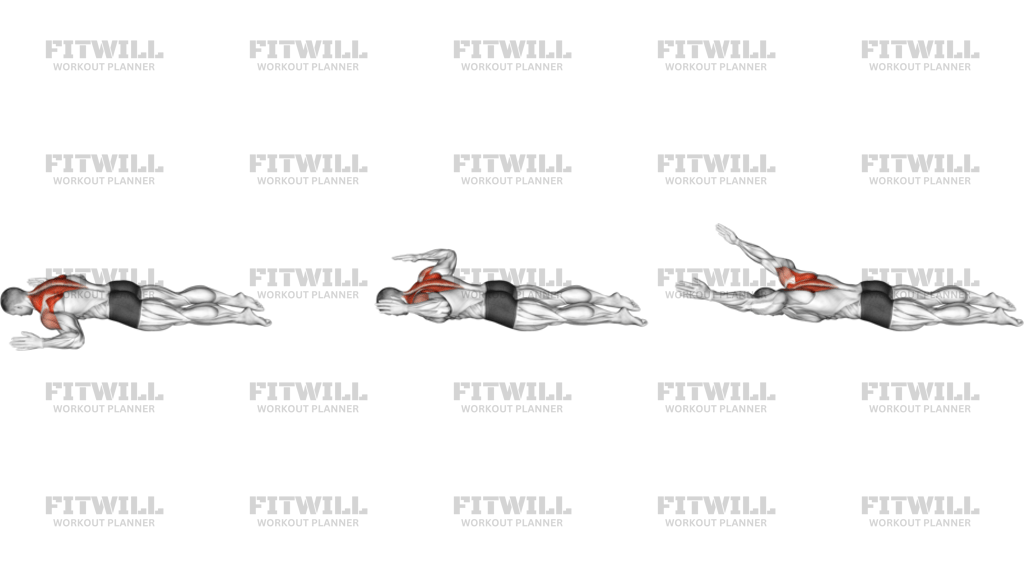
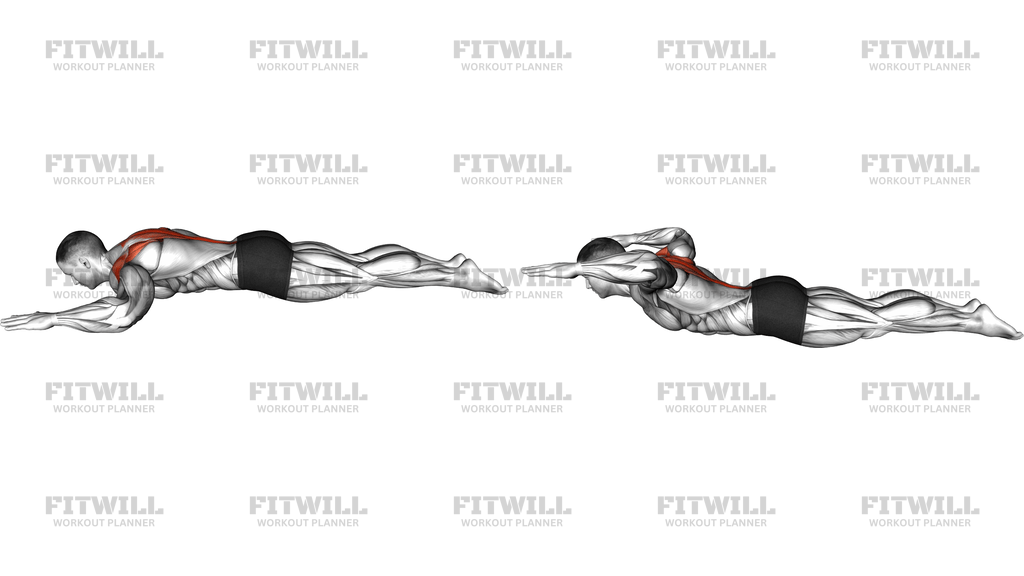
The Lying Prone Trapezius Press Back Extension is a bodyweight floor exercise performed face down with the arms stretched straight overhead, in a position similar to a swimmer's streamline. From there, you press the chest and shoulders upward off the floor while sweeping the arms back and down, driving the movement with the trapezius and the muscles between the shoulder blades. It looks simple, but the overhead arm position puts the trapezius through a longer range than a standard prone raise, which is exactly what makes it worthwhile.
This movement is especially useful for people who spend long hours sitting at a desk or hunched over a phone. Rounded shoulders and a forward head position tend to weaken the upper and mid-back while the chest muscles tighten. Training the traps and rhomboids from a prone position with arms overhead directly challenges the fibers responsible for pulling the shoulders back and down, which helps restore healthier shoulder posture over time.
Beyond the upper back, the exercise also asks the lower back to hold the chest up against gravity, so the erector spinae along the spine work isometrically throughout each repetition. Because no external load is involved, the demand stays modest on the spine, making this a good choice for warm-ups, postural work between heavier lifting sessions, and rehabilitation-style programming where controlled, unloaded extension is preferred.
Setup matters more than it might seem. Lying flat on the floor with the legs extended and the arms overhead means you have no bench or machine to stabilize you, so the floor itself defines your range. The chest should lift only as high as the mid-back can extend without the head craning upward or the hips pressing into the ground. Keeping the arms long and the hands relaxed forces the trapezius to do the work rather than the arms and shoulders shrugging the load up.
To execute it well, think of the arms as levers being swept from overhead down toward the hips, with the shoulder blades sliding down and together as the chest rises. The lift should come from the upper back, not from throwing the head backward or kicking the legs. Move slowly enough that you could pause at the top of every rep — if you cannot, the reps are being generated by momentum rather than muscle.
A typical set lasts 8 to 15 repetitions, held briefly at the top of each rep to emphasize the squeeze around the shoulder blades. It pairs naturally with pushing exercises in the same session, or it can be used as a standalone postural drill several times per week. If you feel it more in the lower back than between the shoulder blades, reduce the height of the lift and focus on the arm sweep before adding any further range.
[ Workout Log & Planner ]
Put your next workout in Fitwill
Keep your plan and training log ready when you are.


Instructions
- Lie face down on an exercise mat or firm floor with your legs extended straight behind you and the tops of your feet resting on the ground.
- Extend both arms straight overhead so they form a natural continuation of your torso, with your palms facing down or slightly inward and your neck in line with your spine.
- Gently brace your abdominals to protect the lower back before you begin lifting.
- Keeping your arms long, press your chest and shoulders upward off the floor as you sweep your hands back and down toward your hips.
- At the end of the movement, your chest should be raised, your arms angled back beside you or slightly above hip height, and your shoulder blades pulled down and together.
- Hold the top position for one to two seconds, actively squeezing the trapezius and the muscles between the shoulder blades.
- Lower your chest and sweep your arms slowly back overhead under control, resisting gravity on the way down rather than dropping.
- Exhale as you lift and press back, and inhale as you return to the face-down position.
- Reset your neck and shoulder position at the bottom of each rep so every repetition starts from the same streamlined arm position.
- Complete 8 to 15 controlled repetitions, stopping before your form breaks down or your lower back starts doing the work of the upper back.
Tips & Tricks
- The most common mistake is lifting the head to fake a higher chest raise — keep your gaze down at the floor and let the neck stay long, or you will feel it in the neck instead of the traps.
- Do not let your hands cross or bend at the elbows during the sweep; bent arms shorten the lever and let the shoulders take over from the trapezius.
- Keep your hips and legs relaxed but in contact with the floor. If your hips lift as you press up, you are extending too far and shifting work into the lower back.
- Think of pulling your shoulder blades toward your back pockets rather than simply arching up — this cue keeps the focus on the mid and lower trapezius.
- If you feel pinching or excessive arching in the lower back, lift the chest only a few centimeters and prioritize the arm sweep; the range can grow as your mid-back control improves.
- Avoid rushing the return. Lowering the arms slowly back overhead over two to three seconds is where a lot of the trapezius work actually happens.
- Pair this exercise with an opposite-day pressing or chest-focused movement if you are doing it for posture, since balanced pushing and pulling volume matters more than any single drill.
- Breathe steadily instead of holding your breath at the top — a held breath plus spinal extension can spike tension in the lower back unnecessarily.
- If your shoulders feel uncomfortable with the arms fully overhead, start with the hands slightly wider or angled outward at 45 degrees and narrow the position as mobility allows.
Frequently Asked Questions
What muscles does the Lying Prone Trapezius Press Back Extension work?
The primary muscles are the trapezius — particularly the middle and lower fibers — along with the rhomboids between the shoulder blades. The erector spinae of the lower back and the rear shoulders work as supporting muscles to hold the chest up and control the arm sweep.
Is the Lying Prone Trapezius Press Back Extension suitable for beginners?
Yes, it is a good beginner movement because it uses only bodyweight and the floor naturally limits the range. Beginners should focus on a small, controlled lift with the neck relaxed rather than trying to raise the chest high.
Why are the arms overhead instead of at my sides in this exercise?
The overhead position lengthens the trapezius at the start of each rep, so the muscle works through a longer range as the arms sweep back and down. Arms at the sides would turn this into a much shorter, more familiar prone raise.
How high should I lift my chest during the Lying Prone Trapezius Press Back Extension?
Lift only as high as you can while keeping the hips on the floor, the neck neutral, and the work felt between the shoulder blades. A few centimeters of clean extension beats a large arch that loads the lower back.
I feel this more in my lower back than my upper back — what am I doing wrong?
You are likely arching from the lumbar spine instead of extending through the mid-back. Reduce the lift height, focus on pulling the shoulder blades down and together, and let the arm sweep create the movement rather than forcing the chest upward.
Can I do the Lying Prone Trapezius Press Back Extension every day?
Because it is unweighted and moderate in intensity, many people can perform it several times per week as a postural drill. If your lower back feels fatigued or sore the next day, cut back to every other session.
What can I substitute if lying face down on the floor is uncomfortable?
The same trapezius emphasis can be trained with a prone press back over a bench, or standing with a resistance band held overhead and swept down toward the hips. Both preserve the long-arm sweep that makes this exercise distinct.
Should I add weight or hold the top position longer?
Master the bodyweight version first with a one- to two-second hold at the top. Adding load before you can control the sweep with a neutral neck usually shifts stress to the lower back and neck rather than the traps.
How is this different from a Superman exercise?
A Superman typically lifts the chest, arms, and legs together with the arms often at the sides or bent. This exercise keeps the legs on the floor and emphasizes a long overhead-to-hip arm sweep, targeting the trapezius more specifically and keeping spinal demand lower.