Resistance Band Lying Single Leg Curl
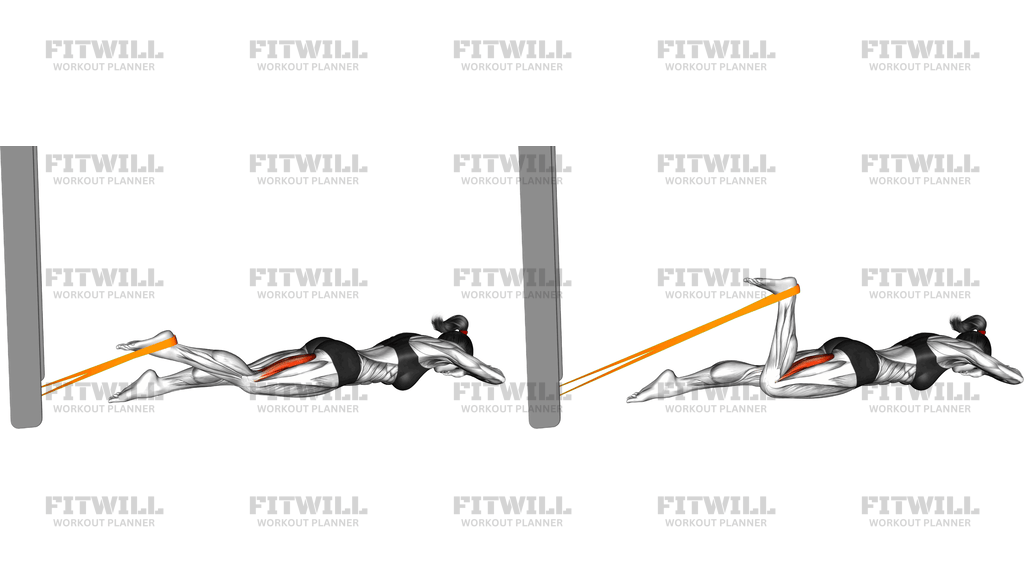
The Resistance Band Lying Single Leg Curl is a hamstring isolation exercise performed face down on the floor. A resistance band is anchored to a sturdy object in front of you and looped around one ankle, so that pulling against the band bends your knee while your torso and extended leg stay anchored to the ground. Because you work one leg at a time, each hamstring has to do the job on its own, which quickly reveals and helps correct side-to-side strength differences.
This movement suits people who train at home, travel, or rehab a knee without access to a leg curl machine. It delivers a similar knee-flexion pattern to a prone or seated leg curl, but the band provides a smooth, joint-friendly resistance that increases slightly as the knee bends. That makes it easy to scale: a lighter band, less slack, or a shorter range for beginners, and a heavier band or slower tempo for more advanced lifters.
The primary muscles worked are the hamstrings on the back of the thigh, especially the biceps femoris on the outside of the leg. The calf muscles assist with knee flexion, and the glutes plus trunk stabilizers work quietly to keep your hips pressed down and square while the working leg moves. Keeping the hips flat against the floor is what keeps the tension on the hamstrings instead of letting the lower back take over.
Setup matters more than it looks. The band must pull from directly in front of your body, roughly in line with your hip and knee, not from an angle. If the anchor point is off to one side or too low, the leg tends to drift and the curl becomes a combination of hip rotation and knee flexion, which reduces the hamstring stimulus and can irritate the knee. Loop the band around the ankle just above the joint rather than mid-foot so the pull tracks naturally with knee movement.
To perform it well, lie face down with your forehead resting on your folded arms and both legs extended. Curl the working ankle toward your glutes by bending only the knee, pause briefly at the top when the band tension peaks, then lower the leg back under control without letting the band snap it straight. The return is where most people lose benefit; resist the band all the way down instead of dropping the leg.
Use this exercise as a main hamstring movement in home workouts, as an accessory after squats or deadlifts, or as a high-rep finisher. Because it is unilateral and low-load, it is also a sensible choice for rebuilding confidence and control after lay-offs, as long as it is pain-free. Stop the set if you feel cramping in the calf, which is common in this position, and stretch briefly before continuing.
[ Workout Log & Planner ]
Put your next workout in Fitwill
Keep your plan and training log ready when you are.


Instructions
- Anchor a resistance band to a sturdy object at or near floor level, positioned directly in front of where you will lie.
- Lie face down on an exercise mat with your legs extended behind you and loop the free end of the band around one ankle, just above the ankle bone.
- Slide forward until there is light tension in the band with your working knee fully straight, and rest your forehead on your folded hands.
- Brace your trunk gently and press both hips down into the floor so your pelvis stays level and square.
- Exhale and bend the working knee, pulling your heel toward your glutes against the band while the rest of your body stays still.
- Pause for a beat at the top of the curl, when the band tension is highest and your heel is close to your hamstring.
- Inhale and slowly extend the knee, resisting the band's pull until the leg is straight again.
- Complete all repetitions on one leg, then unhook the band, switch ankles, and perform the same number on the other side.
- Between sets, sit up and shake out the calf of the working leg to release any band pressure on the ankle.
Tips & Tricks
- If your working hip lifts off the floor as you curl, the band is too strong or your hamstring is fatigued; switch to a lighter band rather than letting the pelvis tilt.
- Avoid pointing your toes hard during the curl, as this shifts work toward the calf; keep the foot relaxed or flex it slightly to keep the hamstrings driving.
- Do not let the band snap your leg back down on the return; a slow two- to three-second lowering phase is where much of the hamstring work happens.
- Check the band angle before each set: it should pull straight ahead from your ankle, because an angled anchor turns the curl into a hip rotation.
- If you feel the band biting into your ankle, pad the loop with a sleeve or use a band with a wider loop rather than shortening the range.
- Calf cramping is common in this position; keep the sets moderate and stretch the calf between legs if it tightens up.
- Keep the non-working leg relaxed and flat on the floor rather than pushing it down aggressively, which can strain the front of that hip.
- For extra resistance, start each rep with slightly less slack or add a second band, instead of yanking the curl past a comfortable knee range.
Frequently Asked Questions
Which muscles does the Resistance Band Lying Single Leg Curl work?
The hamstrings on the back of the thigh are the primary movers, particularly the biceps femoris. The calves assist with knee flexion, and the glutes and trunk stabilize your position as the leg moves.
Why do one leg at a time instead of curling both legs with the band?
The single-leg version lets you match band tension to each leg individually and exposes any strength gap between sides. It also makes it easier to keep your hips flat, since the moving leg cannot borrow help from the other one.
Where should I anchor the band for the Resistance Band Lying Single Leg Curl?
Anchor it low, at or near floor level, to a stable object directly in front of your body such as a heavy post, rack upright, or door anchor. It should pull in a straight line from your ankle toward your head, not off to the side.
Is this a good substitute for a leg curl machine?
Yes, for most training purposes it reproduces the same knee-flexion pattern with scalable resistance. It is lighter on the joints than machine curls, though very heavy maximal loading is easier to achieve on a machine.
My calf cramps when I curl my heel up. What should I do?
Calf cramping is common because the gastrocnemius assists in knee flexion while shortened. Reduce the band tension, ease off just short of full heel-to-glute range, and stretch the calf briefly between sets.
How many sets and reps should I do?
Two to four sets of 10 to 15 controlled reps per leg works well for most goals. Because band resistance is light and joint-friendly, higher rep sets of 15 to 20 are also effective, especially on the slower lowering phase.
Can beginners do this exercise safely?
Yes, it is actually a beginner-friendly hamstring exercise since the load is modest and the floor supports your body. Start with a light band, keep the range comfortable, and focus on moving only the knee while the hips stay still.
Why does my lower back feel involved during the curl?
That usually means your hips are lifting or twisting as you pull. Press the pelvis into the floor, shorten the range slightly, and make sure the band pulls straight ahead rather than at an angle.
Should the band go around my ankle or my foot?
Loop it around the ankle just above the ankle bone. Placing it mid-foot changes the pull direction and can drag the foot into pointing, which shifts work away from the hamstrings.
Is it safe for my knee to curl against a band after an injury?
Band-resisted knee flexion is generally gentle on the knee because there is no compressive load, but clearance depends on your specific situation. Get approval from a health professional and stay within a pain-free range.