Lying Floor Negative Dragon Flag
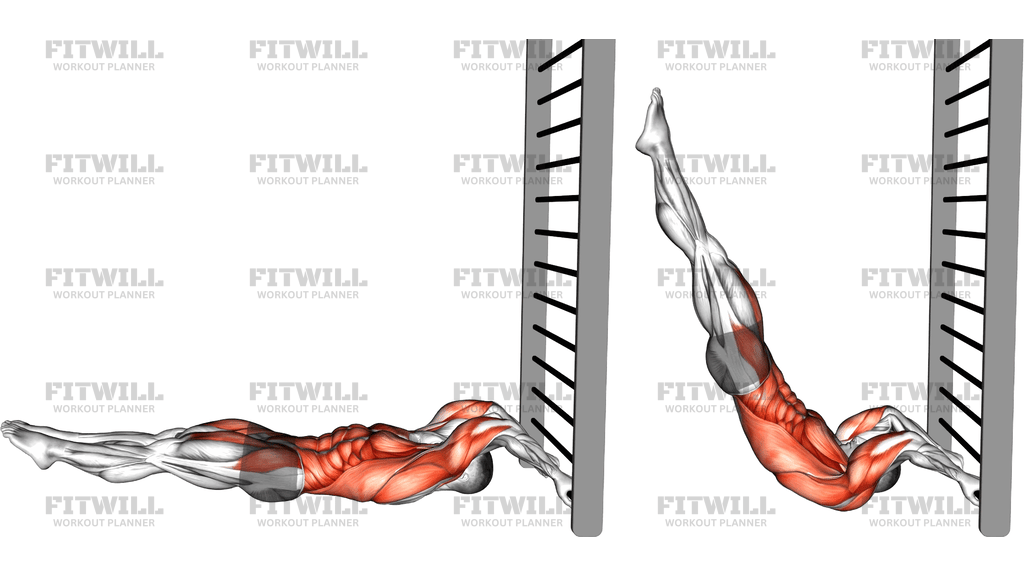
The Lying Floor Negative Dragon Flag is the eccentric-only version of the dragon flag, the legendary core exercise popularized by Bruce Lee. Instead of performing the full lift, you start at the top of the movement with your legs pointed straight up toward the ceiling and fight gravity on the way down until your body is flat on the floor. You lie on your back and anchor your grip on a fixed upright such as a stall bar frame, pull-up bar post, or similar sturdy structure positioned behind your head.
This is one of the most demanding core exercises you can do with just body weight, and the negative emphasis is exactly what makes it such a powerful teaching tool. The lowering phase lets you build strength in the rectus abdominis, lower abs, and deep stabilizers with more control than the concentric lift requires, which is why it is the standard way to work up to a full dragon flag. It also trains the lats and shoulders isometrically, since your arms have to stay locked and anchored to a fixed point for the entire descent.
The setup matters more here than in almost any other floor core exercise. Because your entire body acts as one long lever pivoting around your upper back and shoulders, a loose grip or an unstable anchor turns the movement into a jerky, lower-back-dominant scramble. Keep your arms fully extended overhead, squeeze the bar or post hard, and treat your arms as cables that connect your shoulders to the floor.
To execute it well, press your legs toward vertical, then lower your body as one rigid piece, from shoulders to ankles, over three to five slow seconds. The moment your hips peel away from your ribs or your lower back arches off the floor, you have lost the line, so cut the rep short rather than collapsing. Your whole body should finish flat and long on the floor, then reset and repeat.
Expect to feel this deep in the lower abs rather than as a burning crunch sensation. Use it as a strength finisher in low rep ranges, typically three to six controlled negatives per set, and place it early enough in a session that you are not attempting it while fatigued.
[ Workout Log & Planner ]
Put your next workout in Fitwill
Keep your plan and training log ready when you are.


Instructions
- Lie flat on your back on the floor with your head close to a sturdy upright, such as the vertical ladder of a stall bar frame, so your arms can reach it fully extended overhead.
- Reach overhead and grip the upright firmly with both hands, one above the other, and pull your shoulders down away from your ears so your upper back and shoulders are planted on the floor.
- Lift your legs toward the ceiling and raise your hips until your body is stacked at the top position, with your legs as close to vertical as you can get them and your weight supported on your upper back and shoulders.
- Squeeze your glutes, brace your abs as if bracing for a punch, and point your knees and hips toward full extension so your body forms one straight, rigid line from shoulders to toes.
- Begin lowering slowly, hinging only at your shoulders as your entire rigid body rotates down as one piece. Aim for three to five seconds per descent.
- Keep your lower back long and your ribs down as you descend; the moment your hips can no longer stay aligned with your shoulders, stop the rep rather than arching.
- Finish with your whole body flat and extended on the floor, legs straight and together, arms still locked overhead gripping the upright.
- Exhale steadily through the descent and take a full breath at the bottom before resetting.
- To reset, pike your hips up and raise your legs back to vertical, or lower fully, breathe, and set up again from the floor for the next rep.
Tips & Tricks
- If your grip fails before your abs do, choke up higher on the upright or use a shorter anchor distance; a slipping grip ruins the line of the whole descent.
- The most common mistake is bending at the hips as you lower, which turns the dragon flag into a leg raise. Lock your knees, squeeze your glutes, and think of your torso and legs as a single board.
- If your lower back starts to arch or lift off the floor near the end of the descent, that is your signal the rep is over. Stopping there is not cheating, it is how you progress safely.
- Bend your knees slightly in early sessions to shorten the lever and reduce the load on your abs, then straighten them as your control improves.
- Keep your arms completely straight throughout. Bent elbows let your upper body rise off the floor and steal tension away from the core.
- Do not rush the bottom. The last few degrees before your body lands flat are where the abs work hardest, so stay braced all the way to the floor.
- Perform these on a firm surface rather than a soft mattress; an unstable base makes it impossible to control the pivot at your shoulders.
- Rest fully between sets. Two or three sets of three to five crisp negatives beat six sloppy ones every time.
- Place this exercise before heavy bending or twisting work in your session so your deep core is fresh and your spine position stays controlled.
Frequently Asked Questions
Which muscles does the Lying Floor Negative Dragon Flag work?
It primarily targets the rectus abdominis with heavy involvement of the lower abs and deep core stabilizers, while the hip flexors assist as the body lowers. Your lats, shoulders, and arms work isometrically to hold the anchored grip.
Why train only the negative instead of the full dragon flag?
Muscles can handle more load during the lowering phase than during the lift, so negatives let you build dragon flag strength before you can perform the concentric version. It is the standard progression step toward the full movement.
Can beginners do the Lying Floor Negative Dragon Flag?
Beginners should first build a base with planks, dead bugs, and lying leg raises, then start with bent knees and short two-second descents. If you cannot hold a rigid line for even a brief lowering, the movement is too advanced yet.
How slow should the lowering phase be?
Three to five seconds is the sweet spot for strength. Going much slower usually causes form breakdown near the floor, and much faster removes the eccentric tension that makes this exercise valuable.
What can I use to anchor my grip if there is no stall bar or upright behind me?
Anything fixed and low behind your head works, such as the base of a heavy bench, a rack upright, or a sturdy table leg. The anchor only needs to hold your hands still while your arms stay extended overhead.
Why do my lower back and hips feel this instead of my abs?
That means your body is losing its rigid line and your hips are hinging or your lower back is arching during the descent. Shorten the range, stop the rep when alignment breaks, and keep your glutes squeezed and ribs down.
How many reps and sets should I do?
Three to five sets of three to six controlled negatives is plenty, with full rest between sets. This is a high-tension strength movement, not a high-rep burn exercise.
Is the Lying Floor Negative Dragon Flag safe for the lower back?
It is safe when the body stays rigid and the range is cut off before the lower back arches. The risk comes from grinding through reps with a broken line, so stop each rep the moment your hips peel from your ribs.
What should I do between reps at the bottom?
Lie flat for a breath, then either pike your hips up to return to the vertical starting position or reset completely from the floor. Resetting from the floor is fine and often lets you keep better tension on the next rep.