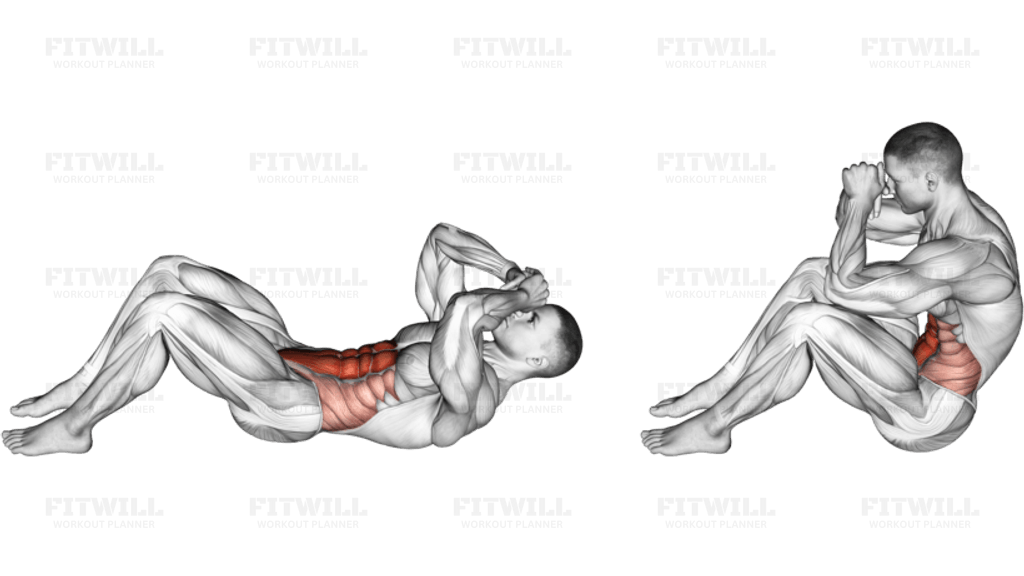
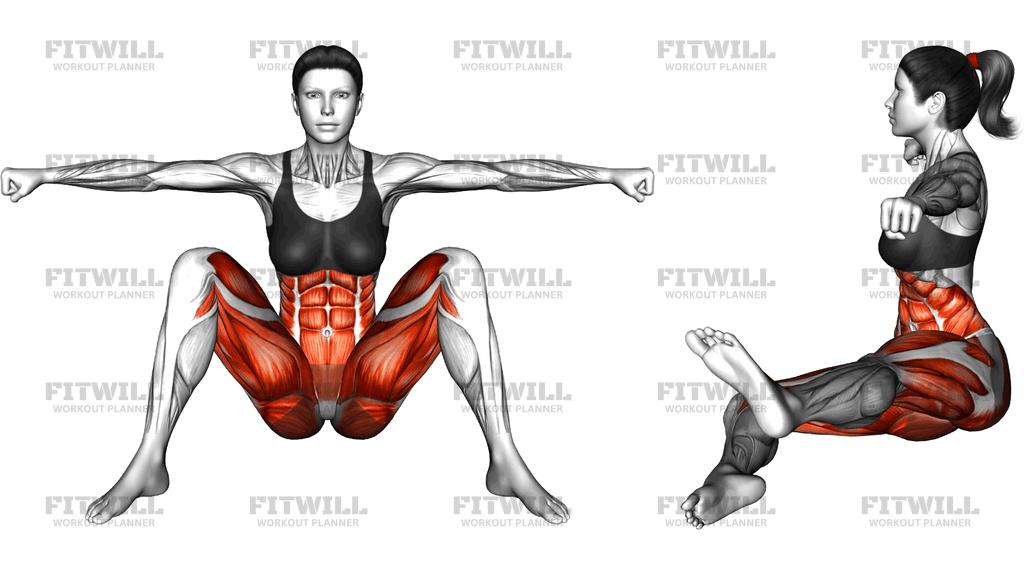
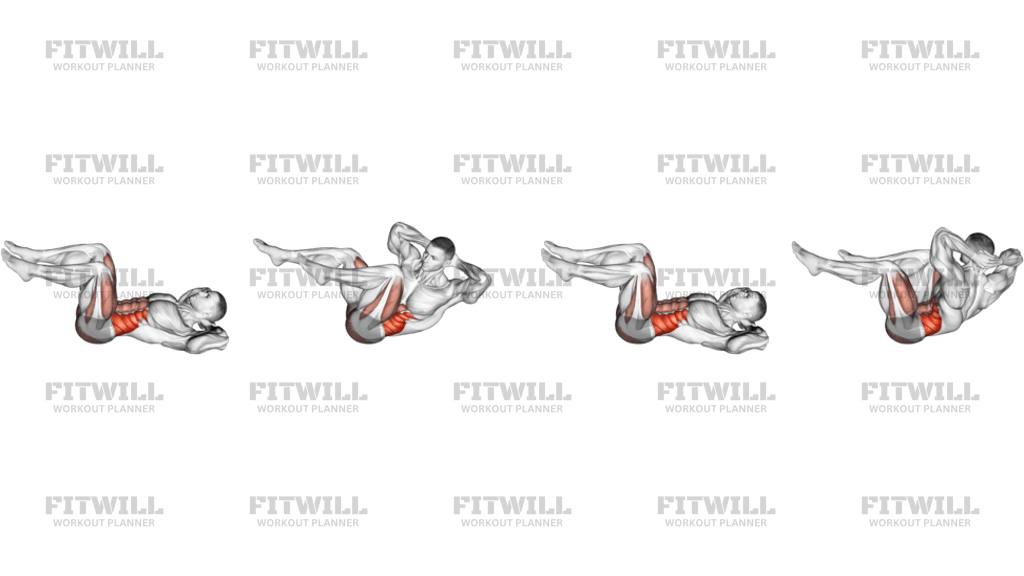
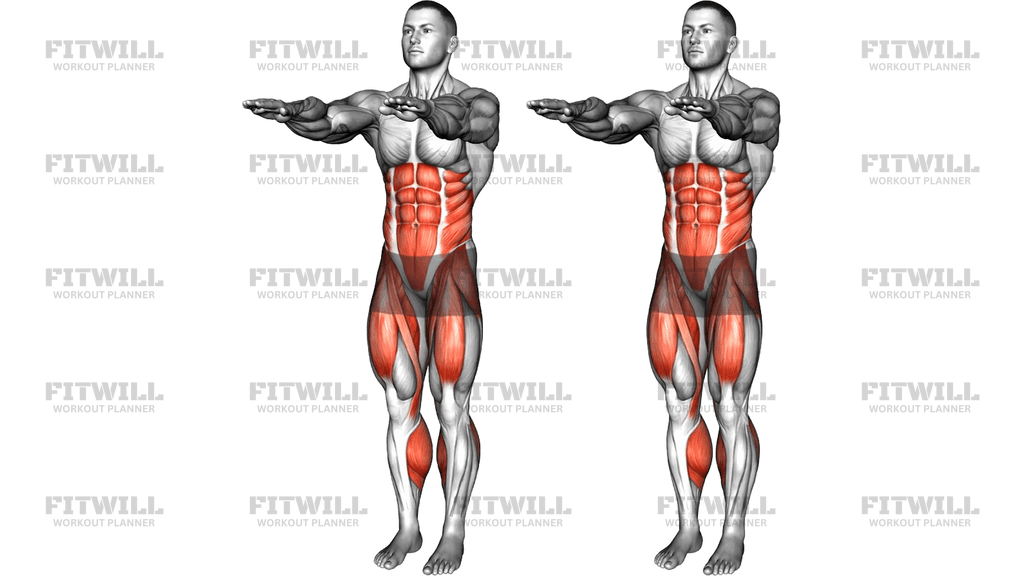
Sitting Floor Side To Side Leg Raise In Out Crunch
The Sitting Floor Side To Side Leg Raise In Out Crunch is a seated bodyweight core exercise that combines two movements most people train separately: pulling the legs in and out toward the chest, and sweeping them side to side across the midline. You sit on the floor, lean your torso back to roughly a forty-five degree angle, plant your hands on the mat beside your hips for balance, and hold your feet off the ground for the entire set. From there, every rep alternates between extending the legs out long and low and drawing the knees in toward the torso, with a side-to-side drift of the legs layered on top.
Because the torso stays leaned back and the feet never touch down, your abdominal muscles have to work continuously just to hold the position. The in-and-out portion drives the rectus abdominis and hip flexors hard, especially at the moment the knees tuck toward the chest and the spine curls slightly forward. The side-to-side component adds rotation through the trunk, which brings the obliques into play and challenges your ability to control the pelvis as the legs swing. This makes it a more complete midsection drill than a plain seated knee tuck.
This exercise suits people who already have some experience with planks, lying leg raises, or basic crunches and want a seated variation that loads the core without any equipment beyond a mat. It is common in home workouts, bootcamp-style circuits, and ab finishers, since one long set can be done in a small space with no setup time. It also works well as a progression for anyone who finds lying leg raises too easy but is not yet ready for hanging variations.
Setup matters more than it looks. Sit far enough forward that your hands can rest comfortably on the floor, lean back until you feel your abdominals engage rather than your lower back rounding into the mat, and lift your feet only as high as you can hold without slumping. If you start too upright, the movement becomes a hip flexor exercise with very little abdominal work; if you collapse your chest and round your lower back, you lose the crunch and put unnecessary stress on the spine.
Execute each rep by extending the legs out in front of you while letting them drift slightly to one side, then tucking the knees in and sweeping them back through center or to the opposite side, letting the torso curl a little at the top. Keep the movement smooth rather than jerky, and resist the urge to pull on your arms. Your hands are there for balance, not to lift your body. A controlled pace of two to three seconds per direction keeps the tension where it belongs.
The main safety point is protecting the lower back. If you feel your lumbar spine pressing hard into the floor or arching sharply every time you extend the legs, shorten the range by not lowering the feet as far, or bend the knees slightly during the extension. Stop the set as soon as your form breaks down rather than grinding out extra reps with a sagging torso.
[ Workout Log & Planner ]
Put your next workout in Fitwill
Keep your plan and training log ready when you are.


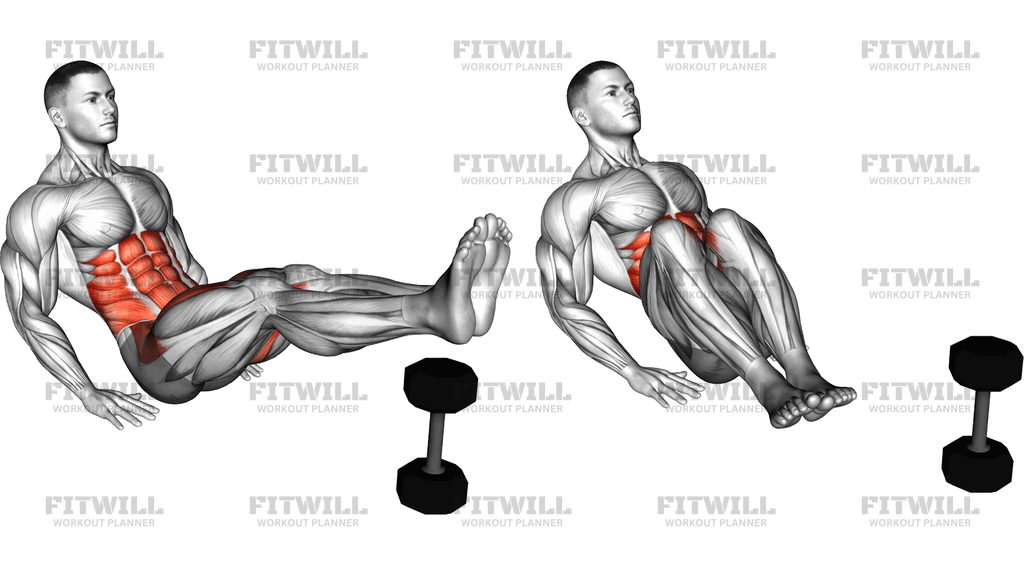
Instructions
- Sit on an exercise mat with your legs extended in front of you and place your palms flat on the floor just outside your hips, fingers pointing forward.
- Lean your torso back to about forty-five degrees until you feel your abdominals engage, then lift both feet off the floor so your weight rests on your glutes and hands.
- Brace your midsection as if bracing for a light punch, keep your chest lifted, and avoid letting your lower back round into the mat.
- Extend both legs out long in front of you, letting them travel a few inches to one side of center while keeping your feet off the ground.
- Draw your knees in toward your chest and sweep them back through the midline or slightly to the opposite side, curling your upper body forward into a small crunch as they arrive.
- Pause briefly at the tucked position and squeeze your abdominals rather than letting your knees rest against your chest.
- Extend the legs back out on the other side of center to complete the side-to-side pattern, keeping the feet hovering the entire time.
- Exhale as you pull the knees in and inhale as you extend the legs out, keeping the breathing rhythm matched to the movement.
- Continue alternating sides for your target number of reps, then lower your feet to the mat and sit upright to reset before the next set.
Tips & Tricks
- If your hands slip or your shoulders tire before your abs, slide your hands a little further back toward your hips and press down through the heel of the palm rather than the fingertips.
- The most common mistake is lowering the legs all the way to the floor on the extension. Keep the feet hovering so the abdominal tension never switches off.
- Watch for the chest caving in as the set gets hard. If you notice your shoulders rounding forward and your head dropping, reduce the reps per set and hold the torso taller.
- Keep the side-to-side travel modest at first. A small drift of the legs across the midline is enough to involve the obliques without pulling your pelvis out of position.
- Do not yank the knees in using your arms. Push lightly into the floor with your hands for balance only, and let the abdominals and hip flexors do the pulling.
- If your lower back arches every time the legs extend, bend the knees slightly during the out-phase instead of straightening them fully.
- Move at a two to three second tempo per direction. Racing through the reps turns this into a hip flexor swing and the crunch portion disappears.
- Place a folded towel under your sit bones if your tailbone aches while balancing, and shorten the set rather than leaning further back to compensate.
- Progress by adding reps before adding speed. Once you can complete all reps with the feet off the floor and the chest tall, pause an extra second at the tuck.
Frequently Asked Questions
Which muscles does the Sitting Floor Side To Side Leg Raise In Out Crunch work?
The primary muscles are the abs, especially the rectus abdominis, with strong assistance from the hip flexors as the legs move in and out. The side-to-side travel recruits the obliques, and the hands-on-floor position lightly works the shoulders and triceps for support.
Why do my hip flexors burn more than my abs during this exercise?
This usually means your torso is leaning back too far or your lower back is arching when the legs extend. Sit slightly more upright, do not lower the feet as far out, and focus on curling the ribs toward the hips at the tuck so the abdominals stay in charge.
Is the Sitting Floor Side To Side Leg Raise In Out Crunch suitable for beginners?
It can be, with modifications. Bend the knees more during the extension, keep the torso a bit more upright, and limit the side-to-side drift until you can hold your feet off the floor for a full set without your lower back arching.
Do I need any equipment besides an exercise mat?
No, the movement itself is bodyweight only. A mat simply cushions your sit bones and gives your hands a non-slip surface to press into.
How is this different from a regular seated knee tuck?
A regular knee tuck moves the legs only forward and back. This version adds a side-to-side path for the legs and an explicit crunch of the torso at the tuck, which brings the obliques into the movement and keeps the abs under tension through a longer range.
How many reps should I do?
Start with two or three sets of eight to twelve full in-and-out cycles, counting one cycle as both sides. Once you can finish every rep with your feet off the floor and your chest tall, add reps or slow the tempo.
My tailbone hurts when I balance on the floor. What should I change?
Place a folded towel or a slightly thicker mat under your glutes, and check that you are not sitting directly on your tailbone with the pelvis tucked under. Shifting your weight back onto the sitting bones takes pressure off the tailbone.
Can I replace this with a lying leg raise or a reverse crunch?
Yes. A reverse crunch on the floor trains a similar in-and-out pattern with less demand on hip flexor strength, and lying leg raises cover the extension phase. You lose some of the side-to-side oblique work, so consider adding a seated twist or bicycle crunch to cover that role.
Should my hands stay on the floor the whole time?
Keeping the palms down beside your hips is the standard setup because it stabilizes the torso. Once you are strong enough, you can raise your arms forward to shoulder height to remove that assistance, but do not sacrifice torso height to do it.
Is it safe for my lower back?
For most people with a healthy back, yes, as long as the range is controlled and the lower back does not arch sharply when the legs extend. If you have a history of back issues or feel pain rather than muscle effort, keep the knees more bent, reduce the range, and check with a qualified professional first.