Plank Pike To Climber
Plank Pike To Climber is a bodyweight core exercise that chains two distinct plank variations into one flowing repetition. You start in a forearm plank, lift your hips up and back into a pike position, then lower back down and drive one knee toward your chest in a mountain climber motion before repeating. Because you are supported on your forearms rather than your hands, your shoulders and trunk have to work harder to control each transition, and there is nowhere for your lower back to hide.
This movement is useful for anyone who has mastered a static forearm plank and needs something more dynamic to keep progressing. The pike portion trains spinal flexion under load while your shoulders push the floor away and your hamstrings and calves work at their end range. The climber portion demands that you hold a rock-solid plank while one hip flexes hard, which challenges your ability to resist rotation and keep your hips level. Together, the two phases train the abs, deep core, shoulders, and hip flexors in a way a static hold never will.
Setup matters more than speed here. Place your elbows directly under your shoulders, forearm parallel to the front edge of your mat, and set your feet about hip-width apart. If your elbows drift forward or your hips sag, every repetition gets sloppier from there. Before moving, squeeze your glutes, brace your midsection like you are about to be nudged in the stomach, and push the floor away with your forearms so your upper back is not collapsing between your shoulder blades.
To execute well, think of the pike as a deliberate hinge rather than a scramble: press through your forearms, pull your hips up and slightly back, and let your head drop between your arms until your body forms an inverted V. Reverse it with control, then immediately drive one knee forward toward the same-side elbow or toward your chest, keeping the trailing leg straight and the hips squared to the floor. Return the foot, reset your plank line, and alternate sides each round or each rep depending on your programming.
You will see this exercise in circuit training, home workouts, and athletic conditioning blocks because it raises the heart rate while still being a controlled strength movement. It is a smart choice as a second or third core exercise in a session, or as part of a timed interval where quality reps matter more than speed. If your hips sag, your pike turns into a small hip bump, or your knee drive twists your torso, shorten the set and rebuild the pattern slowly.
[ Workout Log & Planner ]
Put your next workout in Fitwill
Keep your plan and training log ready when you are.


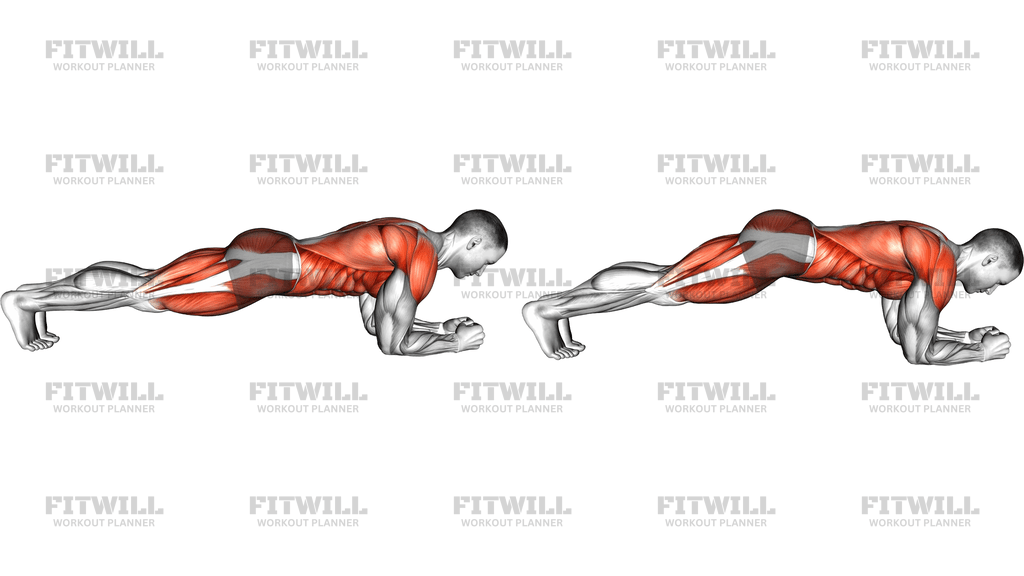
Instructions
- Set up on a mat or non-slip floor in a forearm plank: elbows stacked directly under your shoulders, forearms flat and pointing forward, feet about hip-width apart with toes tucked.
- Create a straight line from your heels through your hips to your head, then squeeze your glutes and brace your abdominal wall before you move.
- Push the floor away with your forearms so your upper back stays broad and your shoulder blades are not sinking toward your spine.
- Exhale as you press through your forearms and lift your hips up and back into a pike, letting your head travel between your arms until your body forms an inverted V.
- Pause briefly at the top of the pike, keeping your legs as straight as your hamstrings allow and your weight shifted slightly toward your shoulders.
- Lower your hips back down with control until you return to a straight forearm plank, not letting your lower back dip below the line.
- Without pausing, drive one knee forward toward your chest or same-side elbow, keeping the other leg extended and both hips facing the floor.
- Return the foot to the plank position, re-brace, and alternate legs on the next repetition or alternate sides each set.
- Breathe out on the pike and the knee drive, and breathe in as you lower back to the plank.
- Finish the set by lowering your knees to the floor rather than collapsing, and reset your elbow position before starting the next set.
Tips & Tricks
- If your pike is small and cramped, the limit is usually tight hamstrings or shoulders rather than weak abs—work within the range where you can still keep your legs relatively straight, and it will improve over time.
- The most common fault is letting the elbows drift forward of the shoulders during the knee drive, which turns the plank into a sort of collapsed headstand position; glance down and check your elbow stack between reps.
- Keep the knee drive in the sagittal plane: if your hips open up and the knee swings outward, you are borrowing momentum from rotation instead of using your hip flexors and abs.
- Do not let the top of the pike become a rest stop—your shoulders are still loaded there, so keep pressing the floor away instead of hanging in your joints.
- If your lower back aches during the climber phase, your hips are probably sagging before the knee lifts; reset the plank line first, then drive the knee.
- Slow the transition from pike back to plank down deliberately—most people fall back down with gravity, which wastes half the exercise's trunk-control benefit.
- Spreading your feet slightly wider gives you a more stable base for the pike, especially if you are new to the movement or training on a slick surface.
- If your shoulders fatigue before your abs, reduce time in the pike position and spend more reps in the plank-to-climber portion until your pressing endurance catches up.
- Alternating legs every rep turns this into more of a conditioning drill; doing all reps on one side before switching makes it easier to notice and fix side-to-side differences.
Frequently Asked Questions
What muscles does Plank Pike To Climber work?
The primary work comes from the abs and deep core, which drive the pike and stabilize the plank. Your shoulders and triceps support your bodyweight on the forearms throughout, while the hip flexors power the knee drive and the glutes keep your hips extended in the plank position.
Is Plank Pike To Climber suitable for beginners?
It is best treated as an intermediate progression. If you can hold a clean forearm plank for 45-60 seconds, start by practicing the pike and the knee drive separately before chaining them together.
Should I alternate legs every rep or complete all reps on one side?
Alternating every rep keeps the workload even and raises the heart rate more, which suits circuits. Doing all reps on one side first makes it easier to spot left-right differences in hip control, so use that when learning the movement.
Why do my hips sag when I drive my knee in Plank Pike To Climber?
That usually means the brace switched off or the knee is being pulled with momentum instead of controlled hip flexion. Slow the knee drive down, exhale as it comes forward, and think about keeping the trailing glute squeezed so the pelvis stays level.
Can I do Plank Pike To Climber if I have tight hamstrings?
Yes, just allow a soft bend in the knees at the top of the pike. The goal is lifting the hips high while keeping control, not achieving a perfect inverted V on day one.
What can I substitute for Plank Pike To Climber?
Forearm plank hip dips, forearm mountain climbers, and dolphin pose pulses all train overlapping qualities. Combining a pike-up with a separate plank knee drive gives you the same pattern in two easier pieces.
How many reps or how long should I perform Plank Pike To Climber?
Start with 6-10 total repetitions or 20-30 second intervals, focusing on clean transitions. Because the shoulders fatigue quickly, stop the set as soon as your plank line or elbow position starts to break down.
Is it safe for my lower back?
When performed with a braced trunk and no sagging between the plank and pike phases, it is a controlled core exercise. If you feel pressure in your lower back, reduce the range of the knee drive, reset your plank position, and stop if discomfort persists.
Why is this done on the forearms instead of the hands?
The forearm support lowers the load on the wrists and increases the demand on the shoulders and trunk to control the pike and climber transitions. It also keeps the movement stricter, since you cannot use a hand-driven push to swing the hips around.