Standing Alternating Double Elbow Knee Touch
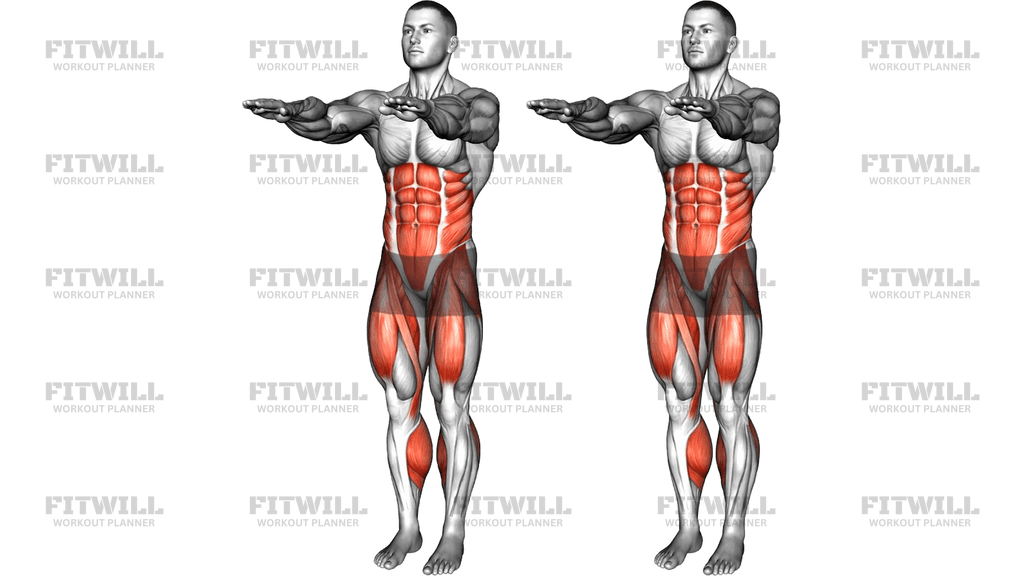
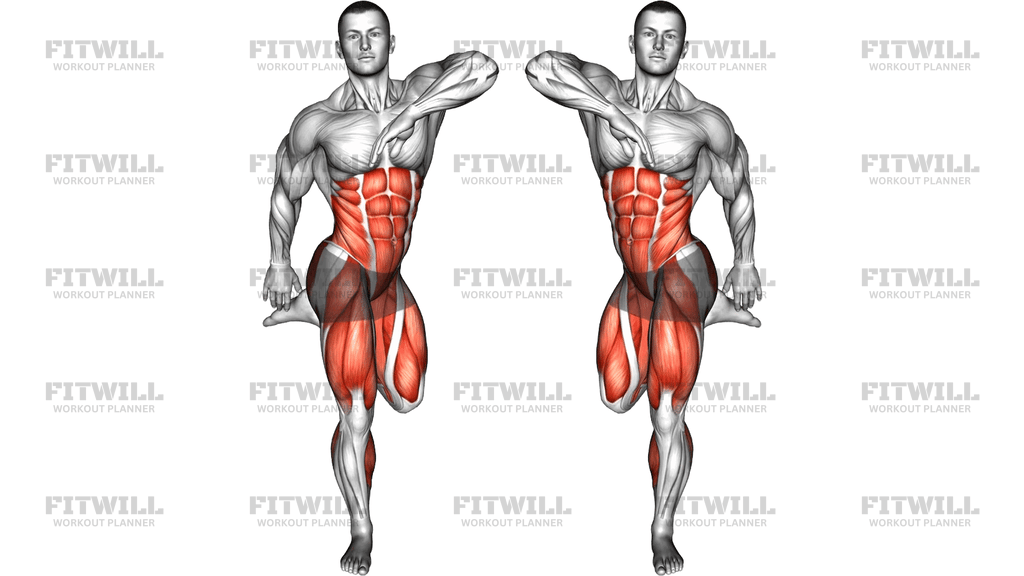
The Standing Alternating Double Elbow Knee Touch is a body weight core exercise performed from an upright stance with both hands placed behind your head. Instead of the classic standing crunch where one elbow meets the opposite knee, this version brings both elbows forward together as you drive one knee up, then repeats the same pattern on the other side. The double-elbow position shortens the lever of your upper body and forces your trunk to curl and flex rather than simply rotate, which puts the emphasis squarely on the front of your abs while your obliques stabilize and control the slight side-to-side shift.
This movement is a good fit for people who want direct abdominal work without getting down on the floor. It suits home workouts, hotel-room training, warm-ups, and finishers at the gym, and it is friendly to beginners because the range of motion is easy to scale. Anyone who finds floor crunches uncomfortable on the neck, or who struggles to feel their abs working during lying variations, often gets a better contraction standing because gravity pulls the torso into flexion rather than against it.
The primary muscles worked are the abs, particularly the upper and middle fibers of the rectus abdominis, which shorten as you round your trunk forward. The obliques work isometrically to keep your ribcage from twisting as you alternate sides, and the hip flexors, especially the iliopsoas and rectus femoris, lift the knee toward the elbows. Your quads assist in the knee lift, and the standing leg, along with your calves and stabilizers around the ankle and hip, keeps you balanced through every rep.
Setup matters more than it looks. Your hand placement behind the head should support the skull, not pull the neck forward, and your feet should be set about hip-width apart so you have a stable base to shift over as each knee rises. Because the movement is alternating, the temptation is to rush and let momentum swing your torso; a deliberate pace keeps the tension on your abs instead of your hip flexors and lower back doing all the work.
To perform it well, think of curling your ribcage down toward your pelvis as the knee comes up, rather than just lifting the leg and letting the elbows passively meet it. Exhale as the knee and elbows converge, squeeze briefly at the top, and lower under control before switching sides. The knee can travel slightly across the body toward the midline, but the torso itself should stay facing forward with minimal rotation.
A few practical points will keep this exercise productive. Keep the movement smooth rather than bouncy, avoid yanking on your head with your hands, and stay tall through your standing leg so your lower back does not arch back as you fatigue. If balance is a challenge at first, stand near a wall or place your feet slightly wider. Used for two to four sets of ten to twenty reps per side, this exercise works well as a standalone ab block or paired with planks and leg raises for a complete standing core session.
Fitwill
Log Workouts, Track Progress & Build Strength.
Achieve more with Fitwill: explore over 9600 exercises with images and videos, access built-in and custom workouts, perfect for both gym and home sessions, and see real results.
Start your journey. Download today!




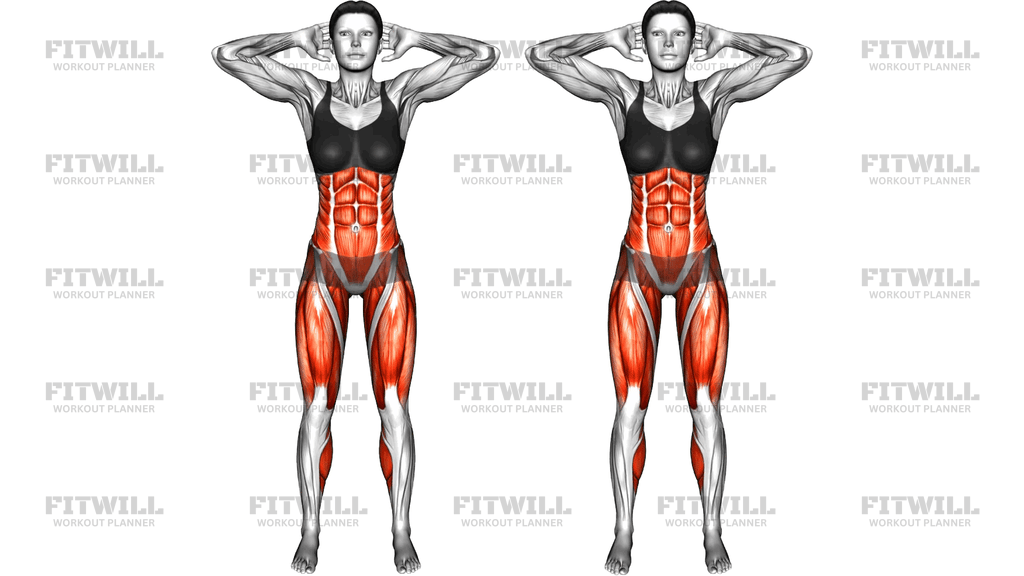
Instructions
- Stand upright with your feet about hip-width apart, toes pointing forward, and your weight balanced evenly across both feet.
- Place both hands lightly behind your head with your fingers near your ears and your elbows flared out wide to the sides.
- Brace your abdominal muscles gently and keep your chest lifted and your gaze straight ahead before you begin.
- Shift your weight slightly onto one leg as you raise the opposite knee up in front of you to roughly hip height.
- At the same time, curl your upper body forward by drawing both elbows down and in toward the rising knee, rounding your upper back slightly as your ribcage tilts down.
- Let the elbows touch or nearly touch the top of the raised knee, with the knee traveling slightly toward your body's midline.
- Exhale as the knee and elbows converge, then squeeze your abs for a beat at the closest point.
- Lower the knee back to the floor with control as you inhale, letting your torso return tall without leaning back.
- Repeat the same double-elbow curl with the other knee, continuing to alternate sides for the desired number of repetitions per side.
Tips & Tricks
- Curl your ribcage toward your pelvis instead of just lifting your leg; if your torso stays upright, your hip flexors do the work and your abs get little out of the rep.
- Keep your fingers resting on the sides of your head rather than laced behind your skull, so you never pull your neck into the curl.
- Do not let your standing knee lock back or your hips push forward as you fatigue; a soft knee on the support leg protects your lower back and keeps you balanced.
- Limit torso rotation. A small shift toward the working side is normal, but if your shoulders swing across your body, slow the tempo and face a fixed point forward.
- Aim your knee slightly inward toward your navel rather than straight up; this shortens the distance to both elbows and increases the abdominal contraction.
- If you wobble on single-leg support, widen your stance to shoulder-width or stand within arm's reach of a wall until your balance improves.
- Avoid bouncing the knee off the floor between reps; the lowering phase should take about the same time as the lift to keep tension on the abs.
- Stop the set when your neck or lower back starts to take over, not when your legs get tired, since those are signs your abs have stopped driving the movement.
Frequently Asked Questions
What muscles does the Standing Alternating Double Elbow Knee Touch work?
The abs, especially the rectus abdominis, are the primary movers as your trunk curls forward. The obliques stabilize your torso between sides, while the hip flexors and quads lift the knee.
Why does this version use both elbows instead of the opposite elbow like a standing cross crunch?
Bringing both elbows forward makes your trunk flex straight down rather than rotate, which targets the front of the abs more directly and uses the obliques mainly for stability.
Is the Standing Alternating Double Elbow Knee Touch suitable for beginners?
Yes. It is low-impact and needs no equipment, and beginners can reduce the range by raising the knee less high and focusing on the abdominal curl rather than forcing an elbow-to-knee contact.
How can I stop my neck from straining during this exercise?
Rest your hands against the sides of your head instead of pulling on the back of your skull, and initiate the movement from your ribcage rather than by jutting your chin forward.
Should my knee touch my elbows exactly?
Contact is a guideline, not a requirement. What matters is that your torso rounds forward and your abs contract; if your knee stops a few centimeters short, the rep still counts.
How many reps should I do per side?
Two to four sets of ten to twenty controlled reps per side is a practical range. Choose a number you can finish without your form breaking down or your lower back taking over.
Can I do this exercise if I have balance difficulties?
Yes. Widen your stance, slow the tempo, or stand beside a wall or sturdy chair you can lightly touch for support while your balance improves.
What can I use as a substitute for the Standing Alternating Double Elbow Knee Touch?
Floor crunches, standing cross crunches, and high-knee marches with a forward torso curl all train similar muscles. The double-elbow version is closest to a standing double-crunch pattern.
Is it normal for my hip flexors to feel this more than my abs?
Some hip flexor work is expected since they lift the knee, but if they dominate, focus on exhaling and rounding your upper back as the knee rises so the abdominal curl leads the rep.