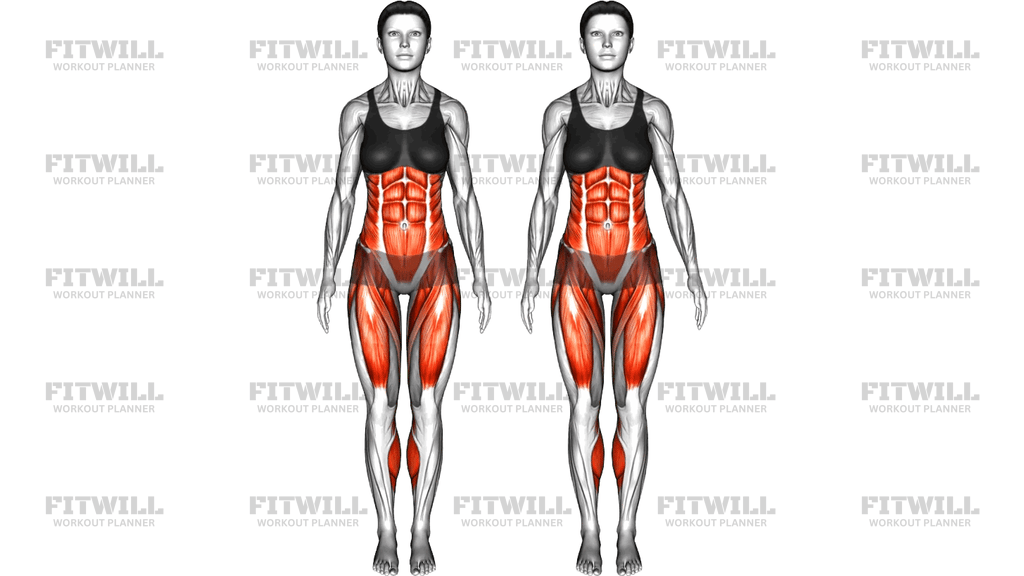
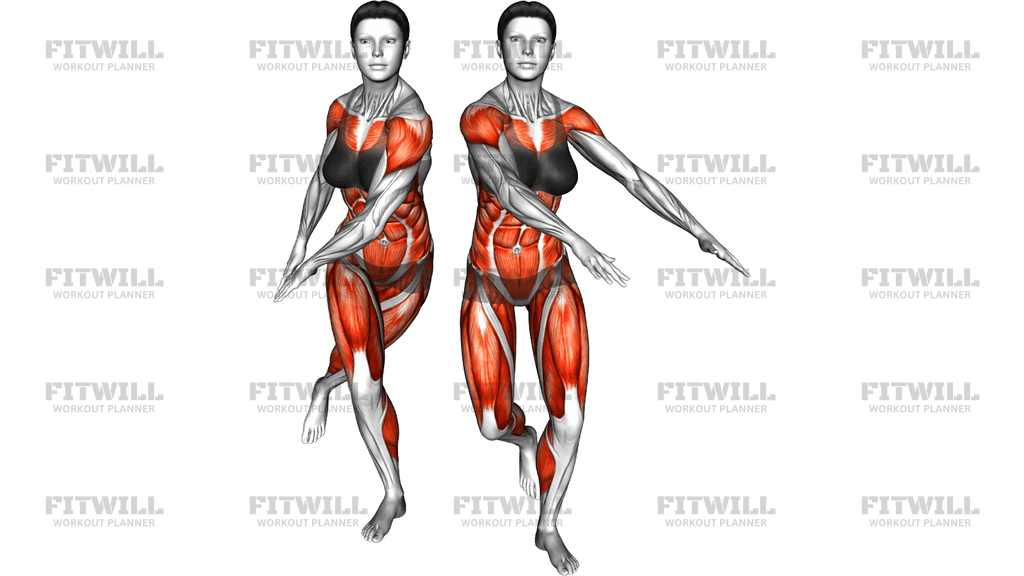
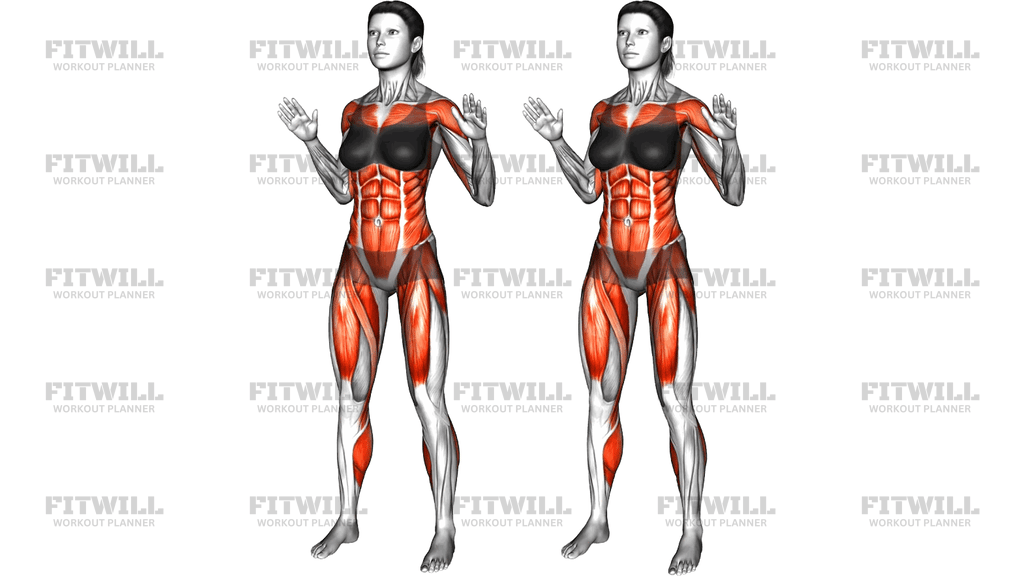
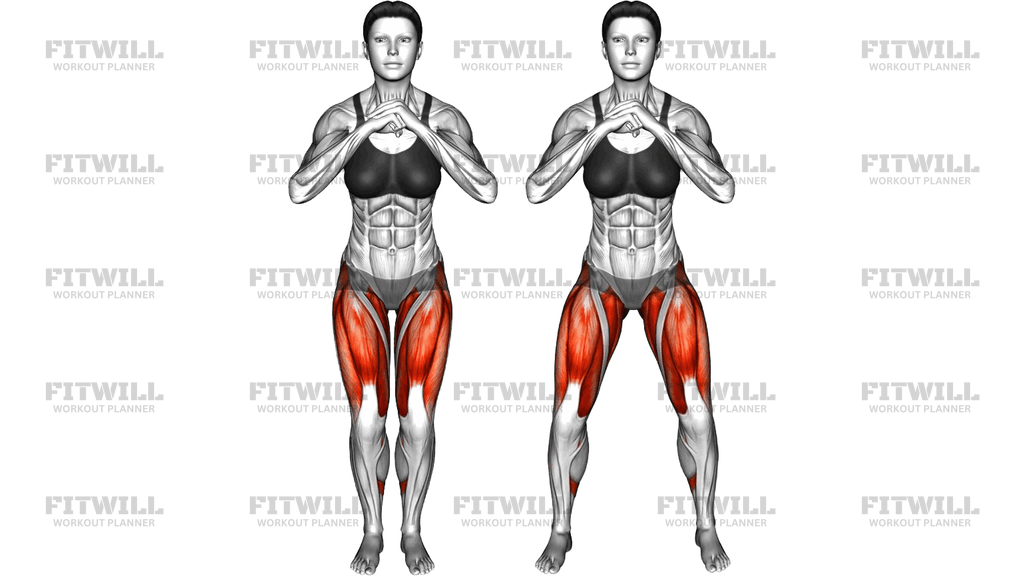
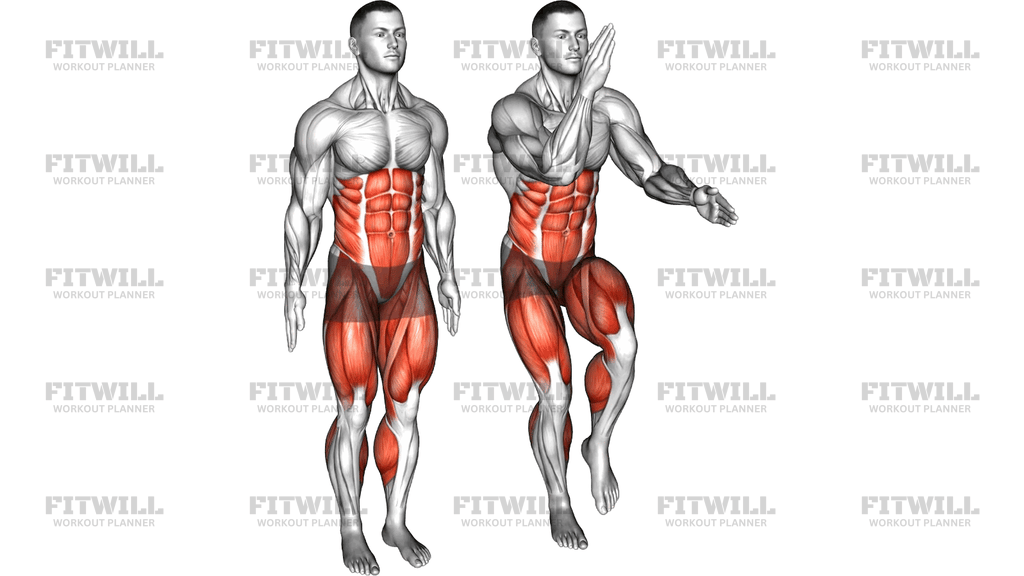
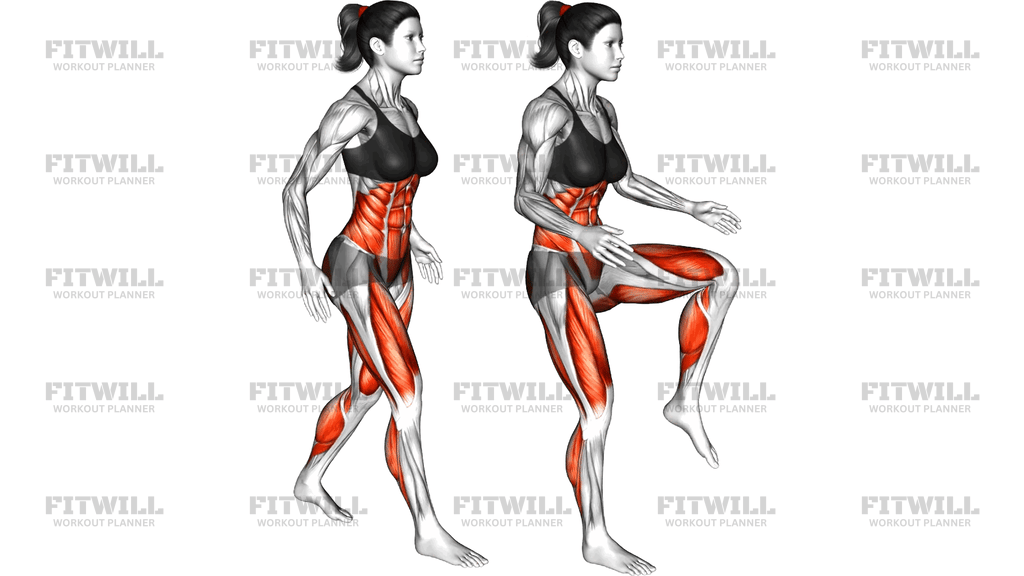
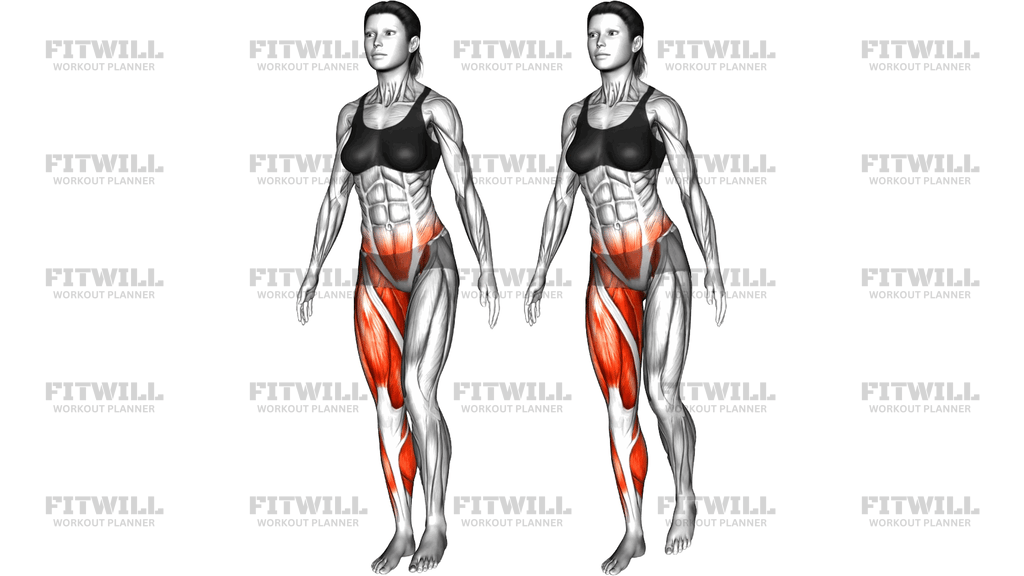
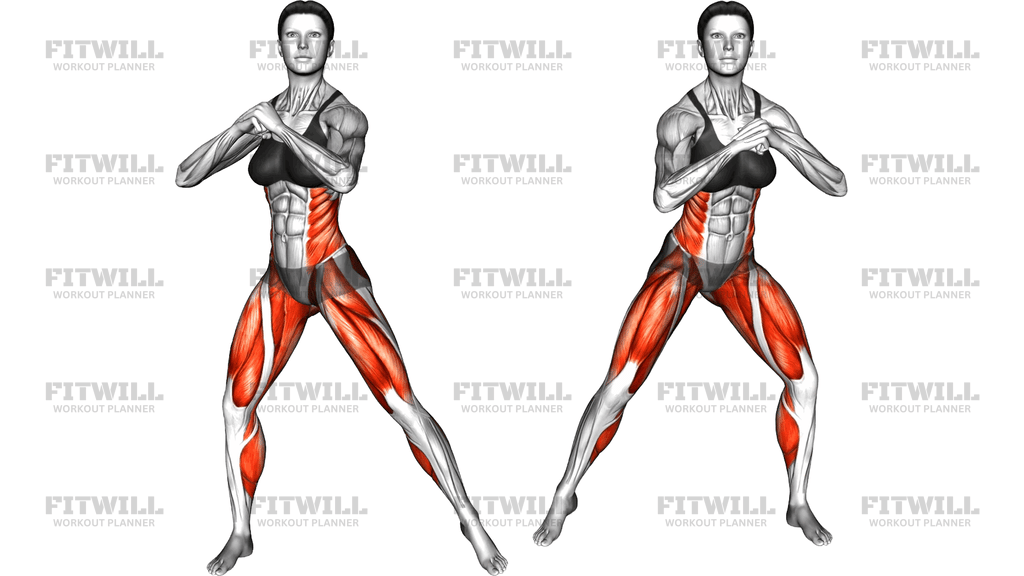
Stepback Front Kick Arms Raise
Stepback Front Kick Arms Raise is a bodyweight movement that combines a rear step with a front kick and a synchronized arm raise. You start standing tall, step one foot back into a controlled staggered stance, then drive that same leg forward into a front kick while your arms sweep up in front of you. Because the lower body and upper body move together on every rep, the exercise doubles as balance and coordination training rather than a simple leg lift.
The main work comes from the kicking leg's quads and hip flexors, which extend the knee and lift the thigh to roughly hip height. The standing leg takes on a quieter but equally important job: the glutes and calf stabilize your torso as your center of mass shifts backward and then forward again. Raising the arms to shoulder height or overhead brings the front shoulders into play and challenges your core to keep the ribcage stacked over the pelvis instead of leaning back as the leg rises.
This exercise suits anyone training at home with no equipment, and it shows up frequently in warm-ups, kickboxing-style conditioning circuits, and general cardio-strength routines. It is a smart precursor to heavier or faster kicking drills because it teaches the sequence slowly: load back, transfer weight, strike forward, and return under control. If you sit for long hours, the deliberate hip flexion also gives the front of the hip some useful active work that static stretching alone does not provide.
Setup matters more than it looks. A narrow, upright stance with the weight balanced over the whole foot gives you a stable base for the backward step, and keeping the torso tall during the kick prevents the common habit of collapsing the chest to fake a higher leg. Kick to the height your hips allow on that day rather than chasing a target; a controlled kick to knee or hip height with a level torso beats a high kick that tips you backward.
To execute well, think of the step-back as the wind-up and the kick as the release. Let the arms rise as the leg comes forward so the movement feels like one flowing action, then lower the arms as the foot returns to the floor. Alternate legs each rep or complete a set per side, depending on your routine. Breathe out on the kick, in on the return, and keep the pace steady enough that your balance never has to scramble.
For safety, stay on a non-slip surface, clear space behind you for the step-back, and keep the kicking knee slightly soft at full extension rather than snapping it straight. If balance is a challenge early on, hold a wall or sturdy chair lightly with one hand until the pattern feels automatic.
[ Workout Log & Planner ]
Put your next workout in Fitwill
Keep your plan and training log ready when you are.


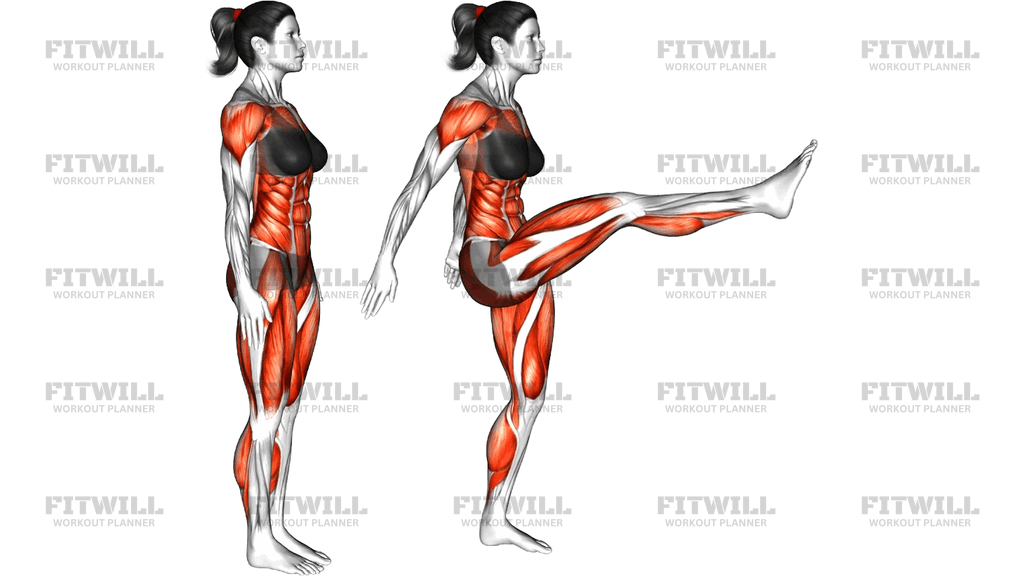
Instructions
- Stand tall with your feet hip-width apart, arms hanging naturally at your sides, and your weight spread evenly across both feet.
- Brace your abdominal muscles lightly and lift your chest so your torso stays upright before you begin moving.
- Step one foot straight back, landing on the ball of that foot with a soft knee, and let your arms drift slightly behind your hips as you step.
- Shift your weight onto the front leg, then drive the back knee forward and up into a front kick, extending that knee toward hip height with the foot flexed or toes pulled back.
- As the leg rises, raise both arms forward and up to shoulder height or above, reaching in the same direction as the kick.
- Pause briefly at the top with the torso tall and the kicking leg extended, without leaning your upper body backward.
- Lower the leg with control, bending the knee as it travels back down, and let the arms lower at the same speed.
- Return the foot to the starting stance beside the other foot, or flow directly into a step-back with the opposite leg for alternating reps.
- Exhale as you kick and raise the arms, inhale as you return to standing.
- Reset your posture and balance between reps, keeping the movement smooth rather than rushed.
Tips & Tricks
- If your torso tips backward when the leg comes up, the kick is going higher than your hip mobility currently allows; aim the kick at knee height and let the range grow over time.
- Keep the knee of the kicking leg bending first before the lower leg extends — kicking from the foot instead of the hip strains the knee and shortens the movement.
- Press the heel of the standing leg into the floor during the kick; rising onto the toes early is the most common cause of wobbling on this exercise.
- Move the arms with intent rather than letting them flop — reaching them forward actually counterbalances the leg and makes the kick easier to control.
- Avoid locking the kicking knee hard at the top of the kick; a small bend in the joint keeps the extension smooth and joint-friendly.
- Keep the step-back narrow, roughly on the same line as your hips; stepping far off to the side turns the balance challenge into a sideways lunge.
- If you feel the front of the standing hip gripping or pinching, shorten the step-back slightly and keep your weight more centered over the front foot.
- Start with 8-10 controlled reps per side before adding speed; this pattern rewards precision, and sloppy fast reps reinforce poor kicking mechanics.
- On soft or springy floors, expect more balance wobble than usual — a firm, non-slip surface makes the step-to-kick transition much cleaner.
Frequently Asked Questions
Which muscles does Stepback Front Kick Arms Raise work the most?
The quads and hip flexors of the kicking leg do the primary work, extending the knee and lifting the thigh. The glutes and calves of the standing leg stabilize you, the front shoulders raise the arms, and the core keeps your torso upright throughout.
Is Stepback Front Kick Arms Raise suitable for beginners?
Yes, as long as you keep the kick low and the tempo slow. Beginners can also rest one hand lightly on a wall or chair for balance until the step-back to kick transition feels steady.
How high should I kick during Stepback Front Kick Arms Raise?
Kick only as high as you can while keeping your torso tall and your standing heel grounded. Knee height is a perfectly good starting point, and hip height or above can come later as hip mobility and balance improve.
Why do my arms need to raise on every kick?
The arm raise coordinates the upper and lower body and acts as a counterbalance, making the kick easier to control. It also adds work for the front shoulders, turning the drill into a fuller-body movement.
The most common mistake in Stepback Front Kick Arms Raise is leaning back as the leg rises — why does that happen?
The hip flexors cannot lift the leg high enough on their own, so the body compensates by arching the lower back and dropping the chest backward. Fix it by reducing the kick height and bracing your abdominal muscles before each rep.
Can I substitute Stepback Front Kick Arms Raise if my balance is poor?
Try a standing front kick without the step-back, or hold a chair for light support. You can also perform the arm raise separately as a front raise to groove the upper-body portion before combining the two.
Should I alternate legs or do all reps on one side?
Either works. Alternating legs keeps you in a continuous rhythm and suits conditioning circuits, while completing all reps on one side before switching lets you focus on balance and technique on each leg.
Is it safe to do Stepback Front Kick Arms Raise every day?
Because it uses only your body weight at a controlled tempo, daily practice is generally fine for most people. If your hips or standing-leg calves feel consistently sore, take a rest day or reduce the reps.
How many reps and sets should I use for Stepback Front Kick Arms Raise?
For technique and warm-up work, 2-3 sets of 8-12 reps per side at a slow pace is a solid starting point. For a conditioning effect, increase the reps and move with a steady rhythm while keeping the kick controlled.