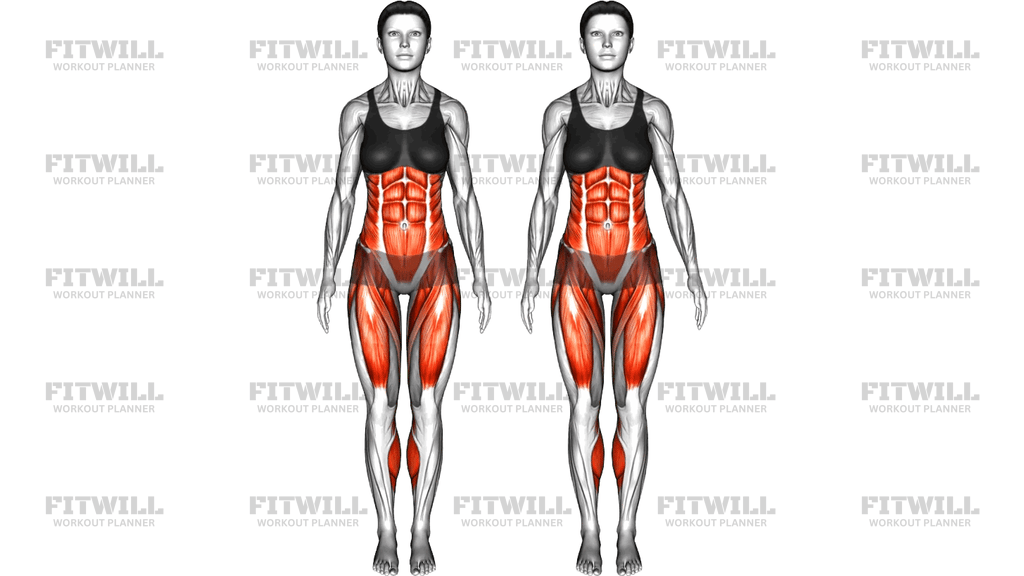
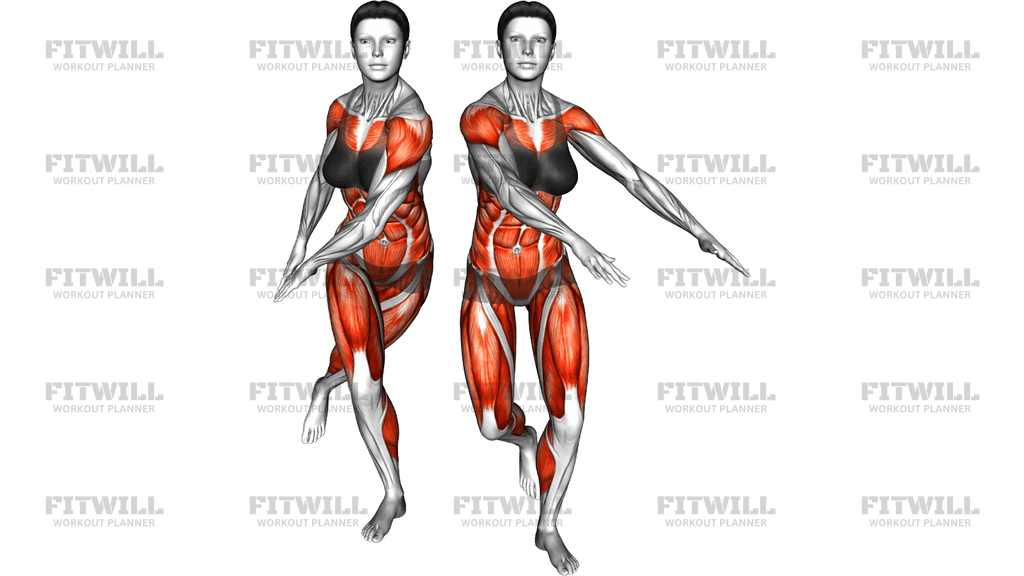
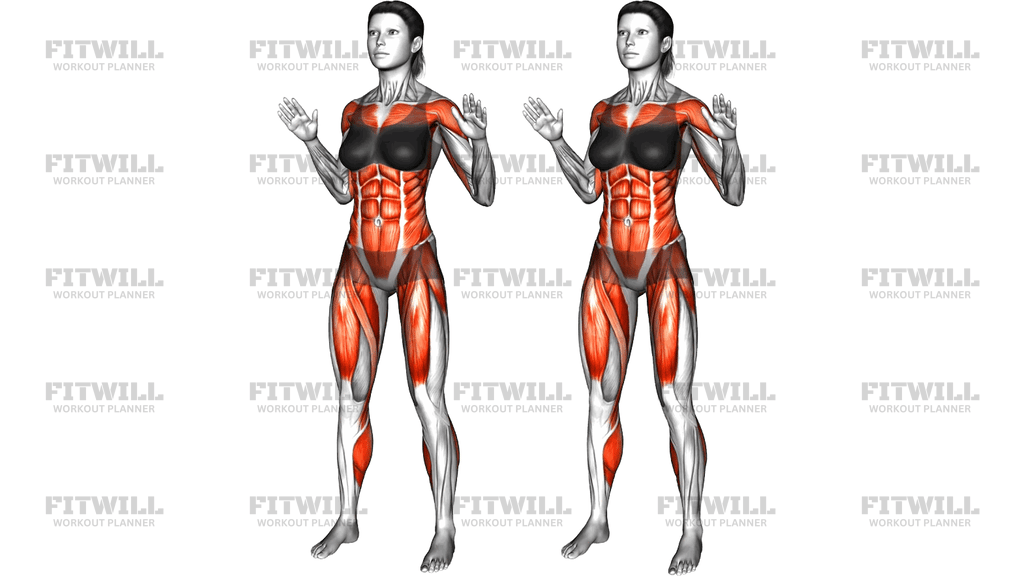
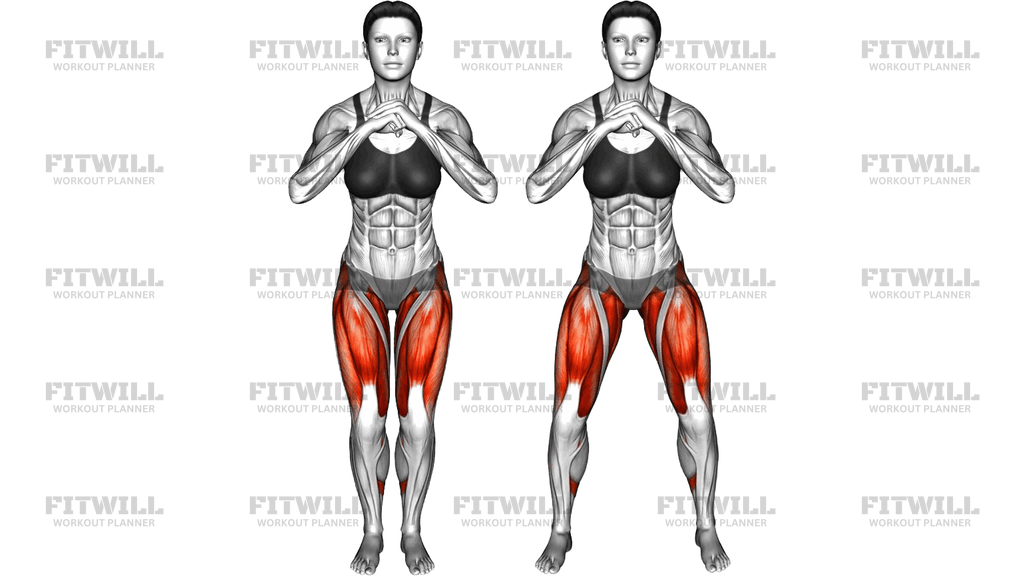
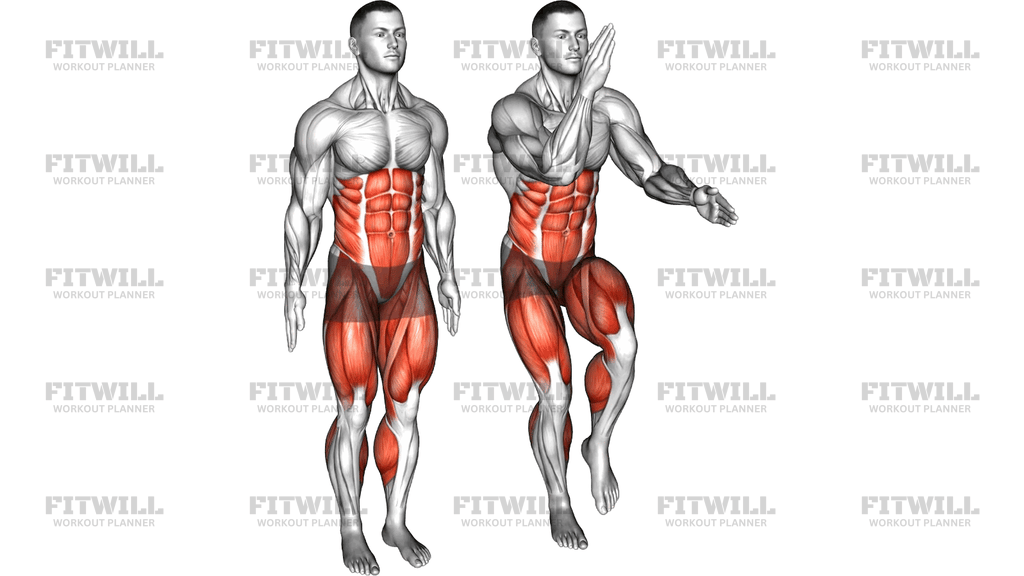
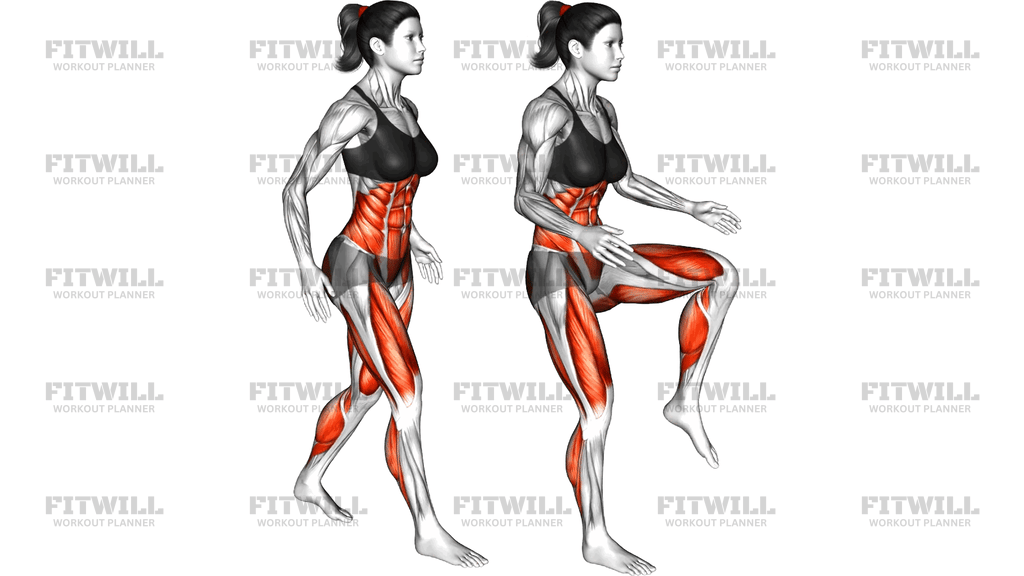
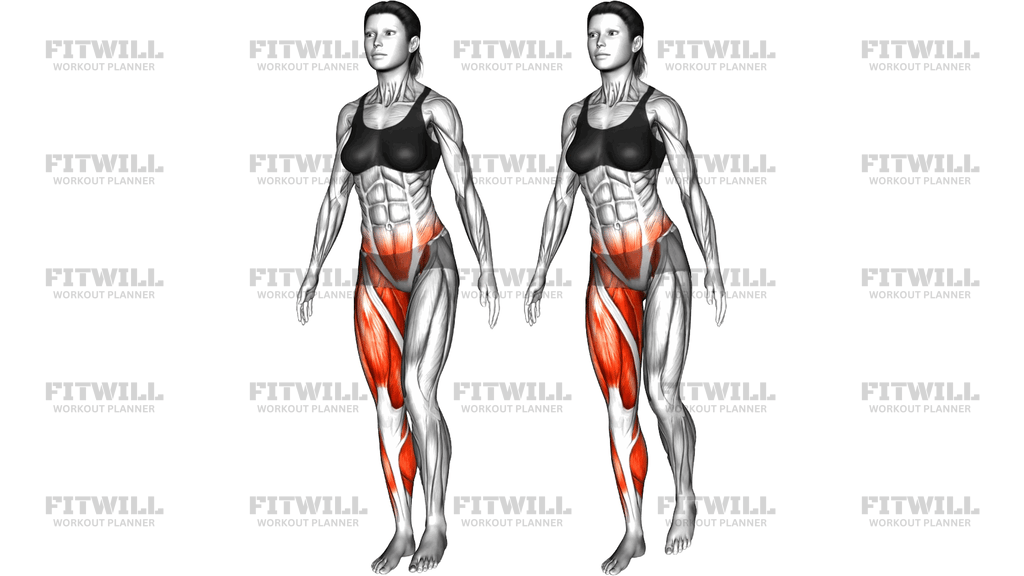
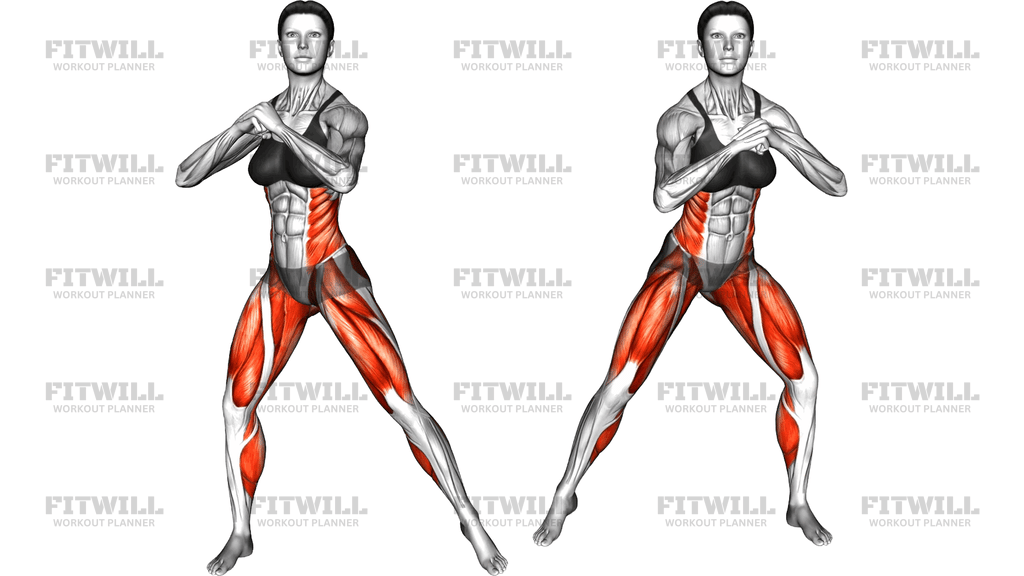
Walking Front Kick Reach Up
Walking Front Kick Reach Up is a bodyweight combination movement that pairs a traveling front kick with an upward reach of the opposite arm. You start standing tall, then drive one knee up, extend the leg into a controlled front kick, and simultaneously punch or reach the opposite hand straight overhead before stepping through and repeating on the other side. Because each rep moves you forward, the exercise doubles as a conditioning drill that covers ground while it trains the legs, hips, and shoulders together.
The main work comes from the kicking leg's quads and hip flexors, which lift and extend the leg, while the standing leg's glutes, quads, and calves stabilize every step. The reaching arm brings the front shoulders into play, and holding your torso upright through the kick-recycle pattern keeps the abs and deep core engaged the entire time. This cross-body coordination is what separates it from a plain standing kick: the opposite arm and leg must move in rhythm, which challenges balance and timing as much as raw strength.
This movement suits warm-ups, kickboxing-style conditioning circuits, and general athletic training. It is especially useful for people who want to develop hip mobility and single-leg control without equipment, and for anyone building the coordinated arm-and-leg patterns used in martial arts and combat sports. Because the intensity scales easily with kick height and travel speed, it works for beginners who kick low and move slowly as well as for advanced trainees snapping kicks to waist height or higher.
Setup matters more than it looks. Stand tall with feet hip-width apart, ribs down, and your weight balanced over the whole foot before you move. If you start with a sway in your lower back or your weight dumped into your toes, the kick will pull you forward and the reach will arch your spine. Keeping the torso tall and the core braced lets the leg move freely underneath you while the arm travels straight up rather than drifting forward.
To execute well, lift the knee first, then extend the lower leg into the kick at a height you can control, usually hip height or below to start. Reach the opposite hand overhead as the leg extends, keep the kick snappy but not reckless, and retrace the same path as you lower the foot and step forward. Alternate sides with each rep and keep your gaze forward to help your balance. Land softly through the ball of the foot, then the heel, and reset your posture between steps if you feel yourself leaning.
The main safety points are keeping the kick at a controllable height, avoiding full-power leg extension if your hamstrings are cold, and never letting the lower back arch as the arm reaches up. Move deliberately at first; speed can come once the pattern feels automatic.
[ Workout Log & Planner ]
Put your next workout in Fitwill
Keep your plan and training log ready when you are.


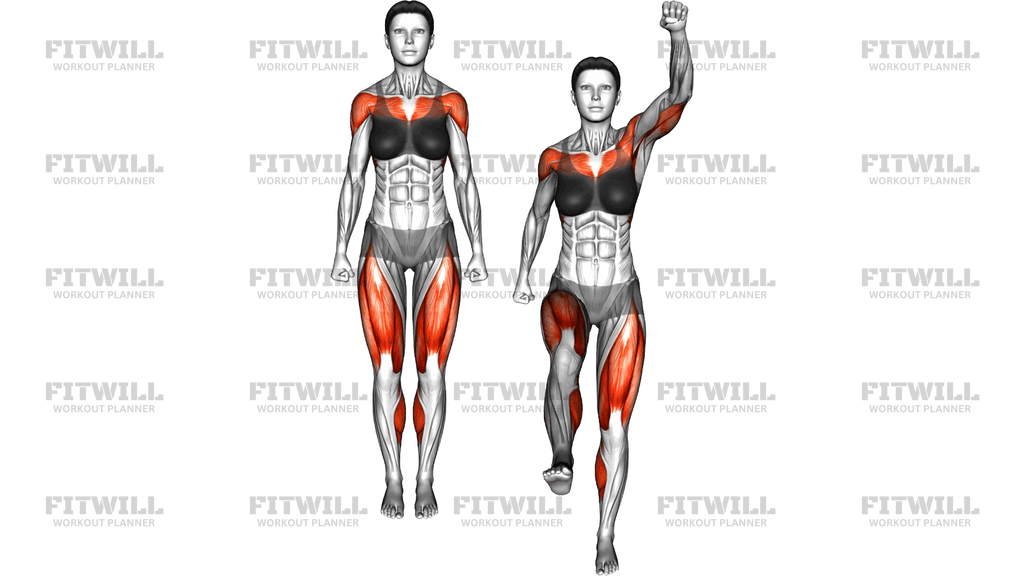
Instructions
- Stand tall with your feet hip-width apart, arms relaxed at your sides, and your weight spread evenly across both feet.
- Brace your core lightly, pull your ribs down, and pick a spot straight ahead to keep your head and gaze steady.
- Shift your weight onto your left leg and lift your right knee up to roughly hip height, keeping your torso upright.
- Extend your right lower leg forward into a front kick at a controlled height, pointing the foot or flexing it back consistently.
- At the same moment, drive your left arm straight up overhead with a firm hand, keeping the shoulder down away from your ear.
- Retract the kick along the same path, bending the knee before lowering the foot, and step forward onto the right foot with a soft landing.
- Exhale as you kick and reach, then inhale as you lower the leg and step through.
- Repeat the pattern on the left leg with the right arm reaching up, and keep alternating sides as you travel forward.
- Pause and reset your posture if you notice your torso leaning back or your steps getting sloppy.
Tips & Tricks
- Lift the knee before extending the leg. Kicking straight from the floor makes you lean back and turns the move into a swing rather than a kick.
- Keep the reach arm stiff at the top. A soft, floppy arm overhead makes the shoulder shrug and reduces the core demand on the kicking side.
- Start kicks at knee or mid-shin height. Most people lose their balance trying to kick to waist height before their standing-leg control is ready.
- Watch for the lower back arching every time the arm goes overhead. Squeeze the glute of the standing leg and keep the ribs down to protect the spine.
- Keep the standing knee slightly soft rather than locked, especially when the kicking leg is at full extension and the balance demand peaks.
- Land each step through the ball of the foot first. Hard heel strikes while traveling forward strain the knees and disrupt your rhythm.
- If you wobble on every rep, slow the tempo down and hold the knee-lift position for a beat before kicking rather than rushing through.
- Keep the kick path narrow, in line with your hip. Kicking across the body twists the torso and pulls the reaching arm off its vertical line.
- Once the pattern is smooth, add speed or raise the kick height for more conditioning effect instead of adding extra arch or lean.
Frequently Asked Questions
Which muscles does the Walking Front Kick Reach Up work the most?
The quads and hip flexors of the kicking leg do the primary work, supported by the glutes and calves of the standing leg. The front shoulders drive the overhead reach, and the abs stabilize your torso throughout.
Is the Walking Front Kick Reach Up suitable for beginners?
Yes, as long as you start with low kicks at knee height and a slow, deliberate tempo. The opposite arm and leg coordination takes a few sessions to feel natural, so master the pattern before adding speed or height.
Why does the opposite arm reach up during the kick?
The overhead reach of the opposite arm trains cross-body coordination, adds front shoulder work, and raises the core stability demand because your torso must stay tall while the arm and leg move in opposite directions.
How high should I kick during the Walking Front Kick Reach Up?
Kick only as high as you can control without leaning back or twisting, which for most people is knee to hip height at first. Height can increase gradually as hip mobility and single-leg balance improve.
What is the most common mistake in this exercise?
Leaning the torso backward as the leg kicks forward. This usually happens when the kick is too high or the core is not braced, and it turns the movement into a lower-back arch rather than a controlled hip hinge and kick.
Can I do the Walking Front Kick Reach Up as a warm-up?
Yes, it works well as a dynamic warm-up because it mobilizes the hips, activates the legs and shoulders, and raises your heart rate. Use lower kicks and slower steps when using it to warm up.
What can I substitute if the balance is too difficult?
Perform the same kick and reach pattern without stepping forward, or hold onto a wall or sturdy support with the non-reaching hand until your single-leg control improves.
How many reps of the Walking Front Kick Reach Up should I do?
For conditioning, work in the range of 20 to 40 total alternating kicks, either for time or distance traveled. For warm-ups, 10 to 15 slow alternating reps per side is usually enough.
Should my kicking foot be pointed or flexed?
Either works, but pick one and stay consistent. A pointed foot keeps the movement smooth and fast, while a flexed foot mimics a striking surface in martial arts and slightly increases the shin and ankle demand.
Is it safe to do this exercise every day?
For most people, yes, since it uses only bodyweight at a controlled intensity. Keep the kicks at a manageable height and stop if you feel persistent pinching at the front of the hip or discomfort in the standing knee.