Standing Bent Knee Alternating Calf Raise With A C
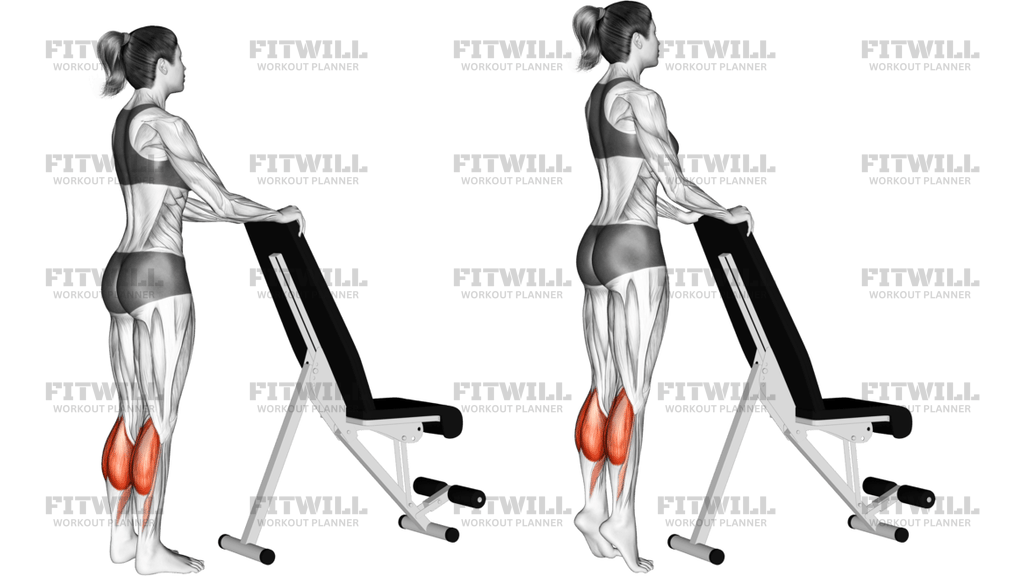
The Standing Bent Knee Alternating Calf Raise With A Chair is a bodyweight calf exercise performed while leaning on the back of a sturdy chair for balance. You stand with your knees bent, shift your weight onto one leg, and rise onto the ball of that foot while the other knee stays bent and its foot hovers off the floor. After completing the reps on one side, you switch legs, which is where the alternating pattern comes in.
The bent-knee position is the defining feature of this movement. When the knee is flexed, the gastrocnemius — the two-headed calf muscle that crosses the knee joint — is placed in a shortened position and contributes less force. That shifts most of the work to the soleus, the deeper, flatter muscle sitting underneath it. The soleus is heavily involved in walking, jogging, climbing stairs, and holding an upright posture, so this variation is especially useful for runners, hikers, and anyone whose daily life loads the calves in a knee-bent position.
The chair serves one purpose: balance. Because you are standing on one leg with the heel rising and lowering, a light hand contact lets you focus on the calf instead of on wobbling. It should not carry your weight — if you find yourself leaning heavily into it, the exercise loses much of its value for the ankle stabilizers, which have to work to keep you aligned over the working foot.
To execute it well, set your feet hip-width apart, bend both knees to roughly a quarter-squat depth, and keep that knee angle frozen for the entire set. Press through the ball of the foot and the base of the big toe to lift the heel as high as it will comfortably go, pause briefly at the top, and lower the heel with control until it is just above the floor — or slightly below it if you are standing on a step edge — before driving back up. The lifting and lowering should be smooth; no bouncing or dropping into the bottom position.
This exercise fits well into home workouts since it needs nothing but a chair, into warm-ups before lower-body training, and into rehab-style programming where light, controlled soleus work is useful. Common form issues include straightening the knee as you rise, letting the ankle roll outward, and pushing so hard into the chair that the torso pitches forward. Fixing those three points is most of what stands between a mediocre set and a productive one.
Start with moderate reps in the 10 to 15 range per leg and progress by slowing the tempo, adding a pause at the top, or eventually holding a light weight in your free hand once balance is no longer the limiting factor.
[ Workout Log & Planner ]
Put your next workout in Fitwill
Keep your plan and training log ready when you are.


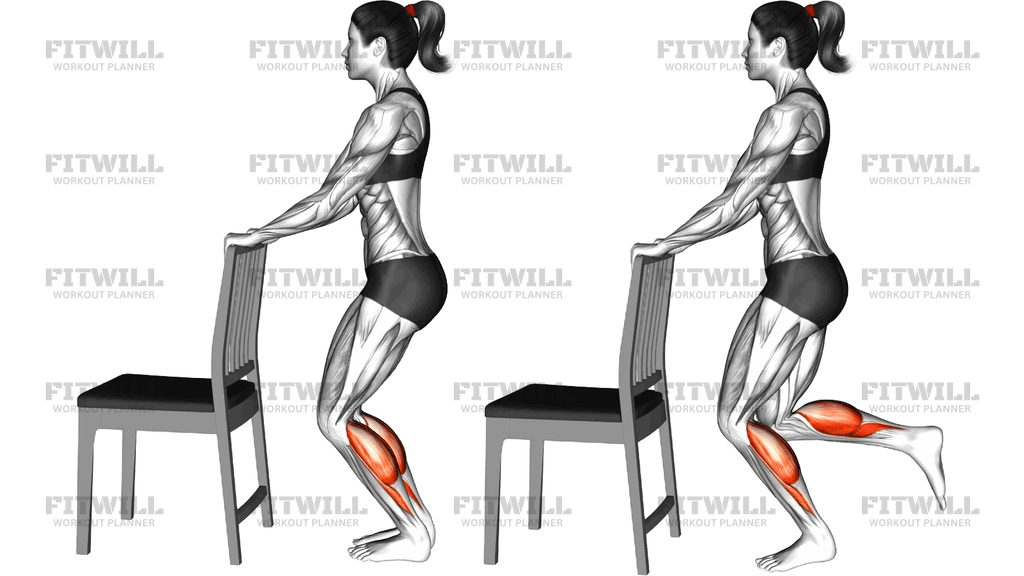
Instructions
- Place a sturdy chair on a non-slip floor and stand facing its back with your feet hip-width apart.
- Rest both hands lightly on the top of the chair back and step back far enough that your arms extend and your torso leans slightly forward.
- Bend both knees to about a quarter-squat depth — roughly 30 to 45 degrees — and keep your heels flat on the floor.
- Shift your weight onto one foot, then lift the other foot off the floor and bend that knee so the foot hangs behind you, relaxed.
- Brace your core lightly and keep your shoulders, hips, and the ankle of the working leg in one line.
- Exhale as you press through the ball of the working foot and the base of the big toe, raising your heel as high as possible while keeping the knee bent at the same angle.
- Pause for one second at the top with the calf contracted and your weight balanced over the forefoot.
- Inhale as you lower the heel slowly, taking two to three seconds, until it is just above the floor without touching down or bouncing.
- Complete all repetitions on one leg, then set the rear foot down, switch sides, and perform the same number on the other leg.
- When finished, stand tall, roll the ankles gently, and stretch the calves before moving on.
Tips & Tricks
- The knee angle is the whole point of this exercise — if you straighten the leg as you rise, the gastrocnemius takes over and you are no longer training the soleus. Lock in your bend before the first rep and check it again on every rep.
- Use fingertips on the chair, not a death grip. If your hands are white-knuckled, you are unloading the working leg and hiding poor balance instead of fixing it.
- Do not let the ankle roll outward at the top. Push the weight through the base of the big toe so the heel rises straight up; rolling outward stresses the outer ankle and reduces calf involvement.
- The rear foot is dead weight — keep it relaxed and off the floor. If it keeps tapping down, your stance is too narrow or you are rushing the tempo.
- Keep the forward lean constant. Pitching further into the chair as you fatigue is a sign the set is over; stop rather than shorten the range to squeeze out extra reps.
- Aim for a full sweep: heel as low as your flexibility allows, heel as high as your calf allows. Most people shortchange the bottom half, which is where the stretch and much of the growth stimulus lives.
- Slow down before speeding up. Two seconds up, one second pause, three seconds down will produce far more tension than fast, bouncy reps that use momentum off the floor.
- Work on a firm, non-slip surface and either go barefoot or wear flat-soled shoes. Thick, soft running shoes make it harder to feel the forefoot and to balance.
- If you wobble badly, stand a few inches closer to the chair and shorten the range slightly for the first week or two — balance on one leg usually improves quickly.
Frequently Asked Questions
Why are the knees bent in the Standing Bent Knee Alternating Calf Raise With A Chair?
Bending the knees shortens the gastrocnemius, which crosses the knee joint, so the soleus underneath has to do most of the work. A straight-leg calf raise would reverse that emphasis.
Which muscles does this exercise target?
The soleus is the primary mover, with assistance from the gastrocnemius. The small muscles around the ankle also work hard to keep you balanced over one foot.
Can beginners do the Standing Bent Knee Alternating Calf Raise With A Chair?
Yes, and the chair makes it beginner-friendly because you have a handhold for balance. Start with a smaller range of motion and 8 to 10 reps per leg if single-leg balance is new to you.
How much weight should I put on the chair?
As little as possible — the chair is a balance reference, not a support. If your arms feel tired before your calves do, you are leaning too much into it.
Can I do this exercise without a chair?
You can use a wall, countertop, or squat rack upright with the same light fingertip contact. Without any support, balance becomes the limiting factor and the calves get less quality work.
How is this different from a regular standing calf raise?
A regular standing calf raise is done with straight legs, which emphasizes the gastrocnemius. The bent-knee version shifts the load to the soleus and is usually done one leg at a time, as the alternating setup here shows.
How many reps and sets should I do?
Start with 2 to 3 sets of 10 to 15 reps per leg. As that becomes easy, slow the lowering phase or add a top pause before considering added weight.
Why does my heel drop or my ankle wobble at the bottom?
That usually means you are moving too fast or standing too far from the chair. Slow the tempo, bring your hand closer to the chair back, and control the last few degrees of the lowering phase.
Is it a problem if my knee angle changes during the set?
Yes — the knee should stay at the same bend from start to finish. If it straightens as you rise, think about pushing your hips slightly back and keeping the thigh still while only the ankle moves.
Is this exercise safe for my ankles?
For healthy ankles it is generally a controlled, low-load movement, and the single-leg balance component can support ankle stability. If you have a recent ankle injury or feel sharp pain, check with a qualified professional before doing it.