Standing 4x Back Criss Cross 4x Front Criss Cross
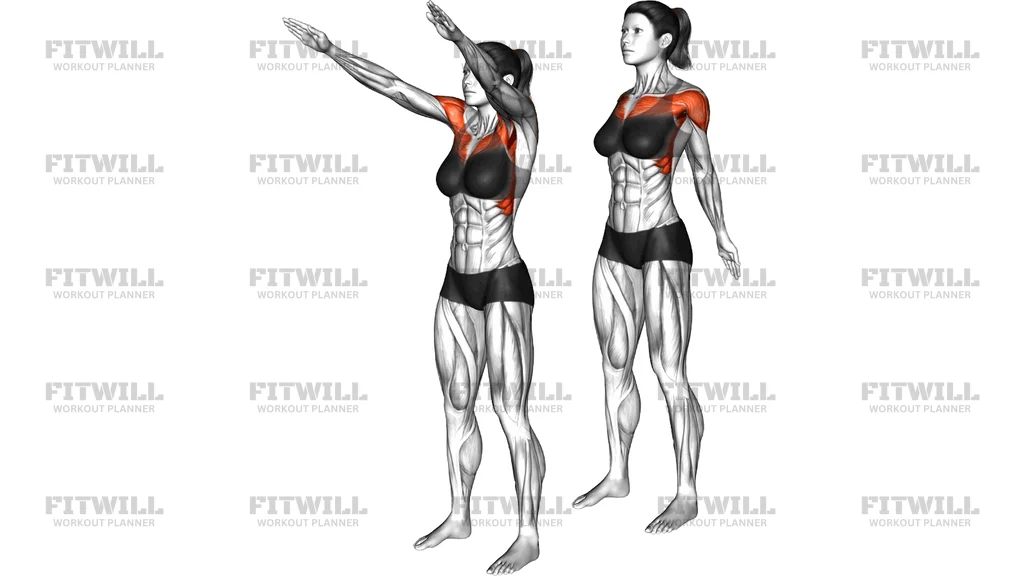
Standing 4x Back Criss Cross 4x Front Criss Cross is a dynamic arm swing drill performed from a tall standing position with no equipment. You swing both arms across the front of your body so they cross over each other, then swing them across behind your back so they cross again, alternating between the two patterns for four repetitions each. The arms travel on a diagonal path, reaching up and across at roughly shoulder to eye level in front, then sweeping down and behind you for the back cross.
This movement is primarily used as a warm-up. Because the arms swing through a wide arc across the body, it takes the front shoulders and upper chest through a broad range of motion while the trunk rotates slightly with each swing. It is a staple in general warm-up routines, martial arts and combat sport preparation, swimming and throwing warm-ups, and any session where you are about to press, punch, swim, or throw and want the shoulder girdle ready to move.
The muscles highlighted by the movement are the front delts and the upper portion of the chest, which help lift and cross the arms in front of the body. The mid-back muscles control the arm paths, the core stays braced to keep the torso tall, and the trunk rotation gently wakes up the obliques. Because it is unweighted and rhythmic, the emphasis is on range, fluidity, and coordination rather than force production.
Setup matters more than it looks. Stand with feet about hip-width apart, knees soft but not bent deeply, and ribs stacked over the pelvis. If you lean back or hunch forward as the arms swing, you lose the clean shoulder path and the drill stops doing its job. Keep the swings relaxed from the shoulders rather than stiff and forced, letting the arms travel in long, smooth arcs.
The rhythm is simple: four crosses in front, then four crosses behind, and repeat the cycle as many rounds as your warm-up calls for. Breathe steadily throughout and let each swing finish before the next one starts. Done well, you should feel warmth building across the front of the shoulders and chest and a gentle opening sensation through the back of the shoulders as the arms cross behind.
As a safety note, keep the swings within a comfortable range. If a swing pinches at the front of the shoulder or pulls sharply across the chest, reduce the height and speed of the arc and build up gradually. The goal is preparation, not maximum stretch.
[ Workout Log & Planner ]
Put your next workout in Fitwill
Keep your plan and training log ready when you are.


Instructions
- Stand tall with your feet hip-width apart, knees soft, and your arms hanging relaxed at your sides.
- Brace your core lightly and keep your ribs stacked over your pelvis so your torso does not lean or arch during the swings.
- Swing both arms up and across the front of your body at the same time, letting each hand cross past the opposite shoulder at roughly eye to forehead height.
- Let the arms swing back down and out to the sides, then cross them again in front, completing four front crosses in a smooth rhythm.
- On the fifth swing, carry both arms down and across behind your hips so they cross behind your back, reaching toward the opposite side.
- Swing the arms back out and around to complete four back crosses behind your body.
- Alternate between four crosses in front and four crosses behind for the desired number of rounds, keeping the tempo even.
- Exhale naturally on the forward swings and inhale on the return; do not hold your breath.
- Finish the set by letting the arms swing back to your sides, then reset your posture before the next drill.
- Keep the effort relaxed throughout; if your shoulders hike up toward your ears, drop the arms, shake them out, and restart with smaller arcs.
Tips & Tricks
- A common mistake is swinging from the elbows only; drive the arcs from the shoulders so the whole arm travels through the cross.
- If the arms clash in front of your body, stagger the timing slightly so one hand passes just above the other instead of colliding.
- Hunching the upper back as the arms cross behind is a frequent fault; think of drawing the shoulder blades down your back to stay tall.
- Keep the crosses in front at shoulder height or slightly above, not cranked as high as possible; the drill works best in a mid range.
- Your torso will want to twist hard with each swing; allow a small, natural rotation but keep the hips facing forward.
- Start with smaller arcs for the first round and widen the swing gradually as the shoulders loosen up.
- If you feel a pinch at the front of the shoulder during the back crosses, reduce how far behind you reach rather than forcing the cross.
- Move continuously without pausing at the top or bottom of each swing; the value comes from the rhythm, not from holding positions.
- Pair this drill with leg swings or hip circles so the whole body is warm before pressing, throwing, or swimming work.
Frequently Asked Questions
What muscles does Standing 4x Back Criss Cross 4x Front Criss Cross work?
It mainly targets the front delts and the upper portion of the chest as the arms lift and cross in front. The muscles of the upper back control the arm paths, and the obliques contribute a small amount of trunk rotation with each swing.
Is this exercise a strength builder or a warm-up?
It is a dynamic mobility and warm-up drill, not a strength exercise. Since you are moving only your arms with no added load, its value is in raising temperature, loosening the shoulder girdle, and rehearsing the crossing arm path.
Why does the exercise alternate four front crosses and four back crosses?
The even four-repetition blocks give both patterns balanced volume and keep the drill rhythmic. Front crosses bias the chest and front shoulders, while back crosses open the back of the shoulders, so alternating covers both directions.
How high should my arms cross in front of my body?
Aim for roughly shoulder to eye level, where each hand passes toward the opposite shoulder. Going higher than that usually causes shrugging and shoulder hiking without adding benefit.
Can beginners do Standing 4x Back Criss Cross 4x Front Criss Cross?
Yes, it is very beginner friendly because it is unweighted and self-paced. Start with smaller, slower arcs and only widen the swing once the shoulders feel loose and comfortable.
My arms collide when I cross them in front. What should I change?
Offset the timing slightly so one hand passes a few centimeters above the other, or narrow the arc a little. The hands should cross past each other, not crash into each other.
What can I substitute if the back crosses bother my shoulders?
Perform only the front crosses and add gentle arm circles behind you at a comfortable height instead. You can also reduce how far behind the hips you reach on the back crosses.
How many rounds should I do in a warm-up?
Two to four rounds of four front crosses and four back crosses is usually enough to feel the shoulders warm. Add more rounds only if you are preparing for a long upper body session.
Should my torso rotate with each swing?
A small, natural rotation is fine and helps the arms travel across the body. Keep the hips facing forward and avoid twisting forcefully, since the drill is about the arms, not the spine.
When is the best time to use this drill?
Use it at the start of a workout before pressing, throwing, swimming, or martial arts training. It also works well as a mid-session reset if your shoulders feel tight between sets.