Standing Double Prayer Push
The Standing Double Prayer Push is a bodyweight isometric exercise where you press your palms firmly together in a prayer position and slide the joined hands up and down in front of your face and chest. Because you are pushing your hands against each other rather than against an external load, the resistance comes entirely from your own muscular effort, which makes the intensity something you can scale moment to moment simply by pressing harder or lighter. The front delts are the main drivers, with the chest, triceps, and the small stabilizing muscles around the shoulder girdle contributing throughout.
This movement is especially useful when you have no equipment available but still want to fatigue the front of the shoulders, or as a low-impact activation drill before pressing work like push-ups or overhead presses. It is also a common inclusion in shoulder health and rehab-style routines because the hands-on-hands position keeps the arms in a midline, joint-friendly path with no external weight pulling the shoulder around. The standing posture means your legs and trunk stay lightly engaged to keep you upright, though the demand on them is minimal.
Setup matters more than it might appear. Stand tall with feet about hip-width apart, elbows lifted so the upper arms are roughly parallel to the floor, and palms touching at chest or face height. If your elbows drift down or your shoulders shrug toward your ears, the front delts lose their working angle and the neck picks up tension that does not belong there. Keeping the forearms vertical and the hands anchored at the midline is what channels the effort into the shoulder and chest.
Execution is a matter of pressing the palms together with moderate to firm force while sliding the hands slowly upward toward the forehead and then downward toward the sternum, keeping contact and pressure constant the whole time. The press should never relax during the slide, and the tempo should be slow enough that you can feel the shoulders working through the entire range. The return is just as deliberate as the upward slide, since the isometric contraction is the point of the exercise, not the distance traveled.
In practice, you will see the Standing Double Prayer Push used in home workouts, warm-up circuits, and as a finisher to flood the front delts with blood after heavier pressing. A typical set runs 20 to 40 seconds or 10 to 15 slow slides. If you feel it mostly in your neck or the tops of your shoulders ride up, reduce the pressing force and lower your hands slightly until the work sits squarely on the front delts.
Fitwill
Log Workouts, Track Progress & Build Strength.
Achieve more with Fitwill: explore over 9600 exercises with images and videos, access built-in and custom workouts, perfect for both gym and home sessions, and see real results.
Start your journey. Download today!




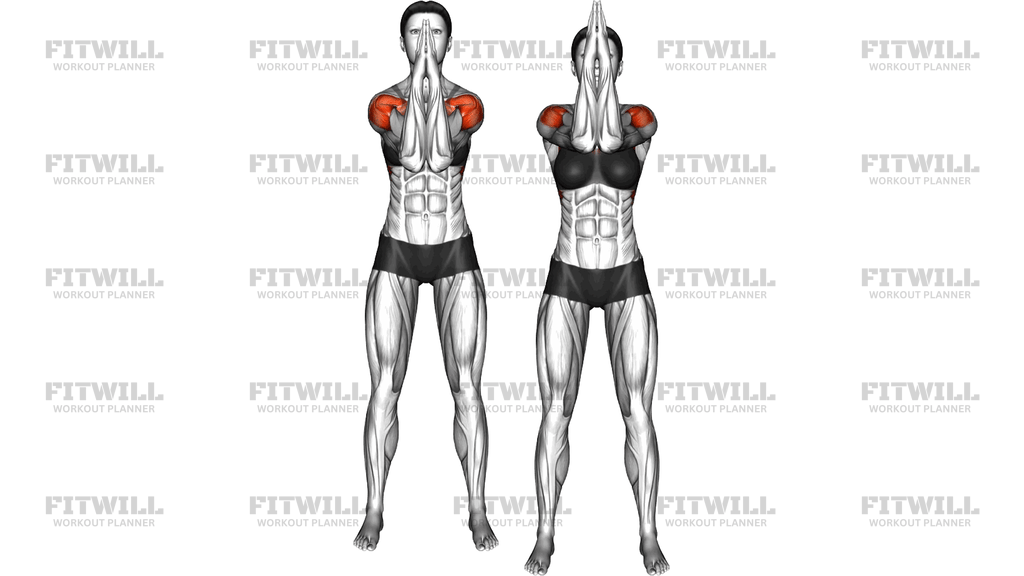
Instructions
- Stand upright with your feet hip-width apart and your weight balanced evenly across both feet.
- Bring your palms together in front of you at chest or face height, fingers pointing upward, in a prayer position.
- Raise your elbows so the upper arms are roughly level with your shoulders and the forearms run vertically along the midline of your body.
- Brace your trunk lightly, relax your shoulders away from your ears, and keep your gaze forward.
- Press your palms firmly into each other and hold that pressure without letting it fade.
- Keeping the press constant, slide both hands slowly upward along the midline until they reach forehead level.
- Pause briefly at the top, then slide the hands back down to sternum level at the same controlled pace, maintaining firm palm contact.
- Breathe steadily throughout, inhaling on the slide up and exhaling on the slide down, without holding your breath.
- Complete your target time or repetitions, then release the palm pressure and drop your arms to reset before the next set.
Tips & Tricks
- The most common error is letting the palm pressure fade during the slide, which turns the exercise into a plain arm movement with almost no shoulder involvement; re-commit to the press at both ends of each rep.
- Watch for shoulders creeping toward the ears as fatigue builds; actively press them down and back before each set and reset the position whenever you notice shrugging.
- If your elbows drop below shoulder height, the resistance angle shifts away from the front delts; think about keeping a straight line from elbow to elbow across the shoulders.
- Press at around 70 to 80 percent of your maximum force rather than all-out; a grip you can sustain for the whole set produces more usable tension than a squeeze that collapses halfway through.
- Keep the hands on the body's midline; letting them drift to one side means one shoulder is doing more work than the other.
- Slow the slides down before you increase the pressing force; a five-second upward and five-second downward slide is harder than it sounds and safer for the shoulder joint.
- If your wrists ache from the sustained pressing, reduce the force slightly and spread the effort across the whole palm rather than loading the heel of the hand.
- Use this as a pre-pressing activation with lighter pressure, or as a finisher with maximum sustainable pressure; the same setup serves both purposes with different intent.
Frequently Asked Questions
What muscles does the Standing Double Prayer Push work?
The front shoulders are the primary muscles working, since they drive the sustained inward press and the vertical hand slide. The chest and triceps assist, and the muscles stabilizing the shoulder blades work isometrically to hold the arm position.
Is the Standing Double Prayer Push suitable for beginners?
Yes, it requires no equipment and the resistance is self-regulated, so a beginner can start with light palm pressure and short sets. It is one of the gentler ways to load the front delts because there is no external weight pulling on the shoulder.
Why do my neck muscles tense up during the Standing Double Prayer Push?
This usually happens when the shoulders shrug toward the ears or the elbows drop below shoulder height. Lower the pressing force, keep the elbows level with the shoulders, and consciously settle the shoulder blades down before continuing.
How hard should I press my palms together?
Press firmly enough that the front delts feel clearly engaged for the entire set, typically around 70 to 80 percent of your maximum effort. If the pressure fades partway through, you are pressing harder than you can sustain.
How many reps or how long should I perform the Standing Double Prayer Push?
A practical starting point is 10 to 15 slow slides, or 20 to 40 seconds of continuous pressing per set. Because the tension is self-generated, quality of pressure matters far more than the number of repetitions.
Can I use the Standing Double Prayer Push as a warm-up before pressing exercises?
Yes, with lighter palm pressure for 15 to 20 seconds it works well as an activation drill before push-ups, bench presses, or overhead pressing. With heavier pressure and slower slides, the same setup becomes a demanding finisher.
What can I substitute if pressing my palms together bothers my wrists?
Try pressing the backs of the hands together instead, or use a doorway push where you press the palms against a fixed frame at chest height. Both keep the front delts working through a similar midline path with less wrist loading.
Should my hands travel all the way above my head?
No, the slide runs from roughly sternum level up to forehead level while the elbows stay lifted and the palms stay pressed together. Extending beyond that range tends to make the elbows drop and the shoulders shrug, which reduces the work on the front delts.
How do I know I am doing the Standing Double Prayer Push correctly?
You should feel a steady burn across the front of both shoulders with the elbows held level and the palms never losing contact. If you feel it mainly in the neck, the chest, or one side more than the other, revisit your elbow height and pressing force before adding volume.