Sitting Alternating Quads Stretch
The Sitting Alternating Quads Stretch is a floor-based flexibility exercise that targets the quadriceps one leg at a time. You sit with one leg extended straight in front of you while the opposite knee is bent so the heel draws back toward the hip, then you hold the foot or ankle and apply gentle tension before switching sides. Because you work one leg at a time, you can match the intensity to each side rather than being limited by your tighter leg.
This stretch is especially useful for runners, cyclists, and anyone who spends long hours sitting, since tight quads and hip flexors are among the most common complaints in those groups. It also fits naturally into a post-workout cooldown after squats, lunges, or leg days, and it works well as a daily maintenance stretch for people dealing with a general feeling of tightness across the front of the thighs.
The main muscles lengthened here are the quadriceps on the front of the thigh, with extra emphasis on the rectus femoris, which crosses both the knee and the hip. The bent-knee position also places a mild stretch on the hip flexors at the front of the bent side, which is one reason this seated version can feel more complete than a simple standing quad stretch. Staying tall through the spine matters as much as the leg position; if you slump backward, the front-of-thigh lengthening is reduced and the lower back takes more of the load.
Setup is straightforward: sit on the floor or a mat with both legs extended, then bend one knee and let the knee point down toward the floor as the foot moves back alongside the hip. Reach back with the same-side hand to hold the foot or ankle. The extended leg stays relaxed but straight, with the toes drifting toward the ceiling. Everything happens from a stable, upright seated position, so the stretch should never require force or bouncing.
To perform it well, draw the heel gently toward the glute or lift the knee slightly off the floor only as far as comfortable, breathe steadily, and hold for 20 to 45 seconds before releasing and switching sides. One round through each leg is usually enough in a cooldown; two rounds can be useful if you feel particularly tight. Expect a strong but tolerable pulling sensation along the front of the thigh and around the knee.
A few practical cautions keep this stretch safe. Move into the position slowly, never yank the foot toward the glute, and back off if you feel pinching in the knee joint itself rather than a muscle stretch along the thigh. If kneeling-style quad stretches bother your knees, this seated version is often a more comfortable alternative because the weight is on your sit bones rather than on the bent knee.
[ Workout Log & Planner ]
Put your next workout in Fitwill
Keep your plan and training log ready when you are.


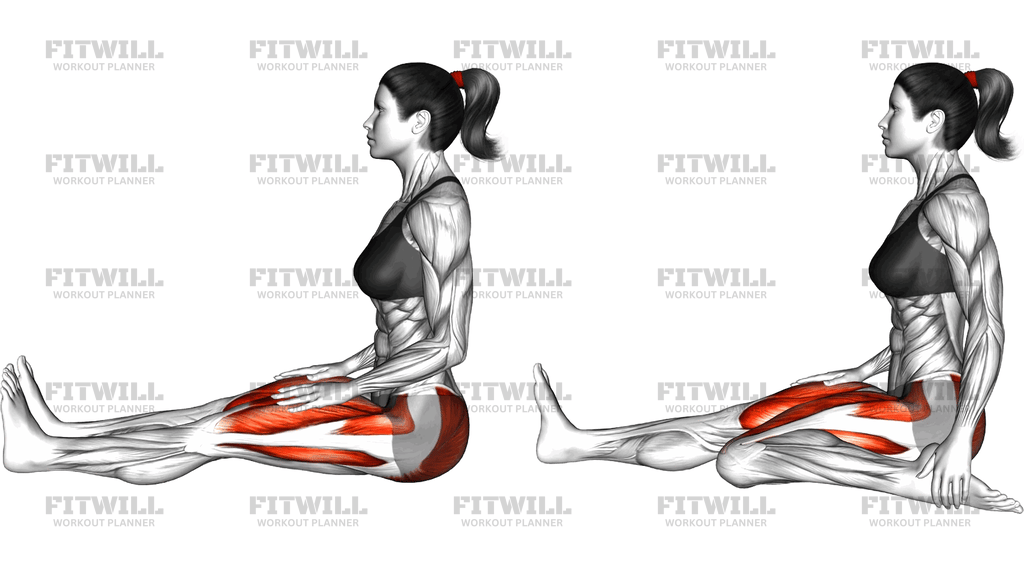
Instructions
- Sit on a mat or the floor with both legs extended straight in front of you and your hands resting on your thighs.
- Sit up tall on your sit bones, stacking your shoulders over your hips so your back stays upright throughout the stretch.
- Bend your right knee and slide the foot back along the floor toward your right hip, letting the knee point down as the heel approaches the glute.
- Reach back with your right hand and take hold of your right foot or ankle, keeping your left leg extended and relaxed with the toes pointing up.
- Brace your core lightly and keep your chest lifted as you draw the heel a little closer to the glute until you feel a steady stretch along the front of the right thigh.
- Hold the position for 20 to 45 seconds, breathing slowly and evenly without holding your breath.
- Release your grip, let the right leg slide back to the extended position, and pause for a breath.
- Repeat the same sequence on the left side, drawing the left heel toward the left glute and holding with the left hand.
- Complete one to two rounds per side, moving into and out of each stretch slowly with no bouncing.
Tips & Tricks
- If you cannot reach your foot, loop a towel around the ankle and hold the ends instead of forcing the shoulder back and rounding the spine.
- Watch for the knee flaring up and away from the floor as you pull; a small lift is fine, but a big lift usually means you are chasing range with tension rather than letting the quad lengthen.
- If the bent knee never comes near the floor and the hip stays very high, prop that hip on a folded towel or cushion so both sit bones stay level.
- Keep the extended leg genuinely straight; letting it bend slightly makes the stretch feel easier but removes the reference position that keeps your pelvis square.
- The sensation should spread along the front of the thigh. If you feel sharp pinching inside or around the knee joint, reduce the pull immediately rather than pushing through it.
- Avoid yanking the heel toward the glute in short pulses. A slow, sustained draw gives the rectus femoris time to relax and lengthen.
- If your low back rounds when you reach back, place a cushion behind you or shorten the range so your hand can reach the ankle with a tall spine.
- Exhale as you settle deeper into the hold; many people unconsciously tense the thigh and hold their breath at the tightest point.
- Do this stretch after training rather than as a heavy warm-up, when the quads are warm and respond more readily to lengthening.
Frequently Asked Questions
Which muscles does the Sitting Alternating Quads Stretch target?
It primarily lengthens the quadriceps on the front of the thigh, with strong emphasis on the rectus femoris since it crosses both the hip and knee. The bent-knee position also adds a mild stretch to the hip flexors on the same side.
Why stretch one leg at a time instead of both quads together?
Working one side at a time lets you control the intensity for each leg individually, so your tighter side gets a proper stretch without being limited by your looser side. It also makes it easier to keep your pelvis level and your spine tall.
Is the Sitting Alternating Quads Stretch suitable for beginners?
Yes, the setup is simple and the intensity is easy to scale by how far you draw the heel back. Beginners should start with a modest pull and a shorter hold of about 20 seconds per side.
My heel will not reach my glute in this stretch. Is that a problem?
No, the heel does not need to touch the glute for the stretch to work. Hold wherever you feel a clear, tolerable pull along the front of the thigh and let the range improve gradually over weeks.
How long should I hold each side of the Sitting Alternating Quads Stretch?
Aim for 20 to 45 seconds per leg. In a post-workout cooldown, one round per side is usually enough; two rounds can help if the quads feel particularly tight.
Can I use a towel if I cannot reach my foot?
Yes, looping a towel around the ankle and holding both ends is a good fix. It lets you keep your chest up instead of hunching or twisting to grab the foot.
Why do I feel this more in my knee than my thigh?
That usually means the pull is too aggressive for your current knee flexibility. Ease off the tension so the sensation moves from the knee joint to the quad muscle itself, and stop if any pinching persists.
What can I use instead if this position bothers my knees?
A standing quad stretch holding a wall for balance, or a side-lying version with the top heel drawn toward the glute, both load the knee less. A prone quad stretch on a mat is another option.
Should I do this stretch before or after training?
It works best after training or on its own during a flexibility session, when the muscles are warm. Save longer static holds like this for the cooldown rather than the warm-up.