Standing Folded Arm Lift And Side Nudge
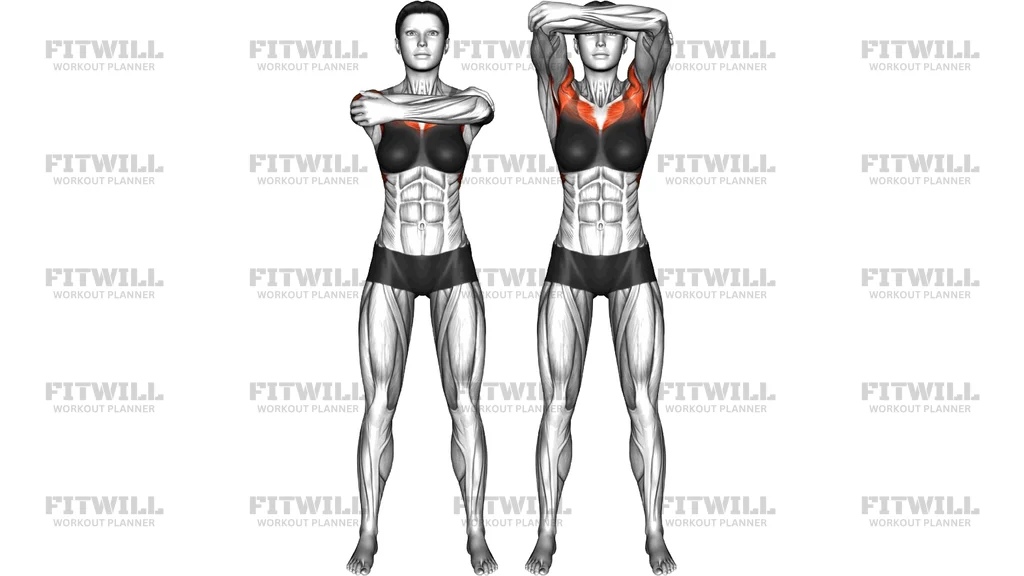
The Standing Folded Arm Lift And Side Nudge is a bodyweight mobility drill performed from an upright standing position. You fold your arms so each hand grips the opposite elbow or forearm, lift the folded arms up overhead, and then gently nudge the elbows from side to side while they are stacked above your head. The movement combines a vertical lift with a lateral stretch, which makes it useful for loosening the shoulders, upper chest, and the muscles along the top of the shoulders and neck.
This drill fits well into a warm-up before upper body training, a cooldown after pressing or pulling work, or a short desk-break routine for anyone who spends long hours sitting with rounded shoulders. Because the arms stay folded rather than moving independently, the position encourages the shoulder blades to rotate upward together, which is exactly the motion that tends to stiffen in people who type, drive, or carry bags on one side all day.
The primary area you will feel is the front of the shoulders and the upper portion of the chest, especially on the side being nudged away from the midline. The upper trapezius and the muscles between the shoulder blades assist as the arms travel overhead, and the core works quietly to keep your torso tall and square. The side-to-side nudge adds a mild oblique involvement and lets you bias one shoulder at a time without letting go of the fold.
Setup matters more than it looks. Stand with feet roughly hip-width apart, weight even across both feet, and ribs stacked over the pelvis. If you arch your lower back or let the head jut forward as the arms rise, you lose the clean overhead position and shift the stretch away from the shoulders. Keep the neck long and the chin level throughout, and let the lift come from the shoulder blades rather than from shrugging toward the ears.
To execute well, fold the arms across the chest, then sweep the whole folded shape up in front of the face until the elbows point toward the ceiling. Once overhead, keep the hands anchored on the opposite arms and nudge the elbows a few inches to the left, back through center, then to the right. The nudges should be small, slow, and pain-free; this is a stretch guided by comfort, not a competition to reach maximum range.
People with cranky shoulders often find this version friendlier than a straight-arm overhead reach, because the fold shortens the lever and keeps the arms close to the body's midline. It is a sensible choice for beginners, for older trainees rebuilding overhead confidence, and as a daily maintenance drill for anyone recovering general shoulder mobility.
[ Workout Log & Planner ]
Put your next workout in Fitwill
Keep your plan and training log ready when you are.


Instructions
- Stand with your feet about hip-width apart, knees soft but not bent, and your weight spread evenly across both feet.
- Cross your arms in front of your chest and tuck each hand onto the opposite upper arm or elbow so the arms form a folded, stacked shape.
- Brace your stomach lightly, keep your ribs stacked over your hips, and look straight ahead with a level chin.
- Sweep the folded arms up in front of your body, leading with the elbows, until they are overhead and pointing toward the ceiling.
- Pause at the top and check that your shoulders are not shrugged up into your ears; let the shoulder blades do the lifting.
- Keeping both hands anchored, nudge the folded elbows a few inches to the left until you feel a stretch across the right shoulder and upper chest.
- Return through center, then nudge to the right to stretch the left side, moving slowly enough to stay in control.
- Breathe steadily throughout, exhaling as you lift and inhaling as you settle into each side nudge.
- Complete your desired repetitions or hold time, then lower the folded arms back down in front of the chest with the same control.
- Unfold the arms, roll the shoulders once or twice, and reset your posture before the next set.
Tips & Tricks
- If your elbows cannot reach overhead, lift only as high as the fold allows and work the side nudges at whatever height you have; forcing the lift usually comes from the lower back instead of the shoulders.
- A common mistake is gripping the forearms too far down, which lets the fold fall apart overhead. Anchor the hands high, near the opposite elbows, so the shape stays compact.
- Watch for the head drifting forward as the arms rise. Imagine the back of your head pressing gently up into an imaginary shelf to keep the neck long.
- Keep the side nudges small. Large sideways leans turn this into a spine stretch and take tension off the exact shoulder area you are trying to open.
- If one side feels tighter, spend an extra nudge or two on that side rather than muscling both sides to match.
- Avoid shrugging toward the ears at the top. Think of pushing the elbows up and slightly back instead of pulling them up with the traps.
- Keep your feet planted. Shifting weight or twisting the hips is a sign the nudge has gone past your true shoulder range.
- Move the lift on an exhale; many people hold their breath as the arms pass face height, which tenses the shoulders and shortens the stretch.
- If folding the arms feels cramped across the chest, practice the same lift with hands simply resting on opposite shoulders before returning to the full fold.
Frequently Asked Questions
What muscles does the Standing Folded Arm Lift And Side Nudge work?
It primarily stretches and mobilizes the front shoulders and upper chest, with the upper traps and muscles between the shoulder blades assisting as the arms travel overhead. The side nudges add a mild stretch to the obliques as well.
Is the Standing Folded Arm Lift And Side Nudge good for beginners?
Yes. The folded-arm position shortens the lever and keeps the arms near the midline, which makes it a gentle way for beginners to work on overhead mobility before attempting straight-arm reaching drills.
Why are the arms folded instead of reaching straight overhead?
Folding the arms keeps the elbows close together and shortens the arms, so the shoulders move through their upward rotation with less demand on joint range. It also lets each hand support the opposite arm during the side nudges.
How high should I lift the folded arms?
Lift only until the elbows point up comfortably without your lower back arching or your shoulders shrugging. Range improves with repetition, and the side nudges can be done at whatever height you currently reach.
How far should I nudge the elbows side to side?
A few inches in each direction is enough. The goal is a comfortable stretch across the shoulder and upper chest on the side being lengthened, not a deep side bend of the torso.
Should I hold the top position or keep moving?
Both approaches work. For a warm-up, move through continuous controlled repetitions; for a stretch, hold the arms overhead and settle into each side nudge for several slow breaths.
Can I do the Standing Folded Arm Lift And Side Nudge every day?
Yes, it is low-load and gentle enough for daily use, especially if you sit for long periods or feel stiff across the shoulders and upper chest in the morning.
My lower back arches when my arms go up. How do I fix that?
Lightly brace your stomach, tuck the ribs down slightly, and stop the lift at the point where the arch begins. Over time that ceiling usually rises as the shoulder range improves.
What can I use if folding my arms is uncomfortable?
Rest each hand on the opposite shoulder instead of gripping the upper arms, and perform the same lift and side nudges. Once that feels free, return to the full fold.
When is the best time to use this drill in a workout?
It works well as part of an upper body warm-up before pressing or pulling, and it is also a useful cooldown to settle the shoulders after heavy overhead or bench work.