Bodyweight Hands Behind Head Romanian Deadlift
The Bodyweight Hands Behind Head Romanian Deadlift is a hip hinge performed standing with no equipment other than your own body. You place both hands behind your head with elbows flared wide, then push your hips back and fold forward until your torso approaches parallel with the floor, before driving the hips forward to return to standing. The hands-behind-head position removes your arms from the movement entirely — you cannot swing them, reach for balance, or use momentum — which makes it one of the cleanest ways to learn what a true hip hinge actually feels like.
This variation is especially useful for beginners who are still building the hinge pattern before touching a barbell or dumbbell, and for anyone who wants a controlled posterior chain drill without load. Because there is no weight in front of the body pulling you forward, all the challenge comes from maintaining a neutral spine and balanced pressure through the feet as you lean into the stretch. It also works well as a warm-up before heavier deadlifts or as part of a minimal-equipment home routine.
The primary muscles working are the hamstrings, which lengthen under tension as the hips travel back and then contract to bring you upright. The glutes drive the return to standing and finish the lockout, the lower back muscles work hard to hold the torso in a stable, neutral position throughout, and the calves help control your balance as your bodyweight shifts behind the midfoot. Your core stays braced for the entire rep, since nothing supports your torso except your own trunk muscles.
The setup matters more here than it looks. With hands laced or placed gently behind the head, the elbows should stay open rather than collapsing forward, and the neck should stay in line with the spine. This position tends to invite chest lifting and neck jutting, so the drill doubles as posture practice — you have to keep the ribcage stacked over the pelvis even when folded forward.
To execute well, hinge at the hips rather than squatting at the knees: the knees bend only slightly, and almost all of the range comes from the hips traveling backward. Move down over two to three seconds, stop when you feel a clear hamstring stretch or your torso reaches parallel, then push the floor away and squeeze the glutes to stand tall. Avoid forcing depth — a hinge that stops higher with a flat back beats a deeper fold with a rounded one.
Watch the two failure points that show up most: rounding the lower back at the bottom to chase range, and letting the hips stay forward so the movement becomes a toe-touch instead of a hinge. If your hamstrings are tight, expect to stop well above parallel at first, and keep the tempo slow enough that you can feel exactly where your spine position starts to change.
[ Workout Log & Planner ]
Put your next workout in Fitwill
Keep your plan and training log ready when you are.


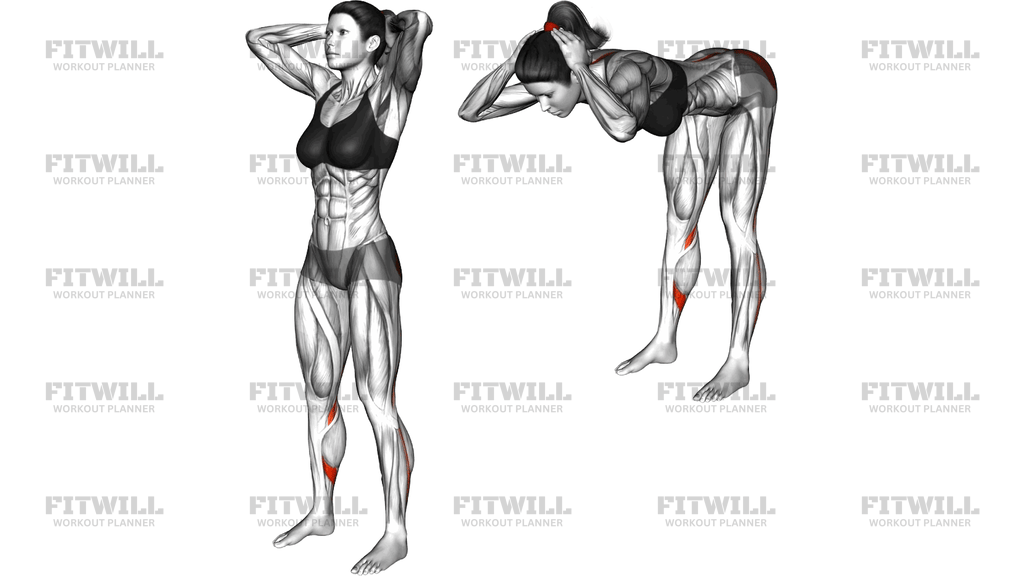
Instructions
- Stand with your feet about hip-width apart, toes pointing forward, and your weight spread evenly across the whole foot.
- Place both hands behind your head — either clasped or lightly resting on the back of the head — and open your elbows out to the sides so they stay wide for the whole set.
- Take a breath into your belly and brace your core as if preparing to be nudged, keeping your ribs down and neck neutral.
- Soften the knees slightly, then push your hips straight back behind you, letting your torso lean forward from the hips rather than the waist.
- Continue hinging until your torso is close to parallel with the floor or you feel a firm hamstring stretch, keeping the back flat and knees only mildly bent.
- At the bottom, check that your weight has shifted slightly toward your heels and midfoot, with the elbows still open and the head in line with the spine.
- Drive the hips forward by pushing your feet into the floor, feeling the hamstrings and glutes pull you back up to standing.
- Squeeze the glutes at the top to finish fully upright without leaning back or arching the lower back.
- Exhale as you rise, reset your brace at the top, and take a breath before starting the next rep.
- Keep every rep deliberate — aim for a two to three second lowering phase and a controlled, non-bouncing return.
Tips & Tricks
- If your lower back rounds at the bottom, stop the descent higher — the depth should be dictated by how far you can hinge while keeping the spine neutral, not by how close you get to parallel.
- When the elbows cave in toward the front, the hands-behind-head position is doing nothing; reopening them keeps the upper back engaged and stops you from reaching with your arms.
- If the movement feels like a toe touch, your hips are not traveling back enough — imagine trying to bump a door closed behind you with your backside.
- Don't turn this into a squat: if your knees bend more deeply as you descend, the hamstrings stop loading. Keep the shin angle nearly vertical.
- Keep a little tension in the knees rather than locking them completely straight; soft knees protect the joint and keep the hinge honest.
- If you lose balance backward, widen your stance slightly to shoulder-width and slow the descent — most wobbling comes from dropping too fast rather than the hinge itself.
- Avoid cranking the head up to look forward at the bottom; keep the neck in line with the spine and look at the floor a meter or so ahead of your feet.
- Don't hyperextend the hips at the top — standing tall with glutes engaged is the finish; arching the lower back adds nothing and irritates the spine.
- For a stronger hamstring signal without adding weight, pause for two seconds at the deepest point of each rep.
Frequently Asked Questions
What muscles does the Bodyweight Hands Behind Head Romanian Deadlift work?
The hamstrings are the primary movers, with strong involvement from the glutes on the way up. The lower back and core work isometrically to keep the torso stable, and the calves assist with balance.
Why are the hands held behind the head in this Romanian Deadlift instead of hanging at the sides?
Placing the hands behind the head takes the arms out of the movement, so you can't swing them or use them for balance. It also encourages an open chest and makes rounding or slouching immediately noticeable, which is why it's a popular teaching position for the hinge.
Is the Bodyweight Hands Behind Head Romanian Deadlift good for beginners?
Yes, it's one of the best ways to learn the hip hinge without load. Mastering the pattern here makes the transition to barbell or dumbbell Romanian deadlifts much safer and more effective.
How much should my knees bend during this exercise?
Only slightly — just enough to keep them comfortable. If your knees bend deeply and your hips drop, the movement becomes a squat and the hamstrings lose their stretch.
How far down should I hinge?
Hinge until your torso is near parallel with the floor or until you feel a strong hamstring stretch, whichever comes first. Stopping higher with a flat back is better than forcing depth by rounding the lower back.
What is the most common mistake in this movement?
Rounding the lower back at the bottom to reach further. The second most common is keeping the hips forward so the torso folds at the waist instead of hinging at the hips. Both reduce hamstring loading and shift stress into the spine.
Can I add resistance to the Bodyweight Hands Behind Head Romanian Deadlift?
Once the pattern is solid, the same hands-behind-head hinge can be loaded with a barbell, dumbbells, or a resistance band. Adding load before your hinge is consistent is not recommended, since the lower back ends up absorbing the weight.
What can I substitute if I can't hinge comfortably yet?
Try a hip hinge against a wall, where you stand a foot or so away and reach your hips back until they touch, or use a dowel or stick held along the spine to give feedback on back position. Both build toward this exercise.
Should I feel this in my lower back?
You should feel the lower back working to hold position, but not straining. If it aches during or after the set, reduce your range, slow the tempo, and double-check that your spine stays neutral.
How many reps should I do?
For learning the pattern, 8–12 slow reps for 2–3 sets works well, either as a warm-up before deadlifting or as a main exercise in a bodyweight routine. Prioritize controlled reps over high volume.