Standing Forward Double Tap And Open
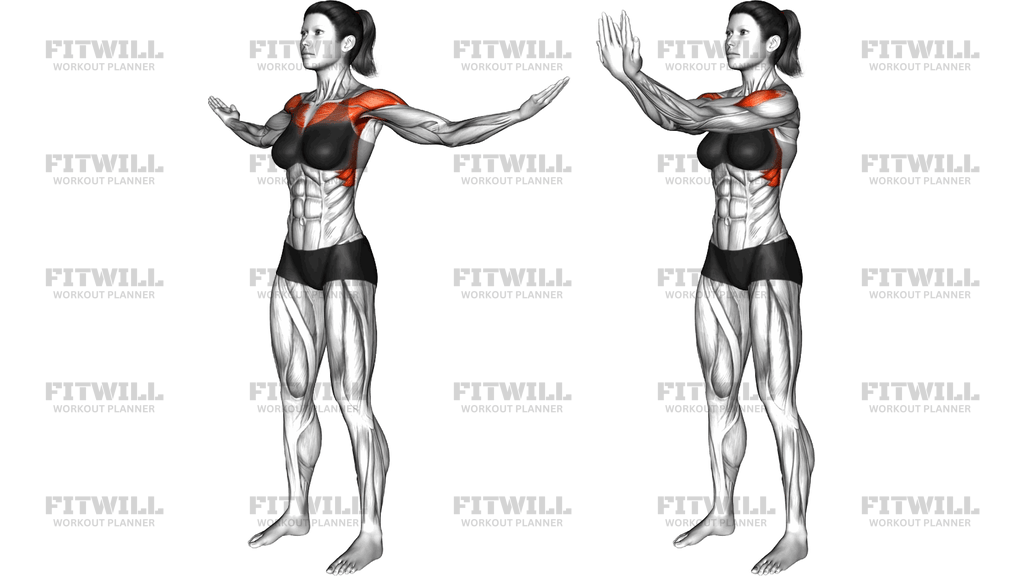
The Standing Forward Double Tap And Open is a bodyweight upper-body movement performed from a tall standing position. You start with both arms extended out to your sides at roughly shoulder height, sweep them forward until your palms tap together in front of your chest, tap twice, then open the arms back out wide. The name describes the rhythm exactly: forward, double tap, open. It looks simple, but the forward sweep and the open work the front of the shoulders and the upper chest through a long, controlled arc with no equipment at all.
The highlighted working areas are the anterior deltoids at the front of each shoulder and the clavicular portion of the pectorals, with the triceps and upper traps helping to control the arms as they extend and return. Because your arms are unsupported and moving against only their own weight, the demand comes from holding the arms at shoulder height and moving them smoothly rather than from heavy load. That makes this a useful activation drill before pressing or flye work, and a low-joint-stress option for building shoulder endurance.
Setup matters more than it might seem. Standing tall with the ribs stacked over the pelvis keeps the movement in the shoulders instead of letting the lower back arch or the torso lean into each tap. Feet stay about hip-width apart, knees soft but not bent into a squat, and the neck stays relaxed so the shoulders do not creep up toward the ears. If the torso starts rocking or shrugging, the shoulders stop doing the work and the drill loses its purpose.
To execute it well, keep the elbows almost straight with only a soft bend, and think about the arms tracing a wide arc from open to closed. The taps should be light and deliberate, not a clap with maximum force. The return is just as important as the tap: open the arms under control, feeling the chest and front shoulders stretch slightly at the widest point before starting the next rep. Rushing turns it into a flailing motion; slowing it down keeps tension on the intended muscles.
This exercise fits well into warm-ups, shoulder rehab-style endurance circuits, desk-break routines, and group or home workouts where no equipment is available. It is also a good teaching tool for people who struggle to feel their front delts during pressing, because the isolation and the long arc make the shoulder's role obvious. Beginners can start with ten to fifteen smooth repetitions and progress by adding reps, slowing the tempo, or holding the open position for a two-count at the end of each rep.
There are no heavy loads or complex positions here, so the main safety points are posture-related: keep the movement at or just below shoulder height if the shoulders pinch, avoid hyperextending the elbows, and stay upright rather than leaning forward. Anyone recovering from a shoulder injury should move through a pain-free range only and reduce the height of the arms if needed.
Fitwill
Log Workouts, Track Progress & Build Strength.
Achieve more with Fitwill: explore over 9600 exercises with images and videos, access built-in and custom workouts, perfect for both gym and home sessions, and see real results.
Start your journey. Download today!




Instructions
- Stand upright with your feet about hip-width apart, weight spread evenly across both feet, and let your arms hang relaxed at your sides for a moment.
- Raise both arms straight out to your sides until they reach shoulder height, palms facing up, elbows almost straight with only a soft bend.
- Stack your ribs over your hips, brace your core lightly, and pull your shoulder blades down away from your ears before you start moving.
- Sweep both arms forward through a wide arc, leading with the palms, until your hands meet in front of your chest.
- Tap your palms together twice with light, controlled contact at the front of the movement.
- Open your arms back out to the sides under control, keeping them at shoulder height and feeling a gentle stretch across the chest at the widest point.
- Exhale as you sweep forward into the taps and inhale as you open the arms back out.
- Keep your torso still throughout, avoiding any rocking forward on the taps or arching backward as the arms open.
- Reset your posture at the bottom of each rep: shoulders down, elbows soft, arms level with the shoulders, then begin the next forward sweep.
- Complete your target repetitions with smooth, even pacing, then lower the arms to your sides to finish the set.
Tips & Tricks
- A common mistake is clapping the hands hard together; aim for light, deliberate taps so the shoulders stay in control instead of the arms being flung forward.
- If your shoulders shrug up toward your ears as the arms come forward, consciously press the shoulder blades down and shorten the arc slightly until you can keep them low.
- Do not let the arms drop below shoulder height as you fatigue; once you cannot hold the open position level, end the set rather than swinging from a lower angle.
- Keep a small bend in the elbows; locking them out completely on every open stresses the joint without adding muscle work.
- If you feel a pinch at the front of the shoulder, lower the arm path a few inches and slow the tempo, which usually removes the impingement feeling.
- Leaning the chest forward to reach the tap is a sign the arc is too aggressive; stand against a wall for a few reps to feel what a still torso should be like.
- Squeeze the chest briefly at the moment the palms touch, then open with intent rather than letting gravity drop the arms back.
- For a harder version, pause for two seconds in the fully open position before each forward sweep instead of rushing through the wide point.
Frequently Asked Questions
Which muscles does the Standing Forward Double Tap And Open work?
The front deltoids do most of the work as the arms sweep forward and hold shoulder height, with the upper chest assisting on the forward arc. The triceps and upper traps help stabilize and control the arms throughout.
Why does this exercise use a double tap instead of a single clap?
The double tap adds a brief pause at the fully closed position, which forces the chest and front shoulders to hold the contraction a moment longer. It also prevents you from rushing the reps with a single forceful clap.
Is the Standing Forward Double Tap And Open suitable for beginners?
Yes, it is a low-load bodyweight movement that is easy to learn and gentle on the joints. Beginners should focus on keeping the arms at shoulder height and the torso still before adding more repetitions.
Should my palms face up or forward during the open position?
Start with the palms facing up in the open position, which encourages external rotation at the shoulder and a comfortable path. The palms turn to face each other as the hands come together for the tap.
What is the most common mistake in this movement?
The most common mistake is rocking the torso forward to reach the tap and letting the shoulders shrug as the arms tire. Keep the ribs stacked over the hips and stop the set once the arms drop below shoulder level.
Can I use the Standing Forward Double Tap And Open as a warm-up?
It works very well as a warm-up before bench presses, push-ups, or shoulder presses because it activates the front delts and chest without fatigue. Two sets of ten to fifteen smooth reps is usually enough.
What can I do if my shoulders pinch when my arms are at full height?
Lower the arm path a few inches below shoulder level and slow the tempo, which keeps the same movement pattern in a more comfortable range. If the pinching continues, stop and choose a different shoulder drill.
How can I make this exercise harder without adding equipment?
Pause for two seconds in the fully open position before each forward sweep, or slow the entire rep to a four-count forward and four-count open. Adding reps beyond twenty also increases the endurance demand on the shoulders.
Is there an equipment-based substitute for this movement?
Light dumbbell or cable front raises and chest flyes train similar muscles with added load. The bodyweight version is still valuable because the wide open-to-closed arc is hard to replicate with weights.