Standing Front Elbow Touch To Overhead Cross
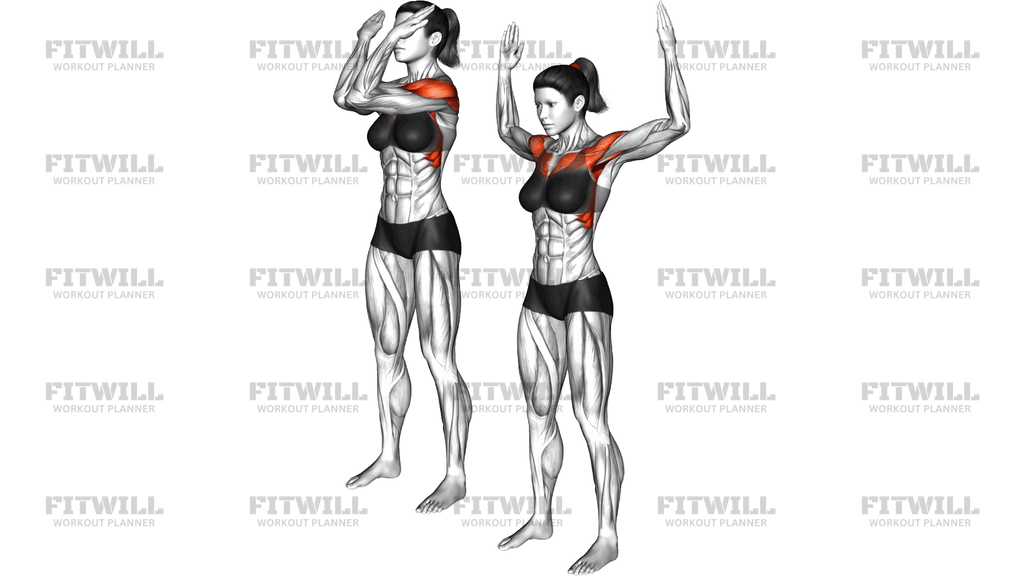
Standing Front Elbow Touch To Overhead Cross is a standing bodyweight movement that takes your arms through two distinct shoulder positions: first the elbows draw together to touch in front of the upper chest, then they sweep out and up into a wide overhead position with the elbows bent and the upper arms framing the head. Because there is no external load, the drill is all about clean joint mechanics, controlled range, and waking up the shoulder musculature before harder work.
The movement primarily challenges the front and side shoulders, with the upper chest assisting as the elbows come together in front and the upper back and traps stabilizing the shoulder blades as the arms travel overhead. It also demands a surprising amount of trunk control, since a tall, braced torso is what stops the lower back from arching as the arms rise.
This drill suits a wide range of people. Lifters use it as a warm-up before overhead pressing, benching, or any upper-body session; desk workers use it to open up shoulders that have spent hours rounded over a keyboard; and general trainees use it as a low-impact way to maintain shoulder mobility day to day. Because it is bodyweight and self-paced, the difficulty scales entirely with your range of motion and control, not with equipment.
Setup matters more than it looks. Stand tall with feet about hip-width apart, weight spread evenly across both feet, ribs stacked over the pelvis, and shoulders pulled gently down away from the ears. If you start slouched or leaning back, the elbow touch becomes sloppy and the overhead position turns into a lower-back extension exercise instead of a shoulder drill.
To execute it well, raise both arms and bend the elbows so they meet and touch in front of the upper chest, forearms roughly vertical and hands open near shoulder height. From there, lead with the elbows and trace a smooth, wide arc up and out until the arms sit overhead in a goalpost-like shape, palms facing forward. Pause briefly at the top, then reverse the exact same arc back down until the elbows touch in front again. The path should feel like a controlled arc, not a swing.
In practice, the Standing Front Elbow Touch To Overhead Cross works best for 10 to 15 smooth repetitions as part of a warm-up, as active recovery between pressing sets, or as a daily shoulder health drill. Keep the range pain-free at all times. If reaching fully overhead is uncomfortable, work within the height your shoulders allow today and let the range improve gradually rather than forcing the elbows up.
[ Workout Log & Planner ]
Put your next workout in Fitwill
Keep your plan and training log ready when you are.


Instructions
- Stand upright with your feet hip-width apart, knees soft but straight enough to feel tall, and your arms hanging relaxed at your sides.
- Raise both arms and bend your elbows so they come together and touch in front of your upper chest, forearms vertical and hands open near shoulder height.
- Brace your core lightly and pull your ribs down so your torso stays stacked over your pelvis before you start moving.
- Inhale, then lead with both elbows and sweep them out and up along a wide arc, keeping the elbows bent close to 90 degrees.
- Finish with your arms in a wide overhead position, elbows up and out to the sides, palms facing forward, and the upper arms framing your head.
- Hold the top position for a brief pause and feel the shoulders and upper chest doing the work rather than momentum.
- Exhale and reverse the arc with control, drawing the elbows back down and in until they touch in front of your upper chest again.
- Keep your torso upright the whole time; do not lean back or push the hips forward as the arms travel overhead.
- Continue for smooth, even repetitions, matching one breath to each touch-and-overhead cycle.
- After your last rep, lower your arms to your sides and let the shoulders settle before starting the next set.
Tips & Tricks
- The most common mistake is shrugging as the elbows rise overhead. Keep the shoulders actively pulled down; if your traps creep toward your ears, reduce the height of the arc.
- Do not let the elbow touch in front become a fast slap. Meet the elbows with control so the chest and front shoulders actually work through the adduction portion.
- Watch for lower-back arch at the top. If your ribs flare and your hips push forward, tighten the brace and take the elbows only as high as you can while staying stacked.
- Let the elbows lead the arc. If your hands race ahead and your elbows drop, the movement turns into a loose arm swing and loses the shoulder focus.
- Keep your neck neutral. The hands pass near your face and head at both ends of the movement, and reaching or jutting the chin forward is a sign you are compensating for limited overhead range.
- Use a deliberate tempo, about two seconds up and two seconds down. Rushing hides range restrictions that a slower pace will reveal.
- If one side feels tighter, pause for an extra second at the top on that side only, rather than twisting your torso to make the tight side match the loose one.
- This drill pairs well before pressing work. Two or three sets of 10 to 15 controlled reps is plenty; treat it as preparation, not a workout in itself.
- If full overhead range is uncomfortable, stop the arc where it stays pain-free and gradually raise the finish point over sessions instead of forcing the elbows up.
Frequently Asked Questions
What muscles does the Standing Front Elbow Touch To Overhead Cross work?
It mainly trains the front and side shoulders, with the upper chest assisting as the elbows touch in front of the body. The upper back and traps stabilize the shoulder blades as the arms travel overhead.
Do I need any equipment for the Standing Front Elbow Touch To Overhead Cross?
No, the movement is performed with body weight only. Once the pattern feels easy and controlled, some people add very light resistance, but the drill works well without it.
Is the Standing Front Elbow Touch To Overhead Cross suitable for beginners?
Yes. The load is your own arms and the range is self-selected, so beginners can start with a smaller arc and build up. Focus on staying tall and keeping the shoulders away from the ears.
Why do the elbows touch in front of the chest in this exercise?
The front elbow touch sets a consistent start and end point, which trains controlled horizontal adduction of the shoulders. It also makes each rep measurable, since you know exactly where the arc begins and finishes.
How is this different from arm circles?
Arm circles spin freely through whatever path feels easiest, while this exercise locks the ends of the range to a specific elbow touch in front and a fixed wide overhead position. That fixed path makes restrictions and side-to-side differences much easier to notice.
Should my palms face forward or inward during the movement?
Start with the hands open near shoulder height at the front elbow touch, then rotate the palms to face forward as the elbows sweep into the wide overhead position. This rotation keeps the shoulders comfortable in the top position.
How many reps of the Standing Front Elbow Touch To Overhead Cross should I do?
Ten to fifteen smooth, controlled repetitions per set works well, usually for one to three sets. If your form breaks down or you start shrugging, stop the set rather than pushing through.
My lower back arches when my arms go overhead. How do I fix that?
Tighten your brace and pull the ribs down before starting, then shorten the arc so the elbows only rise as high as you can manage while keeping the torso stacked. Improving overhead range takes time and forcing it with lumbar extension does not help.
Where should I place this exercise in my workout?
It fits best at the start of an upper-body session as a warm-up, or between sets of pressing exercises as an active reset. It also works as a standalone daily mobility drill on rest days.
Is it safe to do this exercise if my shoulders hurt?
Work only within a pain-free range and reduce the height of the overhead arc if needed. If pain persists or worsens with everyday movements, consult a qualified professional before continuing.