Kettlebell Deadlift
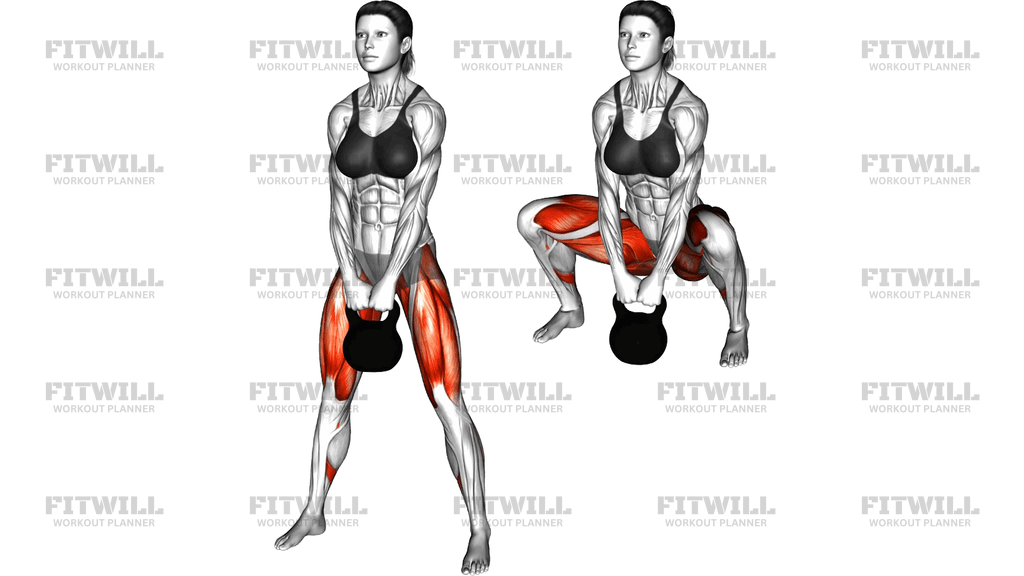
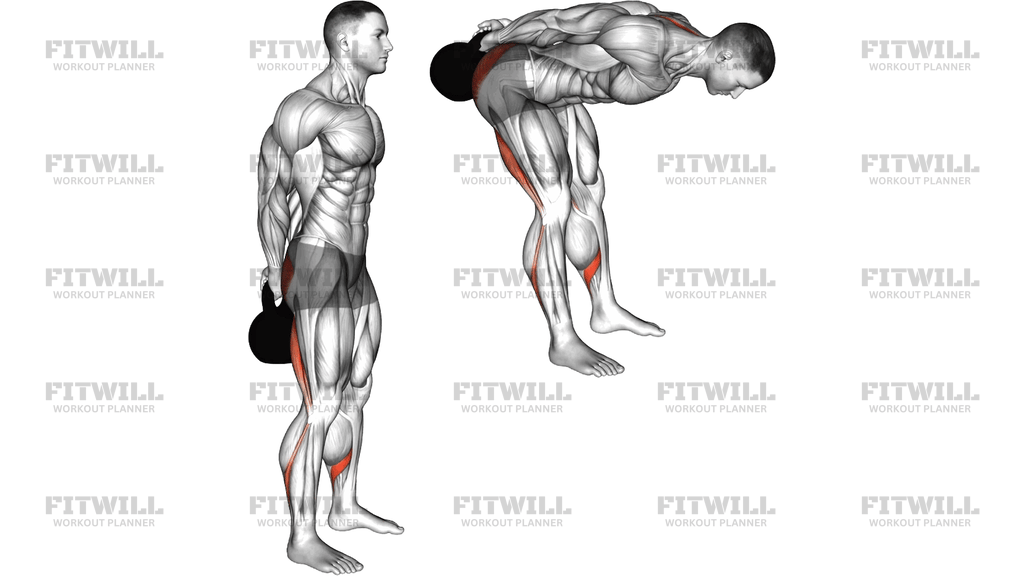
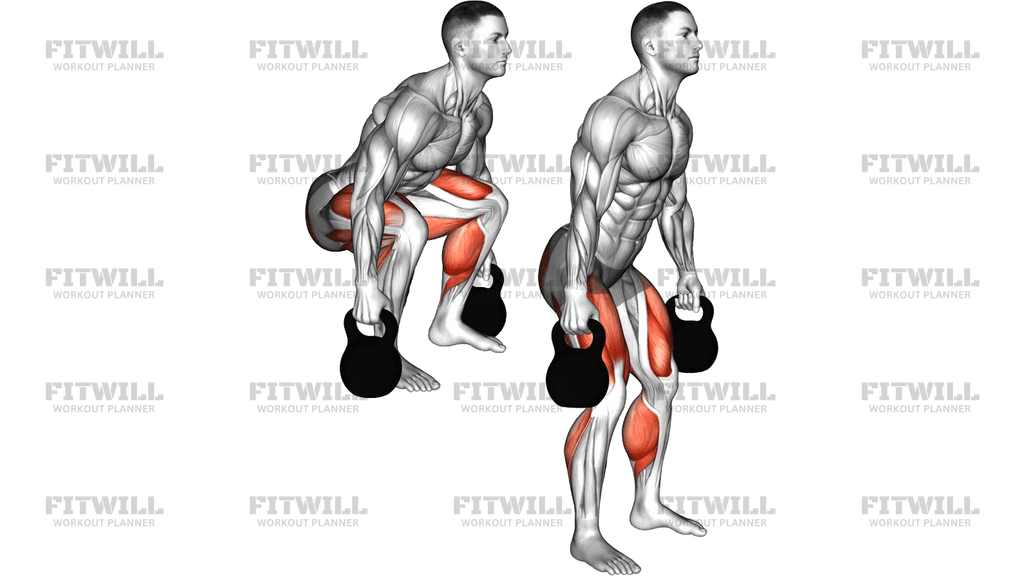
The Kettlebell Deadlift is the foundational hinge pattern loaded with one or two kettlebells on the floor in front of or beside the feet. You drop into a squat or hip hinge, grip the handle or handles, and stand up by driving the floor away until your hips and knees are fully extended. The image shows the two-bell version, with a kettlebell gripped in each hand outside the legs, moving from a deep crouched start to a tall standing finish.
This movement earns its place in almost every training program because it teaches the body to lift something heavy off the ground safely. The main work comes from the glutes and hamstrings, with the lower back holding the spine steady, the quads helping you stand out of the bottom, and the forearms and grip handling the weight. Because the kettlebells sit at your sides rather than in front of a barbell, the shift to keep is simpler, which makes this an excellent first loaded hinge for beginners.
Setup matters more here than most people expect. The bells should be positioned over the middle of the feet, shins close to vertical or lightly touching, and your chest above your hips before you ever pull. If the bells drift forward or your weight rolls onto your toes, the first inch of the lift already puts stress in the wrong places. Taking ten extra seconds to set your stance and grip pays off on every rep that follows.
Execution is a push, not a yank. Brace your torso, take the slack out of the handles, and drive your heels into the floor while your hips and chest rise together. Finish standing tall with the kettlebells hanging at your sides, then reverse the path by pushing your hips back and lowering the bells under control to the floor. The descent should look like a mirror image of the ascent.
You will see the Kettlebell Deadlift used as a strength builder, a warm-up for heavier barbell work, and a high-rep conditioning tool in circuit training. With a double-bell setup like the one shown, the load is split across both hands, which balances the demand on each side of the body and lets you train the pattern with a combined weight that would be awkward as a single implement. Keep the spine long and neutral throughout, and stop the set the moment your lower back starts rounding or your hips shoot up before your chest.
[ Workout Log & Planner ]
Put your next workout in Fitwill
Keep your plan and training log ready when you are.


Instructions
- Place a kettlebell on the floor outside each foot, with the bells roughly under your shoulders and your feet about hip-width apart.
- Push your hips back and bend your knees to crouch down, keeping your chest tall enough that your shoulders sit above your hips.
- Grip the center of each handle with your arms hanging straight down, then rotate your elbows slightly so they point back between your legs.
- Set your weight over the middle of your feet, lift your chest, and brace your core as if bracing for a light punch to the stomach.
- Take the slack out of the handles by gently squeezing them before you initiate the pull, so there is no jerky gap between gripping and lifting.
- Drive your heels and mid-foot into the floor and stand up, letting your hips and chest rise at the same rate until your legs are straight.
- Finish with your hips and knees fully extended and the kettlebells hanging at your sides, shoulders back but not shrugged up toward your ears.
- Reverse the movement by pushing your hips back first, then bending your knees to lower the bells smoothly to the floor.
- Exhale as you stand up and inhale as you lower the bells; rebrace before each rep if you are resetting between them.
- Release your grip once the bells are settled on the floor, stand up, and rebuild your setup before starting the next rep.
Tips & Tricks
- If your hips shoot up before your chest in the first rep, the load is usually too heavy or you are not braced; drop the weight slightly and re-tighten before pulling.
- A rounded lower back at the bottom is the most common fault with this lift; bend the knees more and shorten the range until you can reach the bells with a flat back.
- Keep the kettlebells close to your shins on the way up; if the bells swing away from your body, your hips are drifting back instead of driving forward.
- Do not lean back or over-arch at the top; the finish is standing tall, not hyperextending your hips to search for extra range.
- Grip the handle in the corner where the handle meets the body of the bell to prevent the kettlebell from rotating in your hand during the set.
- Your heels should stay planted for the whole lift; if you rock onto your toes, widen your stance slightly or elevate the bells on a low step while you build mobility.
- For high-rep conditioning sets, do not touch-and-go carelessly; touch the floor lightly and re-brace every few reps to protect your lower back.
- Warm up with a bodyweight hip hinge first, hands sliding down your thighs, to groove the pattern before you add the kettlebells.
- Breathe out forcefully as you pass the sticking point on the way up; holding your breath through the entire set makes heavier doubles much harder than they need to be.
Frequently Asked Questions
What muscles does the Kettlebell Deadlift work?
The primary muscles are the glutes and hamstrings, with the lower back stabilizing your spine and the quads assisting out of the bottom. Your forearms and grip work hard the entire time, especially with two kettlebells.
Is the Kettlebell Deadlift good for beginners?
Yes, and it is often the first loaded hinge people learn. The kettlebells hang beside the legs instead of in front of the body, so balance and keeping the weight close are easier to manage than with a barbell.
Should I use one kettlebell or two for the Kettlebell Deadlift?
Either works. Two kettlebells split the load evenly between your hands and match the setup shown, while a single bell held between your feet makes it easier to keep the weight centered and is a good starting point.
Why do my lower back and not my glutes feel sore after Kettlebell Deadlifts?
This usually means your hips are rising before your chest or your back is rounding at the bottom, shifting work away from your glutes. Re-brace before each rep and consciously drive your hips forward as you stand.
How low should my hips be at the start of the Kettlebell Deadlift?
Low enough that your shoulders sit above your hips and you can reach the handles with a flat back. If your back rounds to reach the bells, bend your knees more rather than reaching further.
Can I touch-and-go reps with the Kettlebell Deadlift?
You can, as long as the bells only lightly kiss the floor and your back position stays tight. If your form deteriorates on fast reps, reset fully on the floor between repetitions.
What can I substitute if I do not have a kettlebell?
A dumbbell in each hand at your sides replicates the movement almost exactly, and a barbell or trap bar deadlift trains the same pattern. Dumbbells are the closest match to the kettlebell setup.
How heavy should the kettlebells be for this exercise?
Start with a weight you can stand up with for 8 to 10 controlled reps while keeping a flat back and full hip extension. Once every rep looks identical, increase the load gradually.
How is the Kettlebell Deadlift different from a kettlebell swing?
The deadlift is a slow, strength-focused lift where you pick the bell up and lower it under control, while the swing is an explosive hip snap where the kettlebell floats up in front of you. The deadlift is the better place to learn the hinge first.
How close should the kettlebells stay to my body during the lift?
Very close, with the bells lightly brushing your shins as they travel up and down. Letting them drift forward multiplies the strain on your lower back and makes the lift noticeably harder to control.