Bodyweight Overhead Forward Lunge
The Bodyweight Overhead Forward Lunge takes the familiar forward lunge and raises the difficulty by placing your arms straight overhead with your hands clasped for the entire rep. Instead of letting your arms hang at your sides, you reach toward the ceiling and keep them there while you step forward, lower your back knee toward the floor, and drive back up to standing. That overhead arm position is what separates this from a standard lunge: it shifts your center of mass higher, lengthens your torso, and forces your core and shoulder muscles to work simply to keep your arms stacked over your hips.
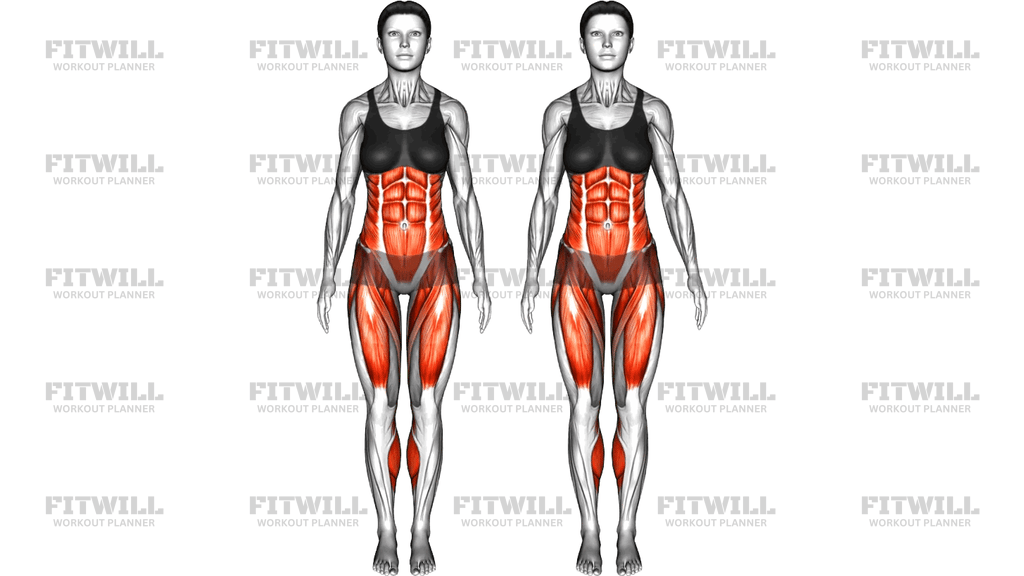
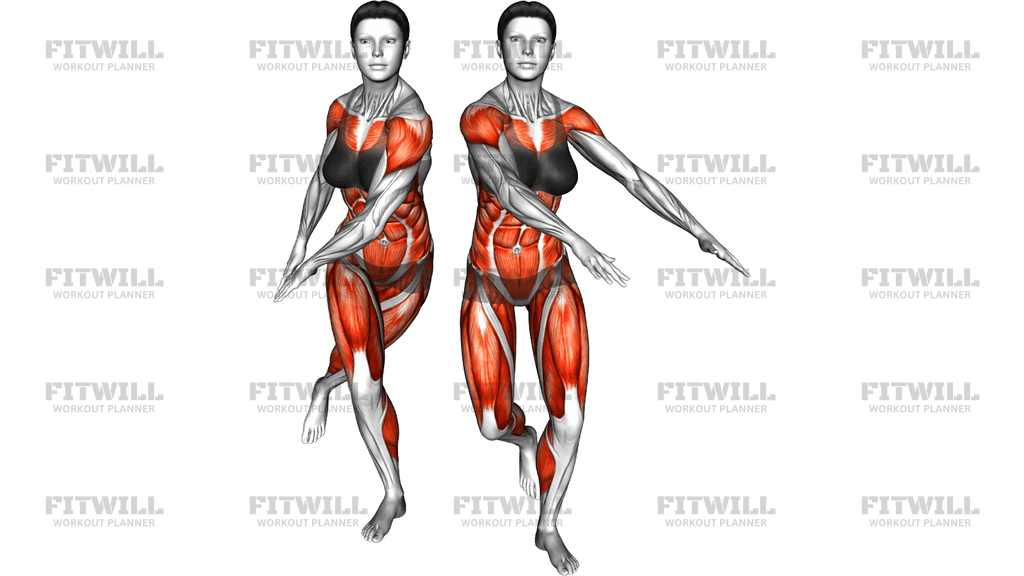
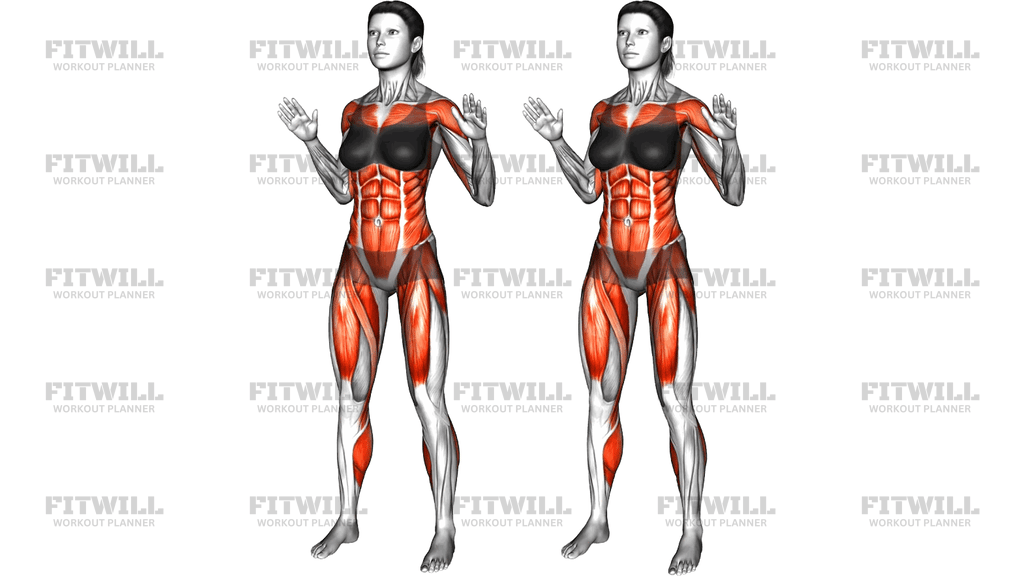
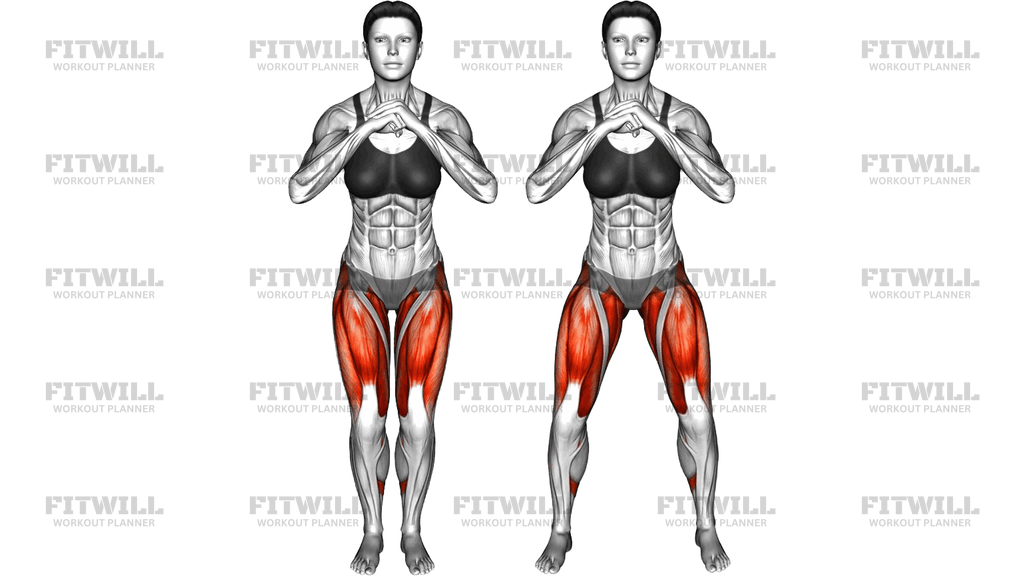
This movement primarily targets the quads of the front leg, with strong involvement from the glutes and hamstrings as you lower and push back to the start. The calves and ankle stabilizers help you balance through the split stance, while the shoulders, upper back, and trunk muscles stay continuously engaged to hold the arms vertical. Because nothing external is loaded, the challenge comes from control, mobility, and balance rather than raw strength, which makes the exercise a useful diagnostic as well as a builder.
The setup matters more than it might first appear. With your arms overhead, any slack in your posture shows up immediately: if your ribs flare, your lower back arches, or your shoulders creep toward your ears, you will feel it as strain rather than as work in your legs. Standing tall with stacked joints — ankles under hips, ribs down, arms in line with the ears — gives you a stable column to lunge around. When the step forward breaks that alignment, you have found a limitation in hip mobility, thoracic extension, or trunk control worth addressing.
To execute it well, keep the overhead reach constant from start to finish. Step forward into a comfortable split stance, drop straight down until your front thigh is roughly parallel and your back knee hovers near the floor, then press through the front foot to return. The most common faults are the arms drifting forward as you descend, the torso collapsing toward the front thigh, and the front knee caving inward. Filming a set from the side is one of the quickest ways to catch these.
This exercise suits beginners learning lunge mechanics with honest feedback, intermediate lifters warming up before lower body training, and anyone working on shoulder and thoracic mobility alongside leg strength. It also fits well into bodyweight circuits where no equipment is available. If balance is a limiting factor, practice next to a wall you can lightly touch, and progress to full freestanding reps as your control improves.
[ Workout Log & Planner ]
Put your next workout in Fitwill
Keep your plan and training log ready when you are.


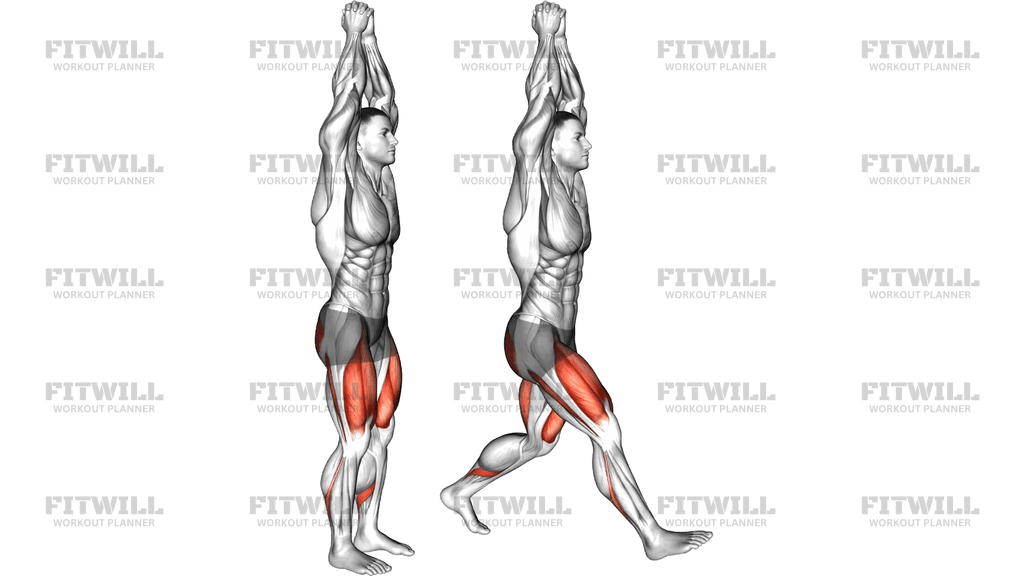
Instructions
- Stand with your feet hip-width apart, toes pointing forward, and clasp your hands together in front of your chest.
- Press your hands straight up until your arms are fully extended overhead, biceps beside your ears, and hold that stacked position.
- Draw your ribs down and brace your trunk so your lower back is not arching before you move.
- Shift your weight onto one leg and step the other foot forward into a long split stance, keeping the arms reaching at the ceiling.
- Bend both knees to lower straight down until your front thigh is about parallel to the floor and your back knee hovers just above the ground.
- Check that your front shin stays close to vertical and your torso stays upright rather than folding over the front leg.
- Drive through the heel and midfoot of the front leg to push back up and bring the rear foot back to the starting stance.
- Exhale as you lower into the lunge and inhale as you drive back up, keeping the breath steady rather than holding it.
- Complete all reps on one side or alternate legs, re-establishing your tall overhead posture and braced trunk between each rep.
Tips & Tricks
- If your arms drift forward as you descend, your chest is likely following — cue yourself to push the ceiling away throughout the whole rep.
- Take a longer step than feels natural; a short step makes the front knee travel far past the toes and turns the movement into a knee-dominant grind.
- Keep your shoulders pressed down away from your ears while the arms stay overhead — shrugging up is a sign the upper traps are compensating for limited shoulder mobility.
- If your lower back arches the moment your arms go up, soften the overhead reach slightly or work on thoracic extension separately before forcing full range.
- Push the floor away evenly through the whole front foot; rolling onto the outside of the foot or letting the arch collapse will destabilize the knee.
- Slow the lowering phase to two or three seconds if you keep losing balance — the overhead position rewards patience and exposes rushing.
- Alternate legs rep for rep if one side feels unstable; the split-stance balance often reveals side-to-side differences that alternating reps help even out.
- Practice the first few reps beside a wall or rail and let a fingertip touch it only when needed, so balance improves without being artificially supported.
- Keep your gaze forward and level rather than looking up at your hands, which helps keep the neck neutral under the overhead arms.
Frequently Asked Questions
What muscles does the Bodyweight Overhead Forward Lunge work?
The quads of the front leg do most of the work, supported by the glutes and hamstrings on the way down and up. Holding the arms overhead keeps the shoulders, upper back, and core under continuous tension for balance and posture.
Why are the arms held overhead instead of at the sides in this lunge?
The overhead position raises your center of mass and removes the counterbalance your arms normally provide, so the trunk and shoulders must stay active to keep you upright. It also adds a shoulder and thoracic mobility demand that a standard lunge does not have.
Is the Bodyweight Overhead Forward Lunge good for beginners?
Yes, as long as the overhead reach does not force the lower back to arch. Beginners can shorten the depth, use a lighter overhead reach, or practice near a wall for balance while learning the split-stance pattern.
My arms keep falling forward when I lunge — what causes that?
This usually means the torso is collapsing toward the front thigh or the shoulders lack overhead mobility. Slow the descent, keep the ribs stacked over the hips, and reduce depth until the arms can stay vertically aligned.
Should the front knee pass over the toes in this exercise?
Some forward knee travel is normal and fine for healthy knees, especially with a long step. Focus on keeping the shin close to vertical, the whole foot planted, and the knee tracking over the toes rather than caving inward.
Can I substitute the Bodyweight Overhead Forward Lunge with a regular forward lunge?
A regular forward lunge trains the same leg muscles but removes the core and shoulder demand of the overhead hold. It is a reasonable substitute when shoulder mobility or balance is the limiting factor, and a good regression before progressing back to the overhead version.
How far should I step forward in the Bodyweight Overhead Forward Lunge?
Step far enough that both knees can bend to roughly 90 degrees at the bottom, with the front shin near vertical and the back knee under or slightly behind your hips. A step that is too short overloads the front knee and makes balance harder.
Is it safe to do this lunge if my shoulders are tight?
Tight shoulders usually show up as an arched lower back or shrugged arms rather than pain in the lunge itself. Reach only as high as you can while keeping the ribs down, and work on shoulder and thoracic mobility before demanding a full overhead position.
How many reps and sets should I do?
For strength and control, two to four sets of six to ten reps per leg with a slow, deliberate tempo works well. For warm-up or circuit use, one to two sets of eight to twelve reps per side at an easier pace is enough.