Standing Arm Crossovers And Lift
Standing Arm Crossovers And Lift is a bodyweight movement that combines two actions into one flowing pattern: you start with your arms crossed in front of your chest at shoulder height, then sweep them up and out overhead so they finish in a wide V with your palms together. Because there is no external load, the exercise works through active range of motion rather than raw resistance, making it a staple for warming up the shoulders before pressing, throwing, or overhead work.
The primary muscles working here are the front shoulders, which drive the arms from the crossed position up overhead. As the arms separate into the V, the upper chest, side shoulders, and upper traps assist, while the muscles between the shoulder blades control the movement on the way back down. The crossed starting position also adds a gentle stretch across the rear shoulders and upper back before each lift, so you get mobility and activation in the same rep.
Setup matters more than it might seem for a load-free movement. Standing tall with feet about hip-width apart, a braced trunk, and ribs stacked over the pelvis ensures the arms move on the shoulders rather than the lower back arching to fake extra range. If you sway backward or shrug toward your ears as the arms rise, you shift work away from the shoulders and lose the clean scapular motion this drill is meant to train.
To execute it well, cross one arm over the other in front of your chest, keep the elbows mostly straight but not locked, and reach forward as you begin the lift. As the arms uncross and travel upward, let them separate into a wide V and press your palms together overhead. The return follows the same path in reverse, finishing with the arms crossed in front. Move at a steady, deliberate tempo so every degree of the arc stays under control.
This exercise suits beginners learning shoulder control, lifters warming up before bench or overhead pressing, office workers reversing long hours of rounded posture, and anyone who wants a low-impact way to keep the shoulders moving freely. It also fits neatly into circuits or active recovery days, since it raises the heart rate slightly without stressing any joints.
Keep the effort honest: the movement is light, but sloppy reps add up. Stay tall, avoid jerking the arms to the top, and treat each crossover-to-lift as a chance to feel the shoulders and upper chest working through a full, smooth arc. If either shoulder pinches at the top, shrink the range slightly and build up over time.
[ Workout Log & Planner ]
Put your next workout in Fitwill
Keep your plan and training log ready when you are.


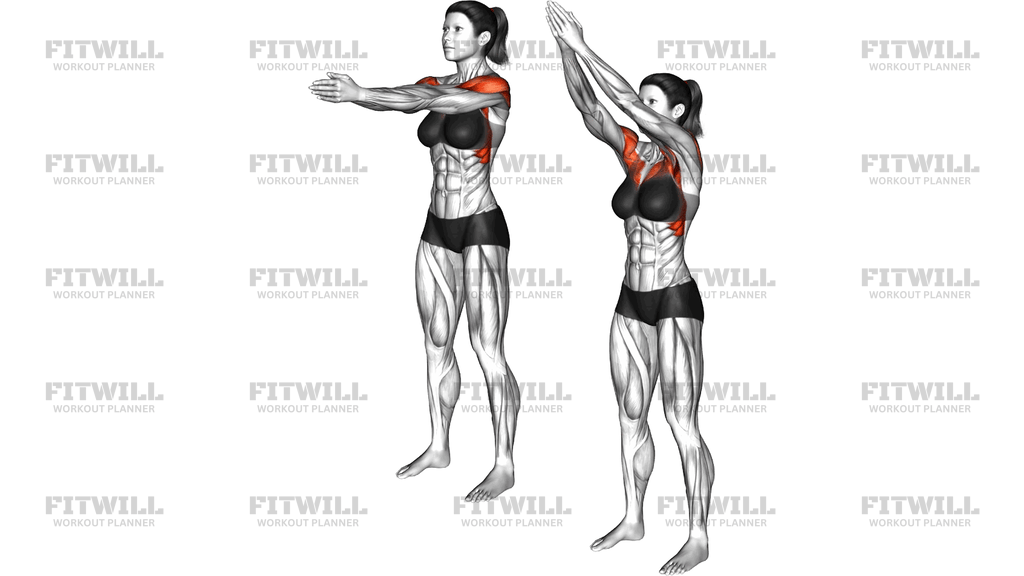
Instructions
- Stand with your feet hip-width apart, weight balanced across both feet, and arms extended straight in front of your chest.
- Cross one forearm over the other so your arms form an X in front of your body, hands open and roughly at shoulder height.
- Brace your trunk lightly, keep your ribs stacked over your hips, and set your gaze forward so your neck stays neutral.
- Inhale, then begin sweeping both arms outward and upward at the same time, uncrossing them as they rise.
- Continue the arc until your arms are extended overhead in a wide V shape, palms pressed together, with your elbows straight but not locked.
- Pause briefly at the top and feel the shoulders and upper chest supporting the position without shrugging toward your ears.
- Exhale as you lower the arms back down along the same path, crossing them again in front of your chest.
- Alternate which arm is on top with each rep, or complete a set on one side before switching.
- Reset your stance between reps if you notice yourself swaying, then continue for your target repetitions.
Tips & Tricks
- If your shoulders ride up toward your ears at the top of the lift, consciously pull your shoulder blades down your back before starting the next rep.
- Crossing the same arm on top every rep creates an uneven pattern, so alternate the top arm from rep to rep or set to set.
- A common mistake is arching the lower back to get the palms overhead; squeeze your trunk and accept a slightly smaller V instead.
- Keep the elbows soft rather than locked so the shoulders, not the joint itself, absorb the motion at the top.
- Move through the crossover slowly on the return portion, since controlling the lowering phase is where the rear shoulders and upper back get their work.
- If one shoulder feels tighter and the cross feels lopsided, spend an extra second in the crossed position on that side before lifting.
- Do not swing the arms with momentum; the sweep should feel smooth the entire way, as if tracing a wide arc through the air.
- Use this before bench presses, overhead presses, or any throwing motion to take the shoulders through their full range under no load.
- If the palms-together position overhead causes pinching, narrow the V slightly and aim your hands toward each other rather than forcing contact.
Frequently Asked Questions
Which muscles do Standing Arm Crossovers And Lift target the most?
The front shoulders do most of the work lifting the arms overhead, with the upper chest, side shoulders, and upper traps assisting. The upper back muscles control the arms on the way back down to the crossed position.
Why do the arms start crossed in front of the chest in this exercise?
The crossed starting position adds a stretch across the rear shoulders and upper back and forces the arms to travel a longer, more complete arc. This makes each rep train both mobility and control instead of just a simple front raise.
Is Standing Arm Crossovers And Lift suitable for beginners?
Yes. Because it uses only body weight, beginners can learn how their shoulders and shoulder blades move without dealing with external load. It is often one of the easiest ways to build awareness of overhead arm mechanics.
Can I use this exercise as a warm-up before pressing?
Absolutely. It is a popular warm-up before bench presses and overhead presses because it takes the shoulders through a full arc and activates the front delts without fatiguing them. Two or three sets of ten to fifteen controlled reps work well.
What is the most common mistake with the overhead position?
Shrugging the shoulders toward the ears or arching the lower back to force the palms together overhead. Both habits shift work away from the shoulders, so keep your trunk braced and your shoulder blades pulled down.
Should I alternate which arm crosses on top?
Yes, alternating the top arm keeps the stretch and movement pattern even between sides. You can alternate every rep, or do a full set with one arm on top and then switch for balance.
What can I use if my shoulders are too tight to press my palms together overhead?
Simply let the hands stop short of contact and hold the wide V position where you are comfortable. Your range will usually improve as you practice, and forcing contact through a pinch is never worth it.
How does this differ from a regular front raise?
A front raise moves the arms straight up in front of the body, while Standing Arm Crossovers And Lift starts from a crossed position and sweeps the arms outward into a V. That wider path involves the upper chest and side shoulders more and adds the crossover stretch.
How many reps should I do?
For warm-ups, 10 to 15 smooth reps for 2 to 3 sets is a solid starting point. As a standalone activation exercise between other movements, you can go slightly higher, as long as every rep stays controlled.
Is it safe to do this exercise every day?
For most people, yes. The movement is low load and low impact, so daily practice is generally fine if it remains pain-free. Stop and reduce the range if you feel sharp pain or pinching in either shoulder.